The Bg Bang theory is false because the current universe can't -by any means - be the product of a "microscopic primeval particle" (*) in the middle of nothing which "who knows how" expanded"
(*The known "primeval atom" the first years after the release of that theory)
Time doesn't exist physically today, and time didn't exist before the apparition of the universe. An existing flowing time has been always just a conventional idea, to which a retarded dude added later on the wieird characteristic of being "flexible" like bubble gum in his theories of Relativity.
Dark matter is a consequence, not a cause.
There is a big flaw in this Big Bang theory that everybody overlooks.
The idea came up when two scientists seem to have discovered cosmic background noise that they postulated was the noise left over from the Big Bang.
The only problem is that they measured radiation and then subtracted what they thought was natural to the earth or man made.
Other people in other parts of the world have conducted the same experiment and have come up with different background levels.
Very weak evidence that may be dependent on false data. However, it seems like a cool thing to believe so everybody goes with it.
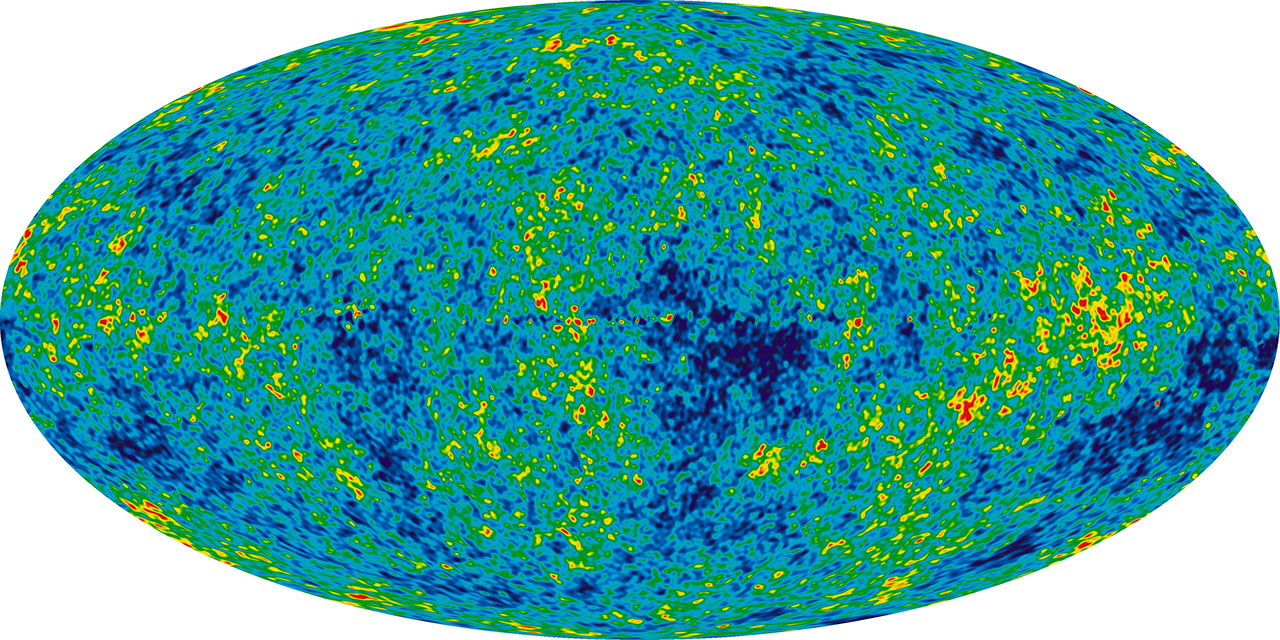
Actually WMAP data on the CMBR (Cosmic Microwave Background Radiation) is significant - some actual images from the WMAP probe:
To address key cosmology scientific questions, WMAP measured small variations in the temperature of the cosmic microwave background radiation. For example:

wmap.gsfc.nasa.gov
Some conclusions reached (a list):
To address key cosmology scientific questions, WMAP measured small variations in the temperature of the cosmic microwave background radiation. For example:
map.gsfc.nasa.gov
WMAP's Top Ten
The WMAP science team has…
- ... has put the "precision" in "precision cosmology" by reducing the allowed volume of cosmological parameters by a factor in excess of 68,000. The three most highly cited physics and astronomy papers published in the new millennium are WMAP scientific papers--- reflecting WMAP's enormous impact.
- …mapped the pattern of tiny fluctuations in the Cosmic Microwave Background (CMB) radiation (the oldest light in the universe) and produced the first fine-resolution (0.2 degree) full-sky map of the microwave sky.
- …determined the universe to be 13.77 billion years old to within a half percent.
- …nailed down the curvature of space to within 0.4% of "flat" Euclidean.
- …determined that ordinary atoms (also called baryons) make up only 4.6% of the universe.
- …completed a census of the universe and finds that dark matter (matter not made up of atoms) is 24.0%
- …determined that dark energy, in the form of a cosmological constant, makes up 71.4% of the universe, causing the expansion rate of the universe to speed up. - "Lingering doubts about the existence of dark energy and the composition of the universe dissolved when the WMAP satellite took the most detailed picture ever of the cosmic microwave background (CMB)." - Science Magazine 2003, "Breakthrough of the Year" article
- … mapped the polarization of the microwave radiation over the full sky and discovered that the universe was reionized earlier than previously believed. - "WMAP scores on large-scale structure. By measuring the polarization in the CMB it is possible to look at the amplitude of the fluctuations of density in the universe that produced the first galaxies. That is a real breakthrough in our understanding of the origin of structure." - ScienceWatch: "What's Hot in Physics", Simon Mitton, Mar./Apr. 2008.
- …detected that the amplitude of the variations in the density of the universe on big scales is slightly larger than smaller scales. This, along with other results, supports "inflation", the idea is that the universe underwent a dramatic period of expansion, growing by more than a trillion trillion fold in less than a trillionth of a trillionth of a second. Tiny fluctuations were generated during this expansion that eventually grew to form galaxies.
- … determined that the distribution of these fluctuations follows a bell curve with the same properties across the sky, and that there are equal numbers of hot and cold spots in the map. The simplest version of the inflation idea predicted these properties and remarkably, WMAP’s precision measurement of the properties of the fluctuations has confirmed these predictions, in detail.
Our literature comments on some of this here:
This is an authorized Web site of Jehovah’s Witnesses. It is a research tool for publications in various languages produced by Jehovah’s Witnesses.

wol.jw.org
"In 1998, researchers analyzing light from a special kind of supernova, or exploding star, found evidence that the expansion of the universe is actually accelerating!
* At first, the scientists were skeptical, but evidence soon mounted. Naturally, they wanted to know what form of energy was causing the accelerating expansion. For one thing, it seemed to be working in opposition to gravity; and for another, it was not predicted by present theories. Appropriately, this mysterious form of energy has been named dark energy, and it may make up nearly 75 percent of the universe!
Dark energy, however, is not the only “dark” oddity discovered in recent times. Another was confirmed in the 1980’s when astronomers examined various galaxies. These galaxies, as well as our own, appeared to be spinning too fast to hold together. Evidently, then, some form of matter must be giving them the necessary gravitational cohesion. But what kind of matter? Because scientists have no idea, they have called the stuff dark matter, since it does not absorb, emit, or reflect detectable amounts of radiation.
* How much dark matter is out there? Calculations indicate that it could make up 22 percent or more of the mass of the universe.
Consider this: According to current estimates, normal matter accounts for about 4 percent of the mass of the universe. The two big unknowns—dark matter and dark energy—appear to make up the balance. Thus, about 95 percent of the universe remains a complete mystery!
*