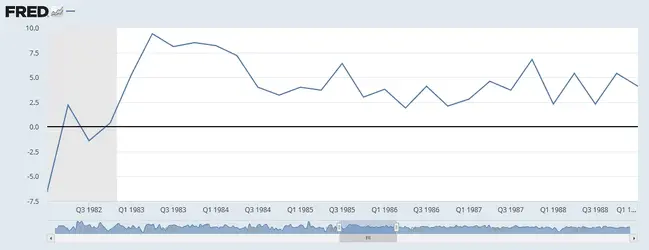
Historical changes in the capital gains tax rate are hypothetical?
You didn't say "rate", you said "revenue". So you're doing that thing again where you exercise sophistry to cover for the massive holes in your shit argument, unable to remember what you say from post to post.
Businesses will generate additional economic activity.
How so? Businesses can reinvest now, pre-tax. So what difference does the corporate income tax rate make when it comes to a business reinvesting? If anything, a higher corporate tax rate would force the business to invest
more to avoid the tax liability. Unfortunately, thanks to Reagan, buybacks and dividends now count as "reinvestment", and that's the "reinvestment" I suspect you're alluding to. Businesses don't expand just because. There has to be demand to justify the expansion. Cutting corporate income taxes doesn't increase that demand. Neither does cutting tax rates for the rich.
I didn't say anything about the rich. I didn't say anything about paying for a tax cut.
That's what you've been saying this entire time...that cutting taxes for the rich and corporations will magically translate into growth, despite a lack of demand to meet. That's not economics, that's zealotry.
Nothing trickles down. That's the point. Despite you promising it does when you claim those cuts "increase economic activity". That's just your way of saying "trickle down" without saying those exact words. We know your playbook.
How does it compare as a percentage of GDP?
It's a pretty significant part. In fact, Chinese government stimulus spending is what kept China's economy going this whole time.
Wow dude...you think that tax cuts reduce the amount of money the people have.
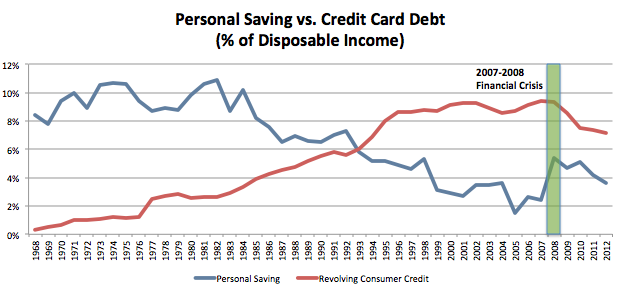
It does, and we know this because after every tax cut, personal savings rate drops and household debt increases. So you cut taxes, which forces cuts to spending, which forces people to pay more out of pocket for essential services.
The best example of this is what happened in Kansas with the Kansas State University Board of Regents...KS cut taxes, which created deficits, which had to be closed because of KS' BBA. So to close those deficits, KS cut spending on education. Those cuts forced the KS State Board of Regents to raise tuition, which resulted in students and families having to borrow more and spend more out of pocket.
KS also increased co-pays, co-insurance, and drug costs for Medicaid patients (of which there are many in KS because it's a piss-poor state of underachievers and losers) because state spending on Medicaid was cut...to pay for tax cuts that didn't pay for themselves as promised.
So that's how tax cuts end up costing taxpayers more in the end.
After the Reagan tax cuts, how much did the government reduce spending on those things?
$44B, which was a 5.7% cut to the overall budget. Over half of the $44 billion budget reduction came from two areas: income security; and education, training, employment, and social services.
Predictably, household debt increased and personal savings decreased. Why? Because those people had to go into debt to get an education or health care or energy or housing.