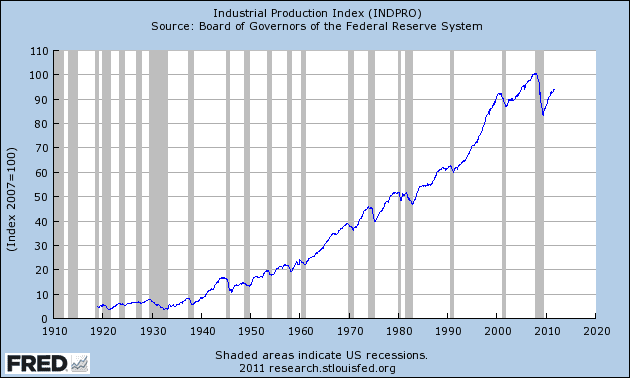
I came in late, yes, but I've followed the discussion. Your graph, which is the piece of evidence presented regardless of what you were talking about, was in reference to industrial productivity and I saw some conclusions being drawn from it that didn't seem warranted.
You also made some misleading statements in the course of the conversation which you just re-quoted, so I'll address them.
expat_panama said:
Americans are high paid; household incomes for the past three years is the highest level ever.
Americans are NOT high paid compared to what we used to earn; exactly the reverse, and the only reason household incomes have increased (barely) despite that is because of two misleading factors:
1) Your use of an average, which mixes the owner class in with the working class; and
2) The dramatic increase in two-earner households.
That least means that if wages had not gone down, real household income would have almost doubled over the past few decades. When a household is working twice as much for essentially the same income, that represents a decline in living standards every bit as bad as if it were working the same and making half as much.
American jobs aren't shipped overseas because a Chinese working doesn't mean an American becomes helpless. The average number of Americans working for the past six years is the highest on record.
This is true, but again misleading. Since the service jobs that replaced manufacturing jobs were almost all non-union, while the manufacturing jobs were union jobs, the net effect has been a decline in real wages. Not that the remaining unionized manufacturing jobs are paid less (they're not), but the jobs that most people are actually doing pay less.
Had the government supported the right of workers to organize and bargain collectively as aggressively in the '80s and '90s as it did in the '40s and '50s, we would still be working mostly service jobs but they would be as well paid as the manufacturing jobs on the average or better.
American factories have not shut down; the value of goods produced in the past six years is the highest ever.
Quite true, and only slightly misleading and that only because of the context, which is discussing declining real incomes. The idea that America has lost manufacturing capacity is a myth. We have lost manufacturing jobs -- lots of them -- but we're producing lots of goods with less labor. That change is permanent. You harp on how the grease-monkey jobs are gone but there are still high-tech jobs in manufacturing, and that's true, but there are far FEWER high-tech jobs, and that will always be so. The implication that people can learn how to do those high-tech jobs and we can have the same levels of manufacturing employment as before only doing different things is completely false. No amount of training will land a person a job that doesn't exist.
In itself that's no more a problem than the loss of agricultural jobs decades ago. It means that manufacturing is becoming more automated and efficient. Just as people moved from the farms into the factories, so in recent decades they've moved from the factories into service occupations. Again, if we had managed to unionize the service sector the way our grandparents unionized the manufacturing sector, that would be no problem at all. In fact, service work is generally more pleasant than factory work, so if labor had retained the same bargaining power and hence the same earning power, it would be an improvement.
Here's something to think about for the future, though. Moving to service jobs, with the above caveat, would be fine. What happens when the service jobs are automated, too? There's no reason most of them can't be. I found (and wrote an article about for a client) software that does MY job -- it writes. It's not up to writing novels or poetry yet, but it can write the kind of short article that's my bread and butter. There is software that does a legal assistant's job, or even an associate attorney's (research, brief-writing, etc.), basically everything a lawyer does except appear in court or harass people. There is software that does scientific research.
When agriculture was automated, people got jobs in the factories. As manufacturing has become automated, people have gotten service jobs. As the service sector is automated, people will do . . . what?
If we can grow our food, manufacture our goods, and provide services with no labor, or with a skeleton labor force, we will be facing chronic double-digit unemployment and a permanently depressed economy, as long as we depend on wages for work to distribute wealth. Distribution of wealth is as crucial to economic health as producing it (hence the problems we're having right now). So if wages for work no longer serve to distribute wealth, another way must be found.
What way?