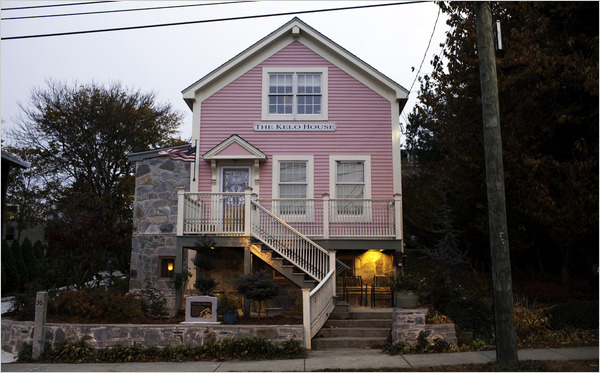
This is what your government is all about. Your government doesn't represent you, it represents special interests, the high rollers, the wealthy, the powerful and the influential. The government owns everything, and can take what they want. We're all just mere stewards of everything in our possession, the government is the owner.
The Government Took Their Homes All That s Left is a Field
Dreams Demolished: 10 Years After the Government Took Their Homes, All That’s Left Is an Empty Field
..................
Kelo and her fellow plaintiffs—Thelma Brelesky, Pasquale Cristofaro, Wilhelmina and Charles Dery, James and Laura Guretsky, Richard Beyer and Bill von Winkle—fought the city of New London to keep their homes. The city wanted to transfer the property to a private nonprofit organization, which would facilitate its development.
Their fight went all the way to the United States Supreme Court, which ruled against the property owners on June 23, 2005.
Though Kelo and her neighbors lost, the case became one of the most contested in the high court’s history, and it sparked reform in the vast majority of the states.
But the land where their homes once stood remains vacant, now a decade later.
----------------------------------------------------------------------------------------------------------------------------------
Heartbreaking and disgusting. Folks, this is what we've allowed to happen in America. We've surrendered, been defeated, and now we're servants of the master, the U.S. Government.
There are problems from both sides. Every bit of land in America is owned by someone. Thus if anything is to be built someone has to sell land. If no one sells there is no progress, except through liniment domain. I am not saying this happened in this case but by what I have seen there will be a project and everyone will sell their land to support the project except maybe one or two who will try and milk the last dime out of the project or are just not willing to see progress.
In my little community we had a company that wanted to build on their land a housing project. The problem was that the land was zoned commercial and needed to be changed to residential. The land was an eyesore which a development would be beneficial to those owning residential property next to the project and to the tax base of the borough.
At first everyone was for the change, for the above reasons. Then someone got the idea that the housing was going to be section 8 housing, code word, black. Which was far from the truth but that didn't stop the hate mongers. There were public meetings held and the longer it went on the more lying that issued forth from the hate mongers.
So when it came to a vote by council they didn't even have the integrity to vote. The LONE republican made a motion to change the zoning and not one of the low life democrats would second the motion. Hate won and the borough lost out on thousands of dollars in revenue and the place still sits idle in the middle of the borough, an eye sore that those who have lived in the boro their whole lives apparently don't see.
Now they want to "mine" in the same area because their was fill from the mills that have precious metals. I hope they do and all the land owners in the area become real pissed off because it will be an allowed use.
Anyway, my point is that progress can't be held up because of one or two people. Although I don't like liniment domain there is sometimes no other alternative.
The point is, if a citizen buys property and owns it, then they should have complete authority and control over it, period. But, in this country, no one owns anything, period. Everything, including all property, is owned by the government. If you think that you own your property, miss paying your property taxes and see how fast it's auctioned off on the court house steps. Or, try to put up a fence and see if the city or county can tell you the height and type that you're allowed to put up. Try flying a flag in your front yard and see how fast you're told to take it down. You own nothing.
We are mere stewards of everything we have, the government is the owner. Fail to renew your license plate of your vehicle and see if you can drive it on the streets and highways that you've paid for. Fail to pay taxes and see how much that you thought you owned is seized by the government. You own nothing.
Truth is you are quoting stuff that isn't and never has been true. In the US there never has been complete control of your land. eminent domain is written into the COTUS.
Much like the 2nd amendment which many misinterpret to make their arguments either way, Eminent Domain has always been part of the US.
What you say about ownership, is very true. Maybe that is why some states are called commonwealth. But just not liking something doesn't mean it isn't so or ever was.
Eminent domain - Wikipedia the free encyclopedia
Constitution[edit]
The practice of condemnation was transplanted into the American colonies with the
common law. In the early years, unimproved land could be taken without compensation; this practice was accepted because land was so abundant that it could be cheaply replaced. When it came time to draft the
United States Constitution, differing views on eminent domain were voiced.
Thomas Jefferson favored eliminating all remnants of
feudalism, and pushed for
allodial ownership.
[4] James Madison, who wrote the
Fifth Amendment to the United States Constitution, had a more moderate view, and struck a compromise that sought to at least protect property rights somewhat by explicitly mandating compensation and using the term "public use" rather than "public purpose," "public interest", or "public benefit".
[5]
The Fifth Amendment imposes limitations on the exercise of eminent domain: the taking must be for public use and just compensation must be paid. Some historians have suggested that these limitations on the taking power were inspired by the need to permit the army to secure mounts, fodder and provisions from local ranchers and the perceived need to assure them compensation for such takings. Similarly, soldiers forcibly sought housing in whatever homes were near their military assignments. To address the latter problem, the
Third Amendment was enacted in 1791 as part of the US Constitution's
Bill of Rights. It provided that the quartering of soldiers on private property could not take place in
peacetime without the landowner's consent. It also required that, in
wartime, established law had to be followed in housing troops on private property. Presumably, this would mandate "just compensation," a requirement for the exercise of eminent domain in general per the Fifth Amendment.
[6] All U.S. states have legislation specifying eminent domain procedures within their respective territories.
[7]
The power of governments to take private real or personal property has always existed in the United States, as it was once claimed to be an inherent attribute of sovereignty. This power reposes in the legislative branch of the government and may not be exercised unless the legislature has authorized its use by statutes that specify who may use it and for what purposes. The legislature may take private property by passing an Act transferring title to the government. The property owner may then seek compensation by suing in the U.S. Court of Federal Claims. The legislature may also delegate the power to private entities like public utilities or railroads, and even to individuals for the purpose of acquiring access to their landlocked land. Its use was limited by the
Takings Clause in the Fifth Amendment to the
U.S. Constitution in 1791, which reads, "... nor shall private property be taken for public use, without just compensation." The Fifth Amendment did not create the national government's right to use the eminent domain power, it simply limited it to public use.
[8]
The
U.S. Supreme Court has consistently deferred to the right of states to make their own determinations of public use. In 1832 the Supreme Court ruled that eminent domain could be used to allow a mill owner to expand his dam and operations by flooding an upstream neighbor. The court opinion stated that a public use does not have to mean public occupation of the land; it can mean a public benefit.
[9] In
Clark vs. Nash (1905), the Supreme Court acknowledged that different parts of the country have unique circumstances and the definition of public use thus varied with the facts of the case. It ruled a farmer could expand his irrigation ditch across another farmer's land (with compensation), because that farmer was entitled to "the flow of the waters of the said Fort Canyon Creek ... and the uses of the said waters ... [is] a public use." Here, in recognizing the arid climate and geography of
Utah, the Court indicated the farmer not adjacent to the river had as much right as the farmer who was, to access the waters.
[10] However, until the
14th Amendment was ratified in 1868, the limitations on eminent domain specified in the Fifth Amendment applied only to the federal government and not to the states. That view ended in 1896 when in the
Chicago, Burlington & Quincy Railroad v. Chicago case the court held that the eminent domain provisions of the Fifth Amendment were incorporated in the Due Process Clause of the Fourteenth Amendment and thus were now binding on the states, or in other words, when the states take private property they are required to devote it to a public use and compensate the property owner for his loss.
[11] This was the beginning of what is now known as the "selective incorporation" doctrine.
An expansive interpretation of eminent domain was reaffirmed in
Berman v. Parker (1954), in which the U.S. Supreme Court reviewed an effort by the
District of Columbia to take and raze blighted structures, in order to eliminate
slums in the Southwest Washington area. After the taking, held the court, the taken and razed land could be transferred to private redevelopers who would construct condominiums, private office buildings and a shopping center. The Supreme Court ruled against the owners of a non-blighted property within the area on the grounds that the project should be judged on its plans as a whole, not on a parcel by parcel basis. In
Hawaii Housing Authority v. Midkiff (1984), the Supreme Court approved the use of eminent domain to transfer a land lessor's title to its tenants who owned and occupied homes built on the leased land. The court's justification was to break up a housing oligopoly, and thereby lower or stabilize home prices, although in reality, following the
Midkiff decision, home prices on Oahu escalated dramatically, more than doubling within a few years.[
citation needed]
The Supreme Court's decision in
Kelo v. City of New London, 545 U.S. 469 (2005) affirmed the authority of New London, Connecticut, to take non-blighted private property by eminent domain, and then transfer it for a dollar a year to a private developer solely for the purpose of increasing municipal revenues. This 5-4 decision received heavy press coverage and inspired a public outcry criticizing eminent domain powers as too broad. In reaction to
Kelo, several states enacted or are considering state legislation that would further define and restrict the power of eminent domain. The Supreme Courts of Illinois, Michigan (
County of Wayne v. Hathcock [2004]), Ohio (
Norwood, Ohio v. Horney [2006]), Oklahoma, and South Carolina have recently ruled to disallow such takings under their state constitutions.
The redevelopment in New London, the subject of the
Kelo decision, proved to be a failure and as of 2012 (seven years after the court's decision) nothing has been built on the taken land in spite of the expenditure of over $80 million in public funds. The
Pfizercorporation, which owned a $300 million research facility in the area, and would have been the primary beneficiary of the additional development, announced in 2009 that it would close its facility, and did so shortly before the expiration of its 10-year tax abatement agreement with the city.
[12] The facility was subsequently purchased in 2010 for just $55 million by
General Dynamics Electric Boat.
[13]