Middle America is being squeezed out of existence. WE pay for the tax shelters for the wealthy. WE pay for corporate bailouts. WE pay for bailouts to save Wallstreet, who turns their back on middle America when their profits are huge.
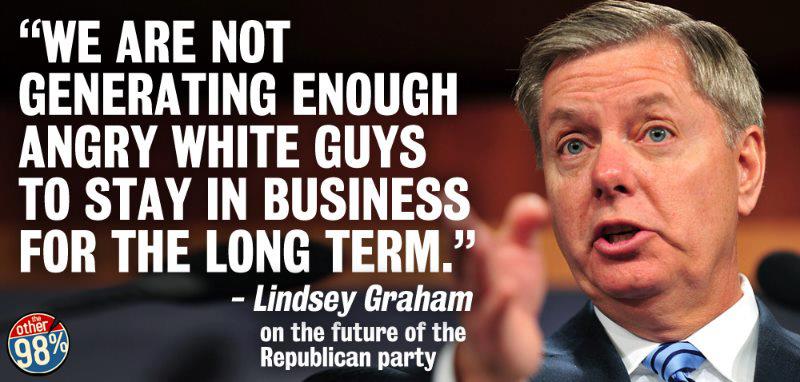
All the while the GOP defends the wealthy in their shafting of the tax system and the GOP defends multinational corporations as they shirk paying their fair share of taxes. The Repub party is in business for the rich guys and the low information poor, many of whom are in the south.
Tell me again how many Wall streeters are in the current administration. You're a freaking idiot if you think your party is pure in the matter.
Who made out well under Obama?
The 1%, and the 47%.
In the middle is the fucked over class.
Ain't hope and change wonderful?
This downturn for the middle class has been going downwards for decades. It's not a brand new thing. Many decision made by presidents and congress have and are now contributing to the further weakening of the middle class.
Now I know that
Salon is left leaning, but this discussion lead me to search for articles about the history of the decline of the American Middle Class. It leans slightly left in my opinion. A "hero" in his article is Richard Nixon's leadership. The "villains", is the leadership of all following presidents (Republican and Democrat). Here are excerpts:
RIP, the middle class: 1946-2013
<snip>
The shrinking of the middle class is not a failure of capitalism. It’s a failure of government. Capitalism has been doing exactly what it was designed to do: concentrating wealth in the ownership class, while providing the mass of workers with just enough wages to feed, house and clothe themselves. Young people who graduate from college to $9.80 an hour jobs as sales clerks or data processors are giving up on the concept of employment as a vehicle for improving their financial fortunes: In a recent survey, 24 percent defined the American dream as “not being in debt.” They’re not trying to get ahead. They’re just trying to get to zero.
<snip>
The last president who had a plan for protecting American workers from the vicissitudes of the global economy was Richard Nixon, who was in office when foreign steel and foreign cars began seriously competing with domestic products. The most farsighted politician of his generation, Nixon realized that America’s economic hegemony was coming to an end, and was determined to cushion the decline by a) preventing foreign manufacturers from overrunning our markets and b) teaching Americans to live within their new limits. When the United States began running a trade deficit, Nixon tried to reverse the trend with a 10 percent tariff on imported products. After the 1973 Arab Oil Embargo suddenly increased the price of gasoline from 36 cents to 53 cents a gallon (and just as suddenly increased the demand for fuel-efficient German and Japanese cars), Nixon lowered the speed limit to 55 miles an hour and introduced the Corporate Average Fuel Economy law, which gave automakers until 1985 to double their fleetwide fuel efficiency to 27.5 miles per gallon.
Had Nixon survived Watergate, he might have set the nation on a course that emphasized government regulation of the economy, and trade protection as a response to globalism. We might also have preserved more of the manufacturing base necessary for a strong middle class. But his successors dismantled that vision, beginning with Jimmy Carter, an economically conservative Southern planter. Nixon’s answer to inflation had been wage and price controls, an intrusion into the free market that would be unimaginable today. Carter deregulated the airline, rail and trucking industries, hoping that competition would result in lower prices. It didn’t, but it gave the newly liberated companies more leverage against their unions. When inflation nonetheless reached 14 percent, Carter’s hand-picked Federal Reserve Board chairman, Paul Volcker, responded by tightening the money supply, raising interest rates so high that Americans could not afford loans for cars or houses. Ronald Reagan also chose low prices over employment, refusing to free up money until inflation declined. Car sales hit a 20-year low. In the fall of 1982, the national unemployment rate was 10.8 percent, the highest since the Great Depression. Walter Mondale accused Reagan of turning the Midwest into “a rust bowl” – a term reformulated to Rust Belt. Buffalo, Cleveland, Flint and Detroit still haven’t recovered. Neither has the middle class.
“You can’t grow an economy, grow a middle class, without making things, producing stuff,” says Mike Stout, a steelworker who lost his job when Pennsylvania’s Homestead Works closed in 1986. “It’s just impossible. I haven’t seen it anywhere.”
RIP the middle class 1946-2013 - Salon.com
Clearly, taking ideological politics out of the equation is the right and objective way to intellectually approach this subject. Pointing fingers only tells half of the story.
Andrew Mellon had a few distinctly progressive ideas. Of particular note, he suggested taxing "earned" income from wages and salaries more lightly that "unearned" income from investments. As he argued:
The fairness of taxing more lightly income from wages, salaries or from investments is beyond question. In the first case, the income is uncertain and limited in duration; sickness or death destroys it and old age diminishes it; in the other, the source of income continues; the income may be disposed of during a man's life and it descends to his heirs.
Surely we can afford to make a distinction between the people whose only capital is their mental and physical energy and the people whose income is derived from investments. Such a distinction would mean much to millions of American workers and would be an added inspiration to the man who must provide a competence during his few productive years to care for himself and his family when his earnings capacity is at an end.
Tax History Project -- The Republican Roots of New Deal Tax Policy
"How many times do you have to get hit over the head before you figure out who's hitting you?" - President Harry Truman