Archaeology Answers About Ancient Civilizations Indus River Valley, Ancient Maps of the World, Ancient India Civilizations, Ancient China Civilization, Strange Pictures, Dead Men's Secrets, Lost Technology, and more...
ARCHAOLOGY NEWSFLASH No. 394
Frank, this news is from Jonathan Gray -
Archaeology Answers About Ancient Civilizations Indus River Valley, Ancient Maps of the World, Ancient India Civilizations, Ancient China Civilization, Strange Pictures, Dead Men's Secrets, Lost Technology, and more... You authorized this mailing when
you requested your free report on our web-site or a
friend enrolled you. See below for removal directions.
PLEASE NOTE: I always try to answer all email requests.
If you receive no reply it is because no person alive
sees emails addressed to
info1@archaeologyanswers.com
Please resend your question to
info@archaeologyanswers.com. (info@ - not info1@)
and I promise you an answer.
MYSTERIES...Would YOU like to solve this one?
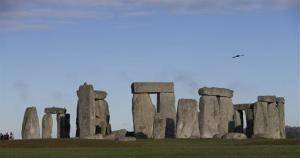
Stonehenge…
WHAT is its special secret?
And the Great Pyramid. Are you ready for a treat today?
DID YOU KNOW?...
FACT 1: A 360-DAY YEAR AT FIRST
The ancient calendars had a 360 day year. That’s
why the earth was divided into 360 degrees.....
FACT 4: STONEHENGE TO RECALCULATE
EARTH’S POSITION (among other things)
The precision of Stonehenge is astonishing.
Consider the heel stone. This heavy boulder had to be
set in a hole in the ground exactly in the right
position. If placed too high, it would need to be
taken out and the hole deepened. If too low, it would
once more have to be shifted. Even if it had been
dropped into precisely the right position, its 35 ton
weight might well have made it settle lower. Nobody
could know for sure how much it would eventually settle.
Such accuracy applied to every stone that was
positioned.
Some of the fallen stones were re-erected in 1958.
Extremely powerful cranes were used. Yet, even with
this modernequipment, it proved impossible to align
or set them up as accurately as had the ancient
builders!
Gerald Hawkins, on the basis of computer syntheses of
a great many measurements at Stonehenge, suggests that
Stonehenge was, in fact, a computer for measuring all
the relationships between earth, the sun and the moon.
(Gerald Hawkins, Stonehenge Decoded. Souvenir Press,
1966)
The heel stone and the trilithons and the shadows cast
by the pillars all played an intricate role.
Experts have long puzzled over the 56 Aubrey holes.
Hawkins suggests they could have functioned as a
computer, this way:
If one stone was moved around the circle by one hole
each year, then all the extremes of the seasonal moon
and eclipses of the sun and moon at the solstices and
equinoxes, could have been foreseen.
If six stones, spaced 9,9,10,9,9,10 Aubrey holes apart,
were used, each of them moved one hole counter-clockwise
each year, amazing powers of prediction could result.
With 6 stones (3 white, 3 black), the Aubrey hole
computer could have predicted - precisely - every
important moon event for hundreds of years.
The terrestrial axis is currently inclined at 23½
degrees.
The early Greek philosophers viewed this tilt as an
“irregular condition,” and not something that had
been fixed since the beginning. Anaxagoras wrote:
“In the beginning the stars moved in the sky as in
a revolving dome, so that the celestial pole which
is always visible was vertically overhead; but
subsequently the pole took its inclined position.”
The Northern Hemisphere sun moves from a maximumpostion
of +23 1/2 degrees northward in summer to a
a -23½ degree extreme southern declination in
winter.
The moon does a reverse move - north in
winter, south in summer. The moon also has
a more complicated relative motion than the sun;
it has TWO northern and TWO southern maxima.
In an 18.61 year cycle, it varies so that its far
north and south declinations move from 29 degrees
to 19° to 29° again. This difference is due to
the combined effects of the earth's tilt and
precession of orbit.
The Stonehenge complex was precisely aligned to
EVERY ONE of these movements. With the 18.61 year
cycle, the only way to attain accuracy with whole
numbers is by the sequence 19-19-18, which, added
together, make 56 - the
number of Aubrey holes!
Amazing but true. Stonehenge is a brilliantly
designed and constructed astronomical device, WHICH
COULD CALCULATE EVERY POSITION of the sun and moon.
And why all this?
The Great Flood, we should consider, had a great
deal to do with the construction of this and other
precise stone structures.
It appears that Stonehenge was built to determine
the new orbital position and thus the new length of
the year, as well as the new axial position of the
earth, following the catastrophe.
If indeed the earth had been jolted abruptly from
its original orbit, such a jolt would also have
severely affected the moon.
If the moon was on the side away from the sun when
it happened, a change of our orbit away from the sun
would have brought the moon closer to earth. The
original shorter-year calendar (360 days) suggests
that the earth was slightly closer to the sun.
The original ancient lunar month was 36 days, which
implies that the moon orbited the earth at a greater
distance. The jolting of earth would have reversed
this - the earth now being further from the sun would
make a longer year; and the moon in orbit nearer to
earth, a shorter month.
The truth is that REVISED ANCIENT CALENDARS
REFLECT THIS CHANGE.
Stonehenge and its counterparts were built, I do
believe, to re-evaluate the length of the year and
the lunar month.
Similar stone computers covered the whole of Britain
and western France. They formed, possibly, a huge
complex, with Stonehenge as the central unit, against
which the findings of all the others were correlated.
And after their purpose had been accomplished there
was no further need for them, and they were left.
That answers another question that has puzzled
scholars. Why, after the final phase of Stonehenge
was completed, was the site abandoned for many
centuries - until the Druids began to use it as a
gathering place?
The answer makes perfect sense. It was built to
perform certain specific functions. Its purpose was
accomplished. It
was needed no more....
Warm regards,
Jonathan Gray
info@archaeologyanswers.com