Perfectly reasonable considering mans limitations that there is a being out there that has abilities beyond our comprehension.
Life didn't create itself, it is irrational to think it could. That the planets perfectly alligned themselves and one planet that has everything to sustain life.
another series of famous false declarations by YWC.
"Life didn't create itself"..YWC
"the planets perfectly alligned themselves and one planet that has everything to sustain life"- YWC
"Perfectly reasonable considering mans limitations that there is a being out there that has abilities beyond our comprehension."YWC
YOU HAVE NO OBJECTIVE CREDIBLE EVIDENCE TO PROVE THESE STATEMENTS ARE FACT.
AT BEST THEY ARE OPINION .
AT WORST THEY ARE confirmation bias : Confirmation bias (also called confirmatory bias, myside bias or verification bias) is a tendency of people to favor information that confirms their beliefs or hypotheses.[Note 1][1] People display this bias when they gather or remember information selectively, or when they interpret it in a biased way. The effect is stronger for emotionally charged issues and for deeply entrenched beliefs. For example, in reading about gun control, people usually prefer sources that affirm their existing attitudes. They also tend to interpret ambiguous evidence as supporting their existing position. Biased search, interpretation and memory have been invoked to explain attitude polarization (when a disagreement becomes more extreme even though the different parties are exposed to the same evidence), belief perseverance (when beliefs persist after the evidence for them is shown to be false), the irrational primacy effect (a greater reliance on information encountered early in a series) and illusory correlation (when people falsely perceive an association between two events or situations).
A series of experiments in the 1960s suggested that people are biased toward confirming their existing beliefs. Later work re-interpreted these results as a tendency to test ideas in a one-sided way, focusing on one possibility and ignoring alternatives. In certain situations, this tendency can bias people's conclusions. Explanations for the observed biases include wishful thinking and the limited human capacity to process information. Another explanation is that people show confirmation bias because they are weighing up the costs of being wrong, rather than investigating in a neutral, scientific way.
Confirmation biases contribute to overconfidence in personal beliefs and can maintain or strengthen beliefs in the face of contrary evidence. Poor decisions due to these biases have been found in military, political, and organizational contexts.
Confirmation bias - Wikipedia, the free encyclopedia
IN OTHER WORDS, PEOPLE FIND WHAT THEY ARE LOOKING FOR EVEN WHEN IT'S NOT THERE .
Exactly my point,many of of my beliefs are based in faith. If you want to call it opinion that is fine but that is what your views are based in.
That is exactly why I asked you to point out a trait in humans you can prove came from mutations. Then you need to prove that trait did not exist already in the gene pool.
If you can't then are your views based on empirical evidence or is it just an opinion based on no evidence ?
faith is an opinion with lot's of wish-full thinking thrown.
once again you assume that my views are based in a kind of faith. and that assumption is base less.
Human Evolution and Frameshift Mutations
By Geoff April 3, 2009
How did humans evolve from early primates? How did human like traits such as a smaller jaw relative to apes and hairlessness pop up when they dont appear in the wild in any real frequency? The typical explanation for why humans have smaller jaws than early primates is that our diets changed and our brains got bigger, pressures that caused a smaller jaw. But theres another way to look at this what if our diets changed and our brains got bigger due to proto-human society dealing and adapting to an increasingly frequent and nearly catastrophic mutation of the jaw?
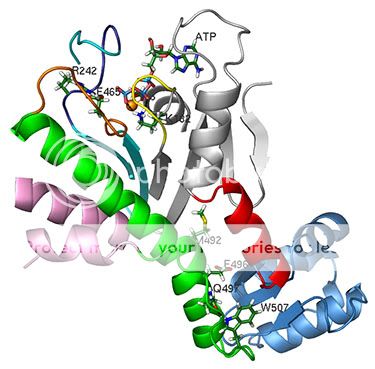
Myosin Heavy Chain 16
The human and chimpanzee genomes have both been mapped, so we are able to make comparisons between them. This is extremely useful, as chimpanzees and humans shared a common ancestor, but genetic lines split apart approximately 7 million years ago. So examining the differences may tell us something about how humans evolved.
There is a protein called myosin heavy chain 16 (aka MYH16) which in chimpanzees and other non-human primates is expressed almost exclusively in their powerful jaw muscles. These strong jaws are an adult trait a logically complex one that would be more sensitive to random mutations.
And thats exactly what seems to have happened. Non-human primates have DNA that codes for the complete MYH16 protein. The corresponding part of human DNA is missing a random chunk which causes a frameshift mutation.
Frameshift Mutations
What is a frameshift mutation? Well, first lets find out how we build proteins. We have a strand of messenger RNA (imagine a long tape with letters on it) which a ribosome (hell, imagine a tiny elf) uses to produce proteins. The critical thing to consider is that a ribosome builds a protein by reading three nucleotides at a time, and these three nucleotides code for a certain amino acid. These amino acids are chained together to produce proteins. Some combinations of three nucleotides can also act as punctuation marks.
So our wee elf looks closely at the long tape of letters, and starts off with the first three. His frame, the little chunk he works on, is three letters long. This frame is an instruction to build a certain amino acid, which he makes. He then goes along the tape, three letters at a time, making an amino acid each time that he sticks onto the last. This will eventually create a long chain of amino acids that we call a protein. But each frame doesnt need to code for just an amino acid it can also code for other instructions (those punctuation marks) starting or stopping this chaining process.
Now you may have guessed what a frameshift mutation is by now its where a single letter in our tape disappears, or a new random one gets thrown in, causing our frame to get shifted slightly. This means that the resulting triplets after this error will be horribly wrong. Its like the difference between
HEY MAN HOW ARE YOU BRO and
HEY MAN HWA REY OUB RO_ or HEY MAN HOQ WAR EYO UBR O__
if one were to speak in sentences containing only three letter words. The first sentence makes sense if we parse three letters at a time. The two others have a random letter removed, and a random letter added in. If we parse them three letters at a time, the sentence turns into garbage halfway through! The resulting nonsense (or malformed protein) is a result of a random insertion or deletion of information (nucleotides) and our frame, the manner in which we interpret it.
Consequences
So a frameshift mutation occured in early humans that affected the production of the protein MYH16. This protein is involved in the strong powerful jaws that primates have, but not humans. We often think of mutations as a simple little blip in the genetic code, but the way our bodies parse this code can cause cascading effects. Instead of MYH16 having a slightly different amino acid in a random spot from a random mutation, the specified amino acids after the mutation will change completely!
So you might think that well have some odd protein thats mostly normal, and the parts after the mutation affected by the frameshift will be wonky. But and this is an important but the triplets code for punctuation marks too, remember? In this MYH16 mutation, it turns out that this frameshift caused a punctuation mark (aka a stop codon) to just pop up so the protein is cut off far sooner than it should be! Not too good for any traits relying on that protein.
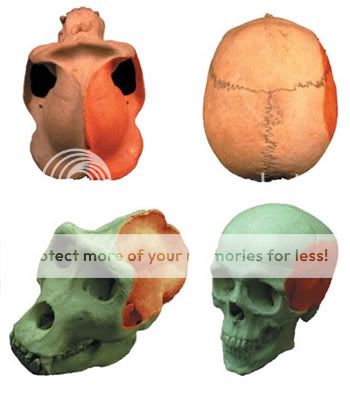
Look at the differences between these gorilla and human skulls below. The large bony ridges on the gorilla skull on the left are where the larger jaw muscles attach otherwise they would literally tear off of the skull. You can also see how the gorilla skull seems empty on the sides thats because it is filled with large jaw muscles, reducing space available for the brain. The red tinted parts are where the jaw muscles attach you can see how much more anchoring a gorillas jaw muscle requires.
And this is where it gets interesting. This mutation in our human ancestors happened approximately 2.4 million years ago. Right before our ancestors stopped looking like primates and started looking like us. If you lacked the protein that operated a powerful jaw muscle, you could not carry a large jawbone around and use it effectively. If you cant carry a large jawbone around, there is strong selection pressure for those with smaller jaws to survive. If your jaw gets smaller, then the loading of the jaw on the skull decreases bony ridges disappear, and the skull can get larger and lighter since it doesnt need to be as strong. A larger and lighter skull can accommodate a bigger brain.
It appears that a random mutation, flipping a single bit of genetic information, has beautifully complex cascading results. Viewing the world as a hostile agent of noise and fury, winding down to an eventual death by entropy is wrong. You can fold a piece of paper, give it to a child, and have them cut crude holes in it with cheap scissors and when you unfold it, the snowflake is beautiful.
So too can randomness be folded and twisted by logical structures in biology and physics and the result is our amazing world.
Human Evolution and Frameshift Mutations | gmilburn.ca
 In Christianity she would be the Tree of Life and the Virgin Mary Jane, and the oil they talk about using in private.