I say there is an average time that a CO2 molecule stays in the excited vibrational mode before it expels a photon and returns to groundstate.
About 1 second
There is also an average time between molecular collisions in the air
About a nanosecond...a billion times shorter than the time it takes to emit a photon.
I hadn't realized there was more to that conversation between Burton and Happer. Here is part of RGBrown's response-
"
Dear Prof. Brown,
I think you might find the discussion below interesting. Prof. Happer's
reply to me is in
[BLUE] below.
Yeah, I already know most of that stuff, and I'm pretty sure I have his
powerpoint presentation slides as well. I wasn't aware that there were
levels with lifetimes as long as 1 second -- that's actually pretty long
as atomic/molecular lifetimes go -- but those particular levels are then
going to be very sharp and not terribly responsive to non-resonant IR.
Either way, CO_2 doesn't "scatter" LWIR radiation, it absorbs it
(typically within a few meters, the mean free path at atmospheric
concentrations) and the energy is almost instantly transferred to the
surrounding air.
That doesn't mean that they don't radiate. It just means that their
radiation temperature is in equilibrium in the surrounding air, and it
isn't reradiating of a photon it absorbed, it is radiation initiated by
e.g. a collision with an air molecule.
That's why the greenhouse effect is basically logarithmic at this point.
It is long ago and overwhelmingly saturated. The atmosphere is
basically totally opaque in the CO_2 aborptive bands from sea level up
to maybe 8 or 9 km. Somewhere up there, where the air is much colder,
the molecules get far enough apart that LWIR emitted from the colder air
have a good chance of escaping without being reabsorbed. Increasing
CO_2 basically causes a very small variation of the average height and
-- due to the adiabatic lapse rate, which has little that is directly
due to the GHE itself -- therefore the temperature at which the
atmosphere becomes effectively transparent. The rate at which the
energy in this band emerges from the atmosphere is hence much less than
the rate at which it was originally emitted at the surface in this band.
Given constant average SWV (visible) delivery of radiation into the
system from the Sun, the ground temperature has to warm a tiny bit in
order to compensate for the loss of outgoing power in the CO_2 band.
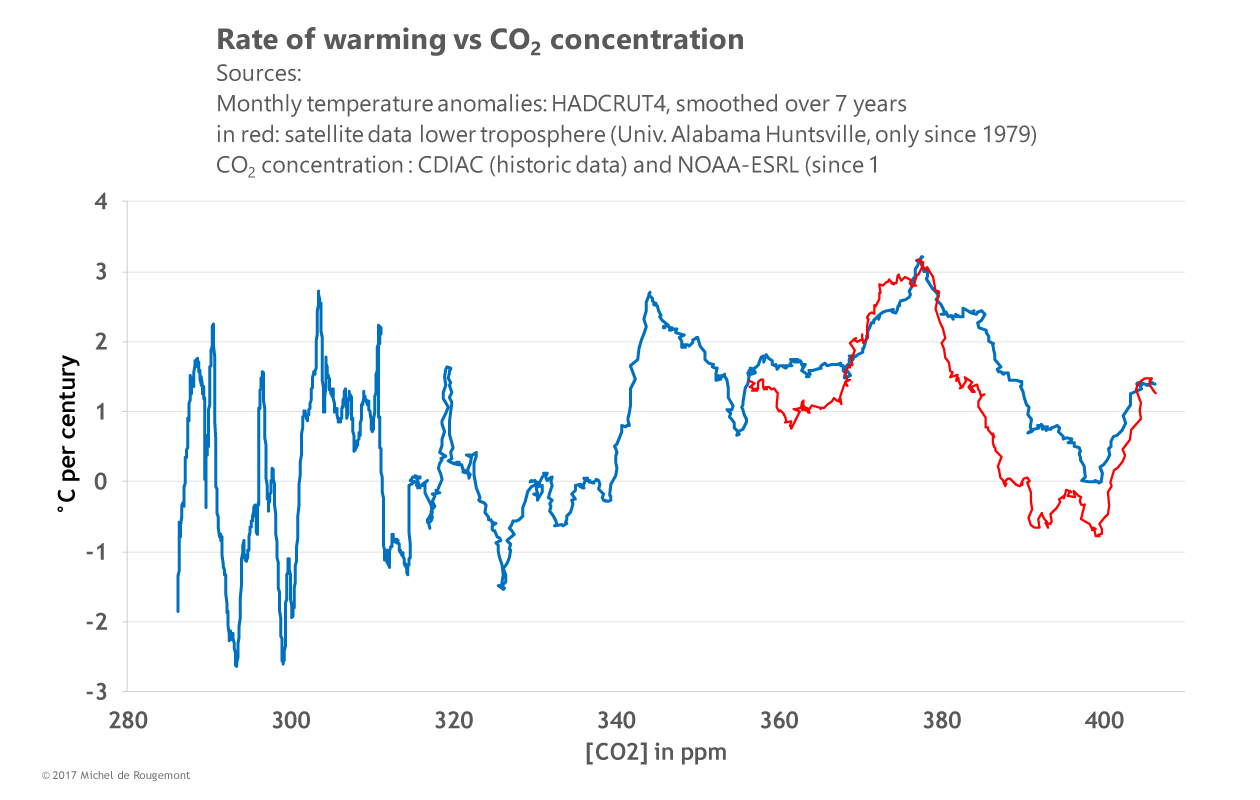
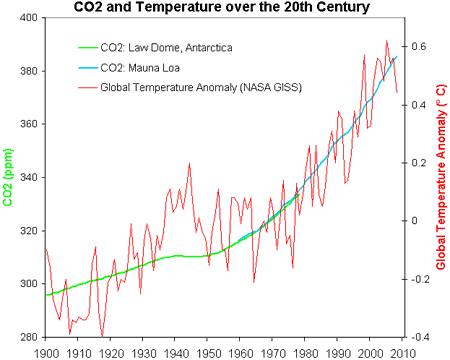
Here is a curve indicating just how much explanatory power CO_2 has as
far as the temperatures over the last 164 years are concerned. Quite a
lot, actually. Happer might be interested in this curve. I think he
passed on the reference to Wilson and Gea-Banacloche in AJP (2012) which
reviews the CO_2-only no-feedback GHE and ends up concluding that the
no-feedback total climate sensitivity on doubling CO_2 ought to be
around 0.9 to 1.1C. I get an excellent fit to all of HadCRUT4 with TCS
around 1.8C,
"
That sounds exactly like what I have been saying.