SSDD- you are purposely ignoring the context of those statements.
When one pathway of energy loss is reduced, the system warms up to push more energy out of the unaffected pathways. The energy required to raise the temperature comes from energy not lost to space while the system moves back to equilibrium.
An analogy for this is a bucket with several holes in it. When you start filling it with a hose the water level will rise until as much water is leaving by the holes as entering by the hose. Equilibrium.
If you plug one of the holes then the water level will rise until the increased pressure from the weight of the extra water forces more water out of the remaining holes and a new equilibrium water level will be established.
At the new equilibrium level the water loss still matches the water input, even though we initially reduced the water loss by plugging one of the holes.
CO2 plugs one of the holes for energy loss. The resultant temperature increase forces more energy through the remaining holes. Equilibrium is reinstated. The energy required to raise the temperature is equal to the amount not lost to space while the system moved towards the new equilibrium.
Yet you ignore the empirical evidence that shows its not occurring and continue to believe.. No "Hot spot" has shown up which would have to occur if your hypothesis were true.
Water vapor does indeed absorb 12um-90um very well. At TOT it becomes LWIR after renunciation of the water to its liquid state. Tell me again how your differentiating this from CO2 emitted LWIR?
The Hotspot is caused by CO2? Since when, what is the mechanism?
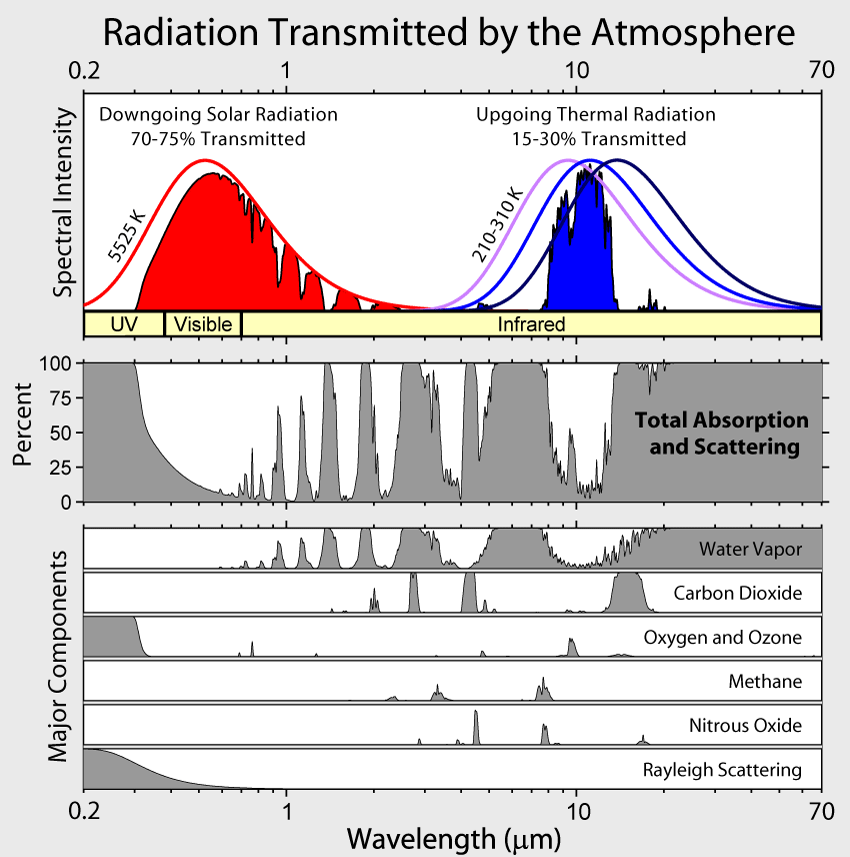
Water vapour has specific wavelengths it favours, just like any other molecule. It has peaks at 1.5, 2, 2.75, a big one at 6, and everything past 20.
Anything less than 100% absorbance means some transmission, or perhaps just scattering.
Looking at this graph, I don't understand why methane is considered a strong GHG.
Ian;
CO2 as a molecule can not hold heat. Its molecular structure will not allow it to hold anything and it immediately re-emits any photon that it receives. CO2 requires another atom with which to collide or receive the energy from.
Now lets look closely at the spectrum graph;
CO2 does in-fact absorb anything in this band that hits it but it also emits it immediately. Water vapor also absorbs in this band and having roughly a 400,000-600,000 % chance of the radiated energy hitting it rather than another CO2 molecule, there simply isn't enough CO2 to create an energy loop. Water vapor, conduction, and convection simply lays any potential energy slowing, waste. IE; no atmospheric hot spot.
IN a desert, where water vapor is 5-10% or less on average, the temps soar in day time (nothing in the atmosphere to block or redirect incoming energy) and at night it cools rapidly to near freezing in just a few hours (again due to the lack of water vapor mass). CO2 levels do nothing to hold in heat because they are incapable of it. Without water vapor, CO2 is incapable of anything.
This is a double edged sword as where there is water vapor it is the water vapor which is capable of holding or slowing heat release. The water vapor is unimpeded by CO2 through conduction and convection in the air column. The shear mass of the air column lays waste to what little effect CO2 might cause. While CO2 can not hold energy or heat, water vapor can and it can hold it for long periods of time. (this is why there should be a hot spot if there is an energy loop-'positive feedback'). The fact that no hot spot is present indicates that no loop is present. There is NO POSITIVE FEEDBACK LOOP. It simply does not exist.
Convection and conduction are removing the heat unimpeded by CO2. A Total AWG hypothesis failure.
Empirical evidence shows us that CO2 ALONE should have caused 0.8 deg C in the last 180 years. Yet we haven't seen but 0.6 deg C (in unadjusted data sets) and all of that rise can be attributed to clouds and albedo change. None of it can be attributed to CO2. The IPCC models say we should have seen over 3.2 deg C rise and we have not.
Putting it simply, Water vapor is shown a negative forcing (by empirically observed evidence) not a positive one as the AGW hypothesis proposes. Water is shown a dampening effect on CO2. And not one GCM has it right to date, they all fail without exception.