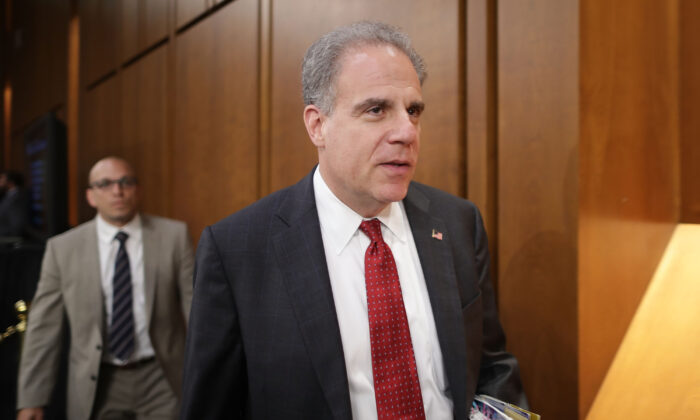
One of the most popular arguments on the right to excuse President Donald Trump from wrongdoing ahead of any findings from the Russia investigation...
They found ZERO evidence that Trump or his campaign was in a criminal conspiracy with the Russians.
... is to claim that the investigation itself is corrupt — and these arguments typically center on the idea, with no evidence whatsoever, that the FBI lied to the judges on the Foreign Intelligence Surveillance Act (FISA) court when pursuing a warrant to probe Trump’s presidential campaign...
They did lie, forged an exculpatory document to make it appear incriminating and they concealed information from the Court that exonerated Page and showed that the FBI's sources were nowhere near as reliable as the FBI claimed.
...Trump himself has made this claim on Twitter,
saying that “the Trump Campaign for President was illegally being spied upon” for “the political gain of Crooked Hillary Clinton and the DNC,” and that “the DOJ, FBI and Obama Gang need to be held to account” because they “Misled the Court to provide a pretext to SPY on the Trump Team.”...
And he's right.
... The idea that the FBI misled FISA judges to get a warrant against the Trump campaign has been
debunked by the release of the FISA applications, revealing that there was a perfectly solid legal basis to investigate Carter Page amid his
suspicious travel to Russia...
No. John Brennan informed the FBI repeatedly and in writing, and he has the paper trail to back it up, and Horowitz has confirmed that he does, that Carter Page was a very reliable and productive CIA source, and as their source he traveled to Russia and interacted with Russian Intelligence. The FBI took one of the emails explaining this and added "NOT A" next to source, a forgery that reversed the meaning of the sentence and submitted it as evidence that Carter Page was a spy in a criminal conspiracy with the Russian Government to harm the interests of The American People. When you lie to, conceal from and forge documents to submit to the FISA Court, the spying that results is ILLEGAL.
... But this narrative persists among Trump’s political allies, and in the right-wing echo chamber. Outgoing House Intelligence Chairman Devin Nunes (R-CA) released a
flimsy, partisan memo that claimed to prove FISA wrongdoing...
Nunes was correct as was his memo and the popular question now is WHY THE FISA COURT repeatedly blew him off, when 18 months ago he reported the FBI misdeeds to the FISA Court. Now this week the FISA Court came out with a CYA rebuke of the FBI, but where the hell were they when the warrants were be submitted and where have they been for 18 months?
FISA court's rebuke of the FBI: It broke or ignored the rules and our rights
The presiding judge of the Foreign Intelligence Surveillance Court (FISC) has issued a
stinging rebuke to the FBI in the wake of Justice Department Inspector General Michael Horowitz’s
report on the bureau’s serial abuses in the surveillance of
Carter Page.
She's the same one that blew off Devin Nunes, twice, when he informed her of all this 18 months ago.
In the FISC’s assessment, the derelictions in the Page surveillance warrants are so serious, the court’s judges
cannot be confident that any warrant applications the FBI has submitted are accurate and complete — i.e.,
that the bureau’s assertions have been true and, even if true, were not misleading because of the omission of relevant information.
Given how many different ways they lied to the Court on the Carter Page Warrants used to spy on The Trump Campaign, Transition and Administration, they are concerned that the FBI may habitually lie to them, about everything, on every warrant,
Consequently, in an extraordinary public
order on Tuesday, the secret court’s presiding judge,
Rosemary Collyer, directed the Justice Department and the FBI to conduct a thorough
review of all submissions the bureau has made to the FISC. They have about three weeks (until Jan. 10, 2020) to explain what steps have been taken to assure the candor of each submission.
Given that there have been many submissions, this seems like a great burden in such a crunched time frame. The FISC, however, is simply demanding to be satisfied that the FBI has done what it has led the court to believe it has been doing all along. Justice Department and FBI procedures, along with FISC rules, require that every factual assertion in an application to the FISC be verified and accurate. The bureau is supposed to go through this process of validating every fact alleged in every foreign intelligence surveillance case as a matter of routine.
The Page surveillance warrants demonstrate that the process either is broken or has been ignored.
It is obviously vital that the court take curative action. The inspector general’s (IG) report outlines
shocking deception of the FISC and violations of Page’s civil rights. The court has supervisory responsibility over the orders it has issued, and it must evaluate the credibility of future government submissions. The IG report’s revelations, moreover, come on the heels of Obama-era surveillance abuses. In 2016, for example, the court observed that, in administering FISA programs,
the intelligence community was guilty of an “institutional lack of candor” — engaging in and concealing the unauthorized interception of communications. The same intelligence community, on the watch of CIA Director John Brennan, was caught hacking the Senate Intelligence Committee.
The most palpable problem with FISA involves what Judge Collyer describes as the heightened duty of candor.
It is not unusual for investigators to meet secretly with judges to obtain highly intrusive warrants. But there’s a big difference between criminal investigations and counterintelligence: When FBI criminal investigators and federal prosecutors secretly apply to a judge for an eavesdropping, search, or arrest warrant, they know their work is going to be checked. In the criminal justice system, the operating assumption is that there eventually will be an indictment, which will trigger due process requirements of discovery. If government officials have made false or misleading statements to the court, if they have withheld critical exculpatory information, that will become known. There will be serious consequences.
In stark contrast, counterintelligence is classified. The goal is to collect information for national security purposes, not build criminal prosecutions. The vast majority of the time, there will be no indictment — and certainly no discovery. The system has no internal check to keep people honest.
In FISA proceedings, the only due process an American can ever get occurs in that secret meeting between the judge and officials from the Justice Department and FBI. If the FISC cannot ensure that intelligence officials honor the codified standards of integrity and transparency, the system fails. And unlike defense counsel in a criminal case (many of whom are former prosecutors), the court is not staffed with experienced investigators. It has neither the capability nor the institutional competence to pore over government submissions, spot the weaknesses, locate witnesses, examine documentary proof and dismantle a weak government presentation. That is not the judges’ fault. What we are talking about is simply not their job. Thus,
the court has no choice but to rely on the government’s candor.
Judge Collyer is right to be outraged at the FBI’s malfeasance here. She has nothing to say, though, about the uncomfortable fact that the FISC did a poor job here, too. The version of the Page warrants made available publicly is
heavily redacted, but what has been revealed shows the probable cause showing was rife with problems — uncorroborated sources; the FBI permitted to “speculate” and offer its “beliefs” about its main informant, rather than being pressed by the court to question him; news media stories offered as evidence, and relied on for 11 months even though the FBI had plenty of time to do independent investigation.
And even after it had become apparent, based on congressional investigations, that significant abuses had occurred, former FISC Chief Judge John Bates made this
astonishing public statement: “I will note, and note with some force, that I have seen nothing that indicates that the court was misled, that the Department of Justice or the intelligence community made misrepresentations to the court.” Really?
FISA court's rebuke of the FBI: It broke or ignored the rules and our rights