Here's What Would Happen if a Solar Storm Wiped Out Technology as We Know It
It's a strange and lucky irony that the worst solar storm in recorded history happened at a time when human civilisation wasn't yet uniquely vulnerable to the Sun's inescapable geomagnetic fury.

www.sciencealert.com
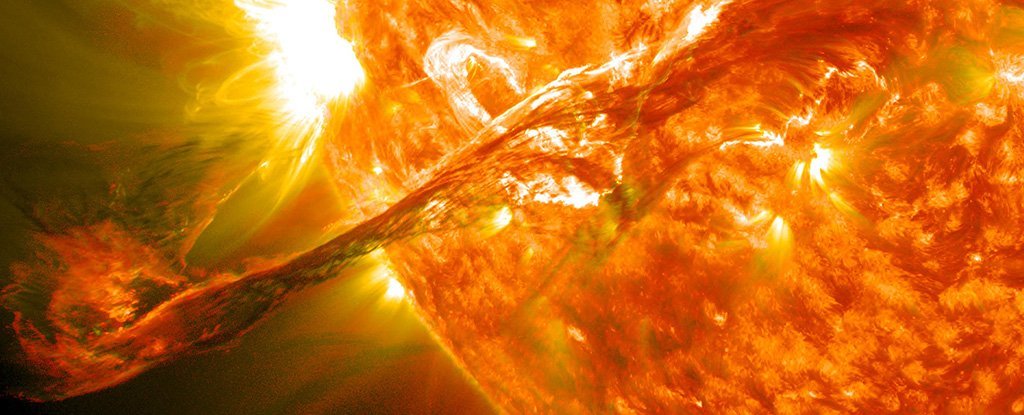
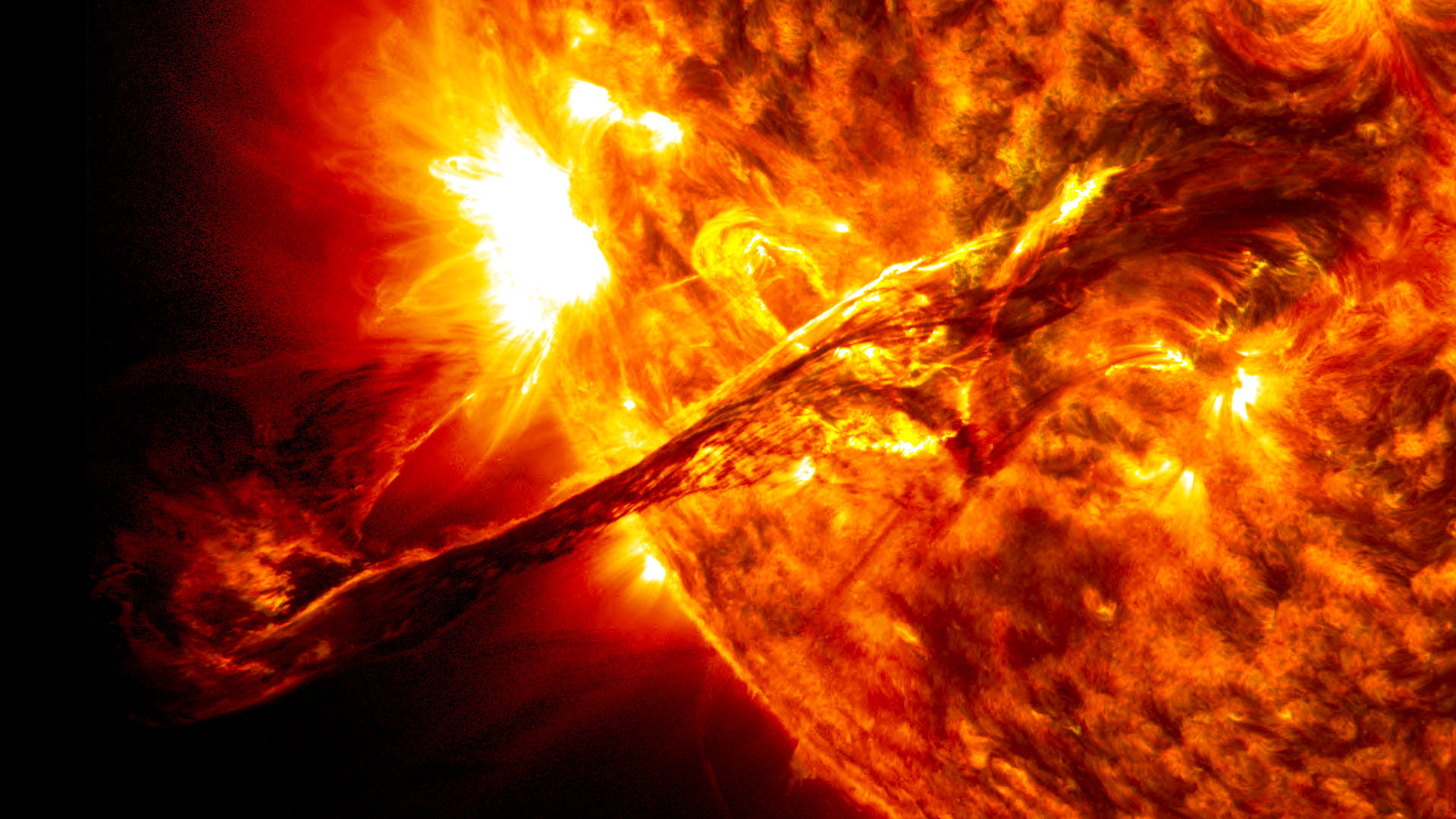
" . . .The Carrington Event – aka the solar storm of 1859 – saw a huge solar coronal mass ejection unleashed at Earth's protective magnetosphere, producing an epic geomagnetic storm the scale of which modern civilisation had never before witnessed.
As a barrage of charged particles collided with Earth's magnetic field, intense auroras lit up skies around the world – but with strong electrical currents sweeping across the globe, the repercussions went far beyond colourful visuals.
Telegraph systems covering Europe and North America went down, as sparks flew from equipment, giving electric shocks to their human operators and even starting fires. Amid the electrified tumult, machines that had been disconnected from their power supplies eerily continued to relay their truncated messages.
It was, in other words, technological chaos. Yet from the comparatively futuristic perspective of 2018, as far as tech apocalypses go, it all sounds rather quaint and contained.
If a similar-scale solar storm were to strike Earth's pervasive technological systems right now – over a century and a half later – what would happen?
Nobody knows for sure how bad things would be, but given how scarily reliant we are on today's deep-rooted technological and electronic superstructures – compared to the primitive and relatively rare contraptions of 1859 – it would certainly be no picnic.. . .
<snip>
We aren't ready for a solar storm smackdown
From CNET Magazine: The sun is constantly sending out megatons of charged particles that could crash the world's electrical grid. Here's what we can do about it.
Here’s what we can do about all those electric-grid crashing charged particles heading our way.

www.cnet.com
A Carrington-class solar storm would be dramatically worse.
The basic problem stems from electrical currents that solar storms generate in the Earth's ionosphere. Those, in turn, induce currents in the power grid that can lead to two unfortunate outcomes. One is voltage collapse — a type of power blackout that can affect entire electric grids. The other is transformer failure.
Transformers change one voltage to another — increasing it for long-distance power transmission and decreasing it for household use. Solar storms could destroy power grid transformers, which can be as big as a house, cost more than $10 million and take 12 to 18 months to replace. It's one reason a science and engineering firm called Metatech warned in 2008 that a massive solar storm could cost the US economy between $1 trillion and $2 trillion and take four to 10 years to recover from.
That projection is too dire, though, say transformer experts at the Institute of Electrical and Electronics Engineers (IEEE) as well as Scott Backhaus, an expert in grid resiliency at LANL.
Of the potential impacts, the one everybody is concerned about is a large power transformer overheating," says Backhaus. "What would probably happen before that would be voltage collapse."
While not as devastating, voltage collapse can still cause regional problems. And the more widespread the blackouts, the harder a recovery becomes because broader outages require power plants to initiate a "black start": using their own power sources, like diesel generators, for the electricity needed to restart the whole plant.
Solar storms cause other problems, too. Satellites beam navigation radio signals to everything from your phone and your car's sat-nav system to oil rigs and airplanes. Massive bursts of charged particles can hobble those services, as well as phone calls and internet data transfers.
Space weather also can expose aircraft to high levels of radiation. The Earth's magnetic field ordinarily provides protection except near the north and south magnetic poles, but CMEs push that radiation down toward the equator. That means transcontinental flights that usually travel over a pole must detour to less direct routes. . . ."
When Will A Massive Solar Storm Knockout Our High-Tech Society? That Depends On Who You Ask
Geologists uncover more evidence for massive solar storms in Earth’s past while mathematicians calculate the probability of a catastrophic geomagnetic storm is lower than estimated.

www.forbes.com
". . In separate research, mathematicians think they’ve proved that massive solar storms are more unlikely than previously thought. Three mathematicians and a physicist from the Universitat Autònoma de Barcelona (UAB), the Mathematics Research Centre (CRM) and the Barcelona Graduate School of Mathematics (BGSMath) calculated that the probability in the next decade of a potentially catastrophic event for the Earth's telecommunications, of ‘Carrington Event’ proportions, is between 0.46% and 1.88%.
That’s far less than estimated before. "In 2012, the results reported in scientific literature estimated the probability to be around 12%, ten times more than our more pessimistic estimation,” says David Moriña, first author of the study and postdoctoral researcher explains.. . "

en.wikipedia.org
My analysis is, a more diverse society, with multiple localized energy sources, with higher inputs from wind and energy would, indeed would mitigate this danger. This is not to say, localities should also have other energy sources. The more energy sources you have, the better. Diversity breeds resilience and reliability.
OTH, a centralized controlled society, completely reliant on Smart tech for command, control, data gathering computation inputs, outputs, and distribution networks is a critical weakness. A confederated, decentralized social sysem, just like a decentralized energy distribution network and resource network, just like a decentrialized political network, would be in the interest of the entire human race.
In this way, if any part of the planet takes a critical hit, the other parts of the planet can help come to the rescue. Making the whole system so integrated, that a killing blow to one part? Brings the whole deck of cards down. . . this is suicidal idiocy. But you can't tell these global psychopaths anything.