In many ways, this is the story of the movement to boycott Israel today.
BDS didn't come out of a vacuum. It is a direct continuation of the Arab boycotts of Israel throughout the 20th century. But the Arab boycott movement had mostly run out of steam by the turn of the century., and BDS came along to modify it and avoid the pitfalls that defeated the Arab boycott.
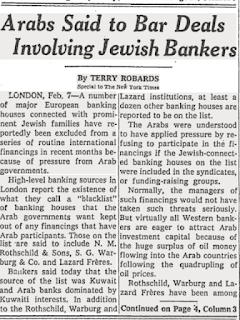
For one thing, like the Holocaust deniers, the Arab boycott was explicitly antisemitic. It demanded that companies that wanted to deal with Arab countries answer questions about
whether their owners or board members were Jewish. It blacklisted Jewish actors and performers. It extended into boycotting Jewish bankers in the 1970s. It didn't allow Jewish employees of multinational companies to set foot in their borders. Blatant antisemitism was not a good look.
Another more technical issue is that the US passed laws against the Arab boycott. The Office of Antiboycott Compliance
summarizes its goals: "These authorities discourage, and in some circumstances, prohibit U.S. companies from taking certain actions in furtherance or support of a boycott maintained by a foreign country against a country friendly to the United States (unsanctioned foreign boycott)."
US anti-boycott laws are specifically against boycotts by foreign countries. So BDS emphasizes that it is supposedly a grassroots, non-government movement, answering a call from "Palestinian civil society," to boycott Israel.
This is also why the PLO and the Palestinian Authority have not officially supported BDS, even though they encourage their own citizens to boycott Israel. (In 2018, the Central Council of the PLO did
explicitly endorse BDS, but it is unclear if that has any official standing as a government body.) If they called on the world to support BDS, then the US anti-boycott regulations would kick in and US citizens would be penalized. The state-level anti-BDS laws are meant, in part, to counter the loophole that BDS exploited to ensure the campaign does not run afoul of US laws at the national level.
For its part, the BDS movement goes out of its way to deny any connection with the Arab League boycotts,
saying "BDS activists are not acting in accordance with the Arab League boycott, which calls for boycott and divestment of any corporation doing business with or in Israel. Modern BDS campaigns take their cues directly from Palestinian civil society groups – not governments or political parties." This is directly to avoid US and possibly European sanctions.
(full article online)
Blogging about Israel and the Arab world since, oh, forever.

elderofziyon.blogspot.com