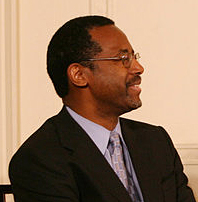
Carson's hand-eye coordination and three-dimensional reasoning skills made him a gifted surgeon.[1] After medical school, he became a neurosurgery resident at Johns Hopkins Hospital in Baltimore. Starting off as an adult neurosurgeon, Carson became more interested in pediatrics. He believed that with children, "what you see is what you get,[1] ... when theyre in pain they clearly show it with a frown on their face or when they are happy they show it by smiling brightly."
At age 33, he became the youngest major division director in Johns Hopkins history, as Director of Pediatric Neurosurgery. Carson's other surgical innovations have included the first intrauterine procedure to relieve pressure on the brain of a hydrocephalic fetal twin, and a hemispherectomy, in which a young girl suffering from uncontrollable seizures had one half of her brain removed.
In 1987, Carson made medical history by being the first surgeon to successfully separate conjoined twins (the Binder twins) who had been joined at the back of the head (craniopagus twins). The 70-member surgical team, led by Carson, worked for 22 hours. At the end, the twins were successfully separated and can now survive independently. Carson recalls:
I looked at that situation. I said, Why is it that this is such a disaster? and it was because they would always exsanguinate. They would bleed to death, and I said, There's got to be a way around that. These are modern times. This was back in 1987. I was talking to a friend of mine, who was a cardiothoracic surgeon, who was the chief of the division, and I said, You guys operate on the heart in babies, how do you keep them from exsanguinating and he says, Well, we put them in hypothermic arrest. I said, Is there any reason that if we were doing a set of Siamese twins that were joined at the head that we couldn't put them into hypothermic arrest, at the appropriate time, when we're likely to lose a lot of blood? and he said, No way . I said, Wow, this is great. Then I said, Why am I putting my time into this? I'm not going to see any Siamese twins. So I kind of forgot about it, and lo and behold, two months later, along came these doctors from Germany, presenting this case of Siamese twins. And, I was asked for my opinion, and I then began to explain the techniques that should be used, and how we would incorporate hypothermic arrest, and everybody said Wow! That sounds like it might work. And, my colleagues and I, a few of us went over to Germany. We looked at the twins. We actually put in scalp expanders, and five months later we brought them over and did the operation, and lo and behold, it worked.[2]
Carson has received numerous honors and many awards over the years, including over 61 honorary doctorate degrees. He was also a member of the American Academy of Achievement, the Horatio Alger Association of Distinguished Americans, the Alpha Omega Alpha Honor Medical Society, the Yale Corporation (the governing body of Yale University), and other prestigious organizations. He sits on many boards including the Board of Directors of Kellogg Company, Costco Wholesale Corporation, and America's Promise. He was also the president and co-founder of the Carson Scholars Fund, which recognizes young people of all backgrounds for exceptional academic and humanitarian accomplishments. In 2007, Carson was inducted into the Indiana Wesleyan University Society of World Changers and received an honorary doctorate while speaking at the university. He returned to IWU the following year when his friend, Tony Dungy, was also inducted into the society.[3] In 2006, he was awarded the Spingarn Medal from the NAACP.[4] On June 19, 2008, Carson received the Presidential Medal of Freedom from President George W. Bush. He is a recipient of the Ford's Theatre Lincoln Medal and the William E. Simon Prize for Philanthropic Leadership, and was elected to the Institute of Medicine (IOM) of the United States National Academy of Sciences.