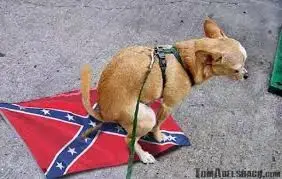
Oh and one more thing......
Secession was a legal act, hence the Southern people could not have been "Traitors". The Traitors were those in the Northern States who violated the tenth amendment to YOUR U.S. CONstitution.
LOL no secession was not legal, that is what the entire Civil War was about, only children believe it was about slavery.
But the Commander is wrong as well, first of all, traitor is a legal term and Grant pardoned all who were accused of being traitors meaning they were in effect NOT traitors.
Second of all, it is very unlikely that any graves the n@gger in the OP robbed were of Confederate soldiers. Simply having a confederate flag is not an act of betrayal of ones country.
Third of all, The stars and bars wasn't even the flag of the Confederacy, it was a Confederate Army battle flag, and anyone who has served in the military (meaning NOT Bodecea) would certainly understand why a person would honor a relative who served in the military during the Civil War regardless of which side they fought on.
OK, let us begin with YOU posting the Article within the 1787/1789 U.S. CONstitution, amendment thereto, law or statute that states that secession was, or is an unlawful or illegal act. Absent a law making an act unlawful or illegal, then an act cannot be stated to be unlawful or illegal.
Most are indoctrinated rather than educated, hence they no not the difference between the battle ensign and our Blood stained banner. But please CITE THAT LAW.
Are we now talking about as pertains to the Civil War or are we talking about the present time?
Both past and present, as there was no law then, nor has a law ever been passed to present making secession an unlawful or illegal act. Even your current SCOTUS justice Scalia could not cite that law.
Some Fred Phelps wannabe stealing Confederate battle ensigns off of Confederate soldiers graves is topical to the root problem.
Perhaps you should reread your COTUS and discover that SCOTUS rules on such matters and then realize that in 1869 they ruled that a state does NOT have the right to secede
Texas V White
Texas v. White - Wikipedia the free encyclopedia
So that certainly answers the question as to present day secessions.
Read that and admit that I am one hundred percent correct, the perhaps we can discuss pre 1869 legality of secession.
First, YOUR SCOTUS did NOT rule, they rendered an opinion concerning U.S. Bonds, NOT secession.
Second, they did NOT even cite the U.S. CONstitution, or U.S. Law in rendering that opinion concerning those bonds.
Third, YOUR SCOTUS is limited in Article III section 2......
"The judicial power shall extend to all cases, in law and equity, arising under this Constitution, the laws of the United States, and treaties made, or which shall be made."
They never cited any law under the U.S. CONstitution, they simply rendered an opinion based on assumptions, from a Constitution that was found, as they stated to be inadequate therefore replaced. Texas was never party to the Articles, nor were most of the States that seceded.
Hence they could not, nor can YOU cite that law. Absent that law, secession was a legal and lawful act, hence those States that seceded were no longer under the jurisdiction of YOUR SCOTUS. therefore any opinion rendered would be no more valid than a SCOTUS opinion concerning China.
Do you know the definition of "DICTA" ?
DICTA is.....
"
Expressions in a court's opinion that go beyond the facts before the court and therefore are individual views of the author of the opinion and not binding in subsequent cases as legal precedent."
Hence Texas v White was NOT a case concerning secession, and arguments concerning the legality of secession were not made in that case concerning U.S. Bonds. So,you see there was no legal precedent set concerning secession. The SCOTUS knew then as now that there IS NO LAW, and once a State secedes, it is beyond U.S. Jurisdiction, hence beyond SCOTUS jurisdiction to render an opinion. Texas v White is a fools use in the legality of secession.
So, again.....PLEASE CITE THE ARTICLE, AMENDMENT, or LAW that states that secession is unlawful or illegal.