The jobs destruction stems from Democrat enviro-wackos who do stupid shit like turn off the water to the entire California Central Valley destroying over 100,000 jobs instantly. Those jobs left the country & food prices rose for everyone. Higher food prices feeds inflation reducing the amount of stimulus quantitative easing the Fed can do.
That would be all great except, a) where is the data for reduced water deliveries to the central valley? b) where do you come up with 100,000 jobs c) through the recession, deflation was the issue, food prices did no rise. (unless you have something that shows that rising food prices were not reflected in the average cost of living)
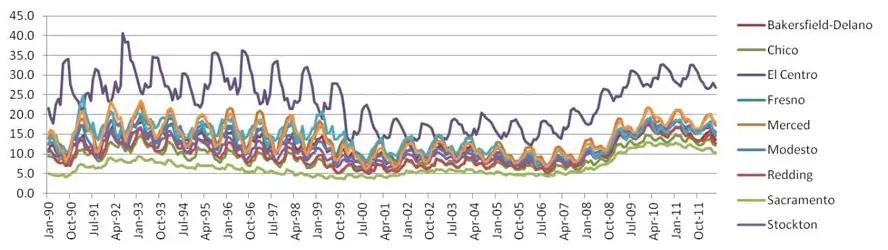
The Central Valley has always been bad. Look at the UE rates going back to 1990
I find the statement, "turn off the water to the entire California Central Valley" a bit of an exageration. And, I tend to believe that the "100,000 jobs" is also an unfounded exaggeration.
Still, the idea of reduced supply to the Central Valley increasing cost of water resulting in increased costs or decreased employment remains theoretically valid.
So here are a few notes on this idea. From what I have found, the issue begins at about May of 2009. There was, simultaneously, the following confounding issues
a) The Central Valley was severely hit by the housing bubble collapse. The FCIC report makes mention to the excitement surrounding increased housing in Fresno and other Central Valley regions during the bubble.
b) There was a drought. (Unconfirmed)
c) There was a decrease in water deliveries through the Delta. This gets all technical and requires an understanding of how the whole water delivery process works. Data is available from
Bureau of Reclamation Mid-Pacific Region
There are some 9 reports for water deliveries to the Central Valley.
Central Valley Project Diversions (Table 21)
Friant-Kern Canal Deliveries (Table 22)
Madera Canal and Millerton Lake Deliveries (Table 23)
San Joaquin River and Mendota Pool Deliveries (Table 24)
Delta-Mendota Canal Deliveries (Table 25)
San Luis and Cross Valley Canal Deliveries (Table 26)
Tehama-Colusa Canal Deliveries (Table 27)
Sacramento River Deliveries (Long-term contracts) (Table 28)
Sacramento - San Joaquin Valley - Streamflow Data (Table 29)
One issue is that, while decreased deliveries may be apparent, it isn't clear if this is due to decreased demand, reduced deliveries due to increased prices, or whether other sources were found to offset decreased deliveries due to the fish thing.
All in all, there are more sources of water to the Central Valley than just the one impacted by the whole environmental fish thing. Trying to figure out the exact impact would take some expertise. It tends to suggest that the fish thing isn't a major effect.
d) There was a national increase in unemployment as a result of the national recession.
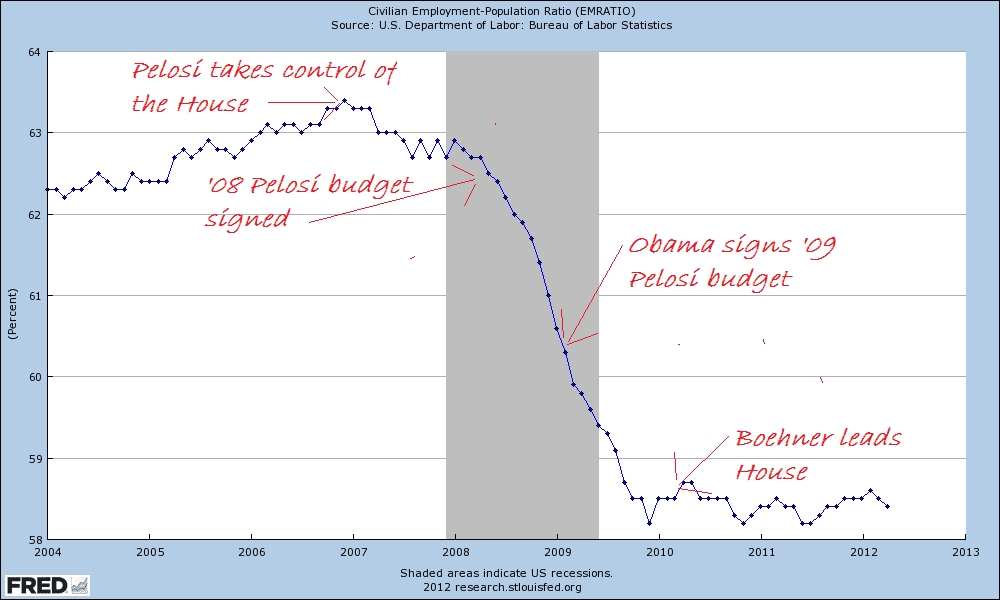
e) National unemployment peaked in October of '09. From the graph, the majority of the central valley peaked close to the same time, with El Centro peaking much later.
f) Increased food prices (unconfirmed and frankly confounded by the next issue.)
g) Fed management of core inflation to a yearly target, at 1.5% for 2010. So, in the final measure, there doesn't seem to have been an increase in food prices. Perhaps digging into the details and seeing if food prices increased disproportionally to other things might be a useful consideration.
h) Deflation had ended by Jan '09. CPI inflation was at target, on a yearly basis, since. On a monthly basis, it spiked in Jun '09. It also peaked at a monthly annulized rate of 12.4% in march '11. In between, it was well within the target range. At best, that single Jun '09 spike, to 10.8% monthy annualized rate has potential. But then we have it returning to normal up to the March '11 spike which then suggests that the Jun '09 spike was simply coincidental. There is no clear increase in unemployment in the Central Valley that seperates the decrease in water supply from the national housing bubble collapse.
So there are a few considerations.
Basically, the cascade of causal events would be;
The central valley housing collapse was part of the national housing bubble collapse. These drove national unemployment and reduced demand. Locally, the central valley housing collapse drove central valley unemployment. Then, simultaneously, we have the drought and decreased deliveries further depressing the local economy of the central valley. This, then, helps to drive increased food prices which further exacerbate the economic conditions. In the mean time, the Fed is actively managing inflation to keep it on target.
It is a bit difficult to differentiate the final magnitude on the national economy when there is a cascade of multiple causal conditions on a point issue.
This point, "Higher food prices feeds inflation reducing the amount of stimulus quantitative easing the Fed can do." is interesting, even academically. I am not convinced it is true. The idea of increasing the money supply is that the increase in M goes towards increasing Q. If the mechanism exists, that by increasing M, Q will increase, then a shortage in food supply, along with increased prices would be seperate. It would seem, simply, that a larger increase in M would be necessary to offset the effective losses.
Obviously, how much P and Q increase due to an increase in M is a matter of proportions, depending upon the state of the economy. An increase in M doesn't all go towards one or the other. Still, in general, under our oversimplified theory, I am not left with the impression that "inflation reducing the amount of stimulus quantitative easing the Fed can do" is a major factor.
From a national standpoint, a decline in production in Ca would be picked up by an increase in production elsewhere. Agriculture has been highly efficient and shortages are not an issue. I wouldn't expect that we would see a major decline in quanity in the details of the GDP accounting. If, in fact, there was an effect, at most, we would see an increase in relative pricing of food to other products, a shifting of money from other products to food products. Then, the increase in money supply would go towards stimulating other production activity which is well below full output due to a lack of labor utilization.
The idea is reasonable, in theory. The problem is that it comes down to a matter of magnitudes of effects carrying through a cascade of causal relationships that are confounded by other simultaneous events. In practice, this tends to make the final effect far less.