
The Second Punic War is well known, for the skill of Hannibal, and his crossing the Alps in winter with a herd of elephants. It was waged from 218-201 BC.
Many people have heard of Cannae, one of the most devastating military defeats in world history. This battle, and the tactics of Hannibal, has been taught at military colleges for millenia.
But the year before Cannae, in 217, was the Battle of Lake Trasimene, another overwhelming defeat of the Romans, and this set the precedent for something new, the annihilation of your enemy in a pitched battle, which was not the norm. Most battles broke off with survivors fleeing and regrouping.
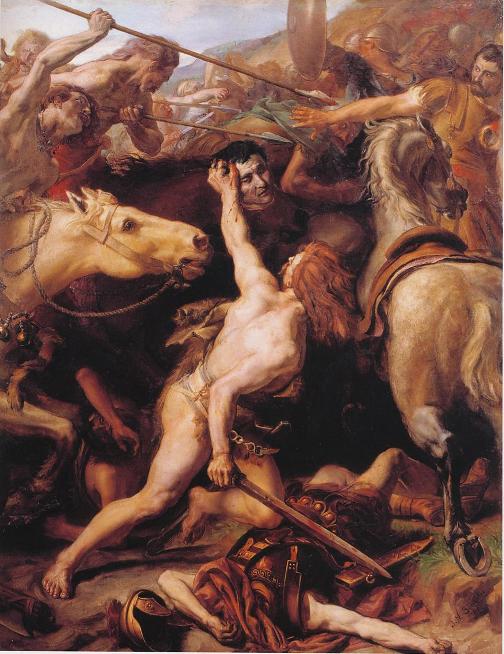
The following spring, the Romans positioned an army on each side of the Apennine Mountains, but were surprised when a Carthaginian army more than 50,000 strong crossed the range by a difficult but unguarded route. The Carthaginians moved south into Etruria, plundering, razing the villages and killing all men encountered. Flaminius, in charge of the nearest Roman army, set off in pursuit. Hannibal arranged an ambush on the north shore of Lake Trasimene and trapped the Romans.
With the Carthaginians attacking unexpectedly from the flank and the rear, possibly in poor visibility, there was no chance for the Romans to form even a rudimentary fighting line and they were defeated after three hours of hard fighting with 15,000 being killed. The trap failed to enclose the 6,000 Romans at the front of the column, who escaped; later in the day they were surrounded by pursuing Carthaginians and surrendered.
Thus nearly all 25,000 Romans in Flaminius's army were killed or captured. This destruction of an entire army as a result of an ambush by another army is widely considered a unique occurrence. Several days later the Carthaginians wiped out the entire cavalry force of the second Roman army, who were not yet aware of the earlier disaster.
The Carthaginians then marched towards southern Italy in the hope of winning over some of the ethnic Greek and Italic city-states there. News of the defeat caused a panic in Rome and led to the election of Quintus Fabius Maximus Verrucosus as dictator. Impatient with his Fabian strategy of avoiding major battles, the next year the Romans elected Lucius Paullus and Gaius Varro as consuls. These more aggressive commanders engaged Hannibal at the Battle of Cannae in 216 BC, resulting in a third and even worse disaster for Rome; it was followed by thirteen more years of war.
 en.wikipedia.org
Many people have heard of Cannae, one of the most devastating military defeats in world history. This battle, and the tactics of Hannibal, has been taught at military colleges for millenia.
But the year before Cannae, in 217, was the Battle of Lake Trasimene, another overwhelming defeat of the Romans, and this set the precedent for something new, the annihilation of your enemy in a pitched battle, which was not the norm. Most battles broke off with survivors fleeing and regrouping.
The following spring, the Romans positioned an army on each side of the Apennine Mountains, but were surprised when a Carthaginian army more than 50,000 strong crossed the range by a difficult but unguarded route. The Carthaginians moved south into Etruria, plundering, razing the villages and killing all men encountered. Flaminius, in charge of the nearest Roman army, set off in pursuit. Hannibal arranged an ambush on the north shore of Lake Trasimene and trapped the Romans.
With the Carthaginians attacking unexpectedly from the flank and the rear, possibly in poor visibility, there was no chance for the Romans to form even a rudimentary fighting line and they were defeated after three hours of hard fighting with 15,000 being killed. The trap failed to enclose the 6,000 Romans at the front of the column, who escaped; later in the day they were surrounded by pursuing Carthaginians and surrendered.
Thus nearly all 25,000 Romans in Flaminius's army were killed or captured. This destruction of an entire army as a result of an ambush by another army is widely considered a unique occurrence. Several days later the Carthaginians wiped out the entire cavalry force of the second Roman army, who were not yet aware of the earlier disaster.
The Carthaginians then marched towards southern Italy in the hope of winning over some of the ethnic Greek and Italic city-states there. News of the defeat caused a panic in Rome and led to the election of Quintus Fabius Maximus Verrucosus as dictator. Impatient with his Fabian strategy of avoiding major battles, the next year the Romans elected Lucius Paullus and Gaius Varro as consuls. These more aggressive commanders engaged Hannibal at the Battle of Cannae in 216 BC, resulting in a third and even worse disaster for Rome; it was followed by thirteen more years of war.


