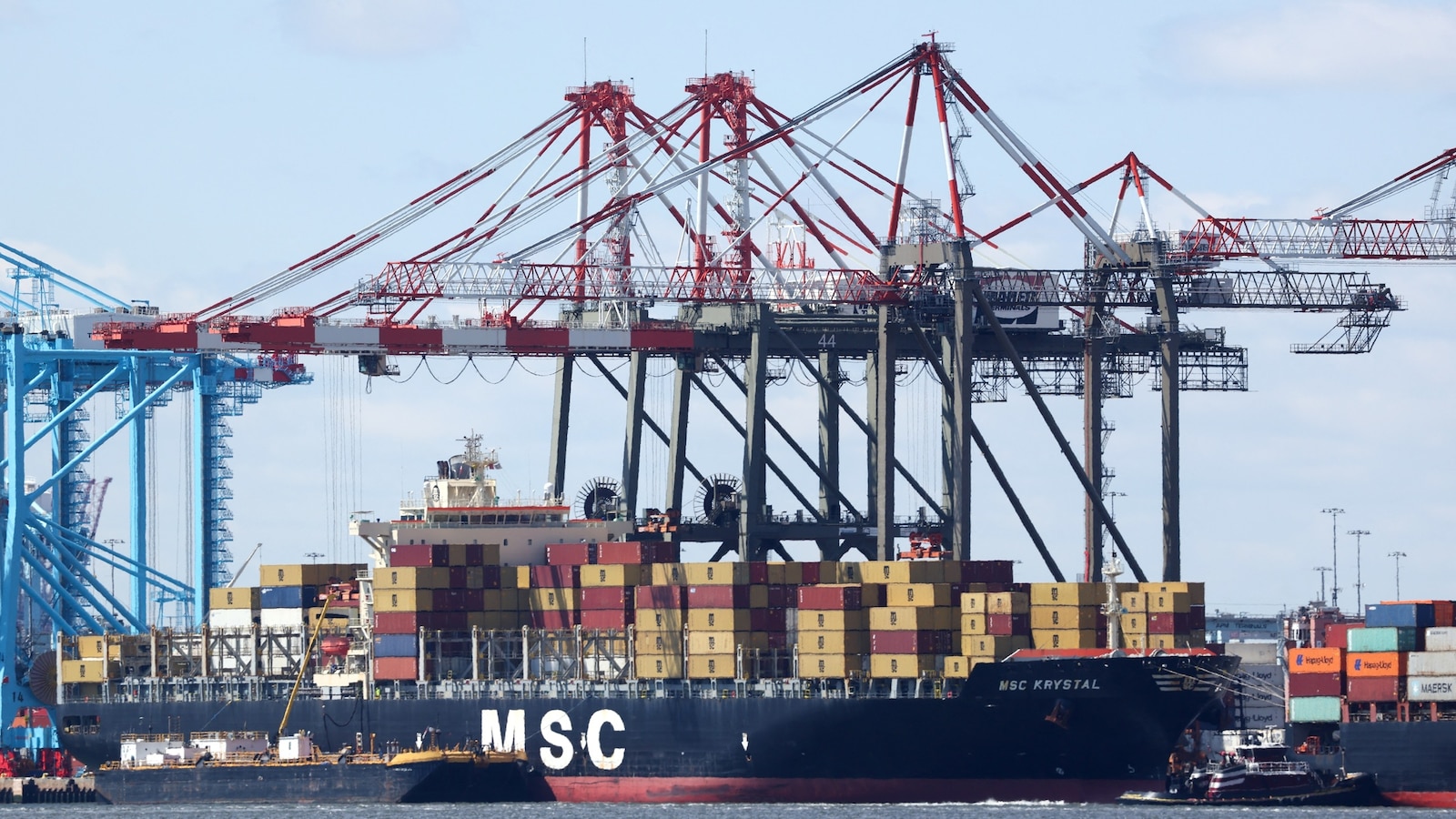
Are tariffs to blame for nearly 40% spike in wholesale vegetable prices? Experts weigh in

Bananas are grown in many places in the United States; from Wikki:
"

Current production​

Hawaii is by far the largest banana producer in the United States, followed by Florida. Banana plantation in Hawaii has followed a descending trend, from 29 million pounds (13 thousand long tons; 15 thousand short tons)<a href="Banana production in the United States - Wikipedia"><span>[</span>2<span>]</span></a> in 2000 to 17.8 million pounds (7.9 thousand long tons; 8.9 thousand short tons) in 2010,<a href="Banana production in the United States - Wikipedia"><span>[</span>3<span>]</span></a> and 4.7 million pounds (2.1 thousand long tons; 2.4 thousand short tons) in 2023.<a href="Banana production in the United States - Wikipedia"><span>[</span>4<span>]</span></a> Hawaii produces mainly the conventional Cavendish assortment and the Hawaiian apple banana, which are sold in the local markets due to high employment and land expenses. The chief US banana exporter is Florida, which produces mostly Thai and cooking bananas (Bluggoe type). In addition, US banana producers are looking for opportunities in the organic and specialty segments of the banana market in Florida, Texas, California, Mississippi, Alabama, South Carolina, and Georgia.<a href="Banana production in the United States - Wikipedia"><span>[</span>5<span>]</span></a> Banana cultivation in Florida has been about 500 acres, valued at roughly 2 million US dollars.<a href="Banana production in the United States - Wikipedia"><span>[</span>5<span>]</span></a>

Other states that remain popular locations for independent banana farming, which usually only export on a highly domestic level, are Georgia, Louisiana, Mississippi, Arkansas, Texas, Oklahoma, Alabama, South Carolina, North Carolina, Virginia, Arizona, and California. These states produce a variety depending on the region, including Cavendish, Bluggoe, Ice Cream, Goldfinger, Lady Finger, Red Dacca, Latundan, Pisano Awak, and Balbisinia subtypes.

Independent banana cultivation in the United States is diverse, with some areas of the country able to sustain fields of a wide variety of banana trees perennially or near-perennially, similar to a plantation system. This is most notable (outside of Florida and Hawaii) in Texas, Louisiana, California, Arizona, Mississippi, Georgia, Alabama, South Carolina, and coastal North Carolina. In other areas of the country (northern Arkansas, southern Missouri, mountain Tennessee, southern Kansas, the far southern Midwest and along the Ohio River, Kentucky, and Virginia,) containing a climate similar to that of the banana growing region of inland south-central and eastern China (Sichuan, Anhui, Zhejiang, Hubei, Jiangsu, Henan, Jiangxi, Hunan, Chongqing, and Guizhou provinces,) banana cultivation is more seasonal.

Bananas are also grown commercially in Puerto Rico,<a href="Banana production in the United States - Wikipedia"><span>[</span>6<span>]</span></a> Guam, and American Samoa.<a href="Banana production in the United States - Wikipedia"><span>[</span>7<span>]</span></a>"
 
Bananas are grown in many places in the United States; from Wikki:
"

Current production​

Hawaii is by far the largest banana producer in the United States, followed by Florida. Banana plantation in Hawaii has followed a descending trend, from 29 million pounds (13 thousand long tons; 15 thousand short tons)<a href="Banana production in the United States - Wikipedia"><span>[</span>2<span>]</span></a> in 2000 to 17.8 million pounds (7.9 thousand long tons; 8.9 thousand short tons) in 2010,<a href="Banana production in the United States - Wikipedia"><span>[</span>3<span>]</span></a> and 4.7 million pounds (2.1 thousand long tons; 2.4 thousand short tons) in 2023.<a href="Banana production in the United States - Wikipedia"><span>[</span>4<span>]</span></a> Hawaii produces mainly the conventional Cavendish assortment and the Hawaiian apple banana, which are sold in the local markets due to high employment and land expenses. The chief US banana exporter is Florida, which produces mostly Thai and cooking bananas (Bluggoe type). In addition, US banana producers are looking for opportunities in the organic and specialty segments of the banana market in Florida, Texas, California, Mississippi, Alabama, South Carolina, and Georgia.<a href="Banana production in the United States - Wikipedia"><span>[</span>5<span>]</span></a> Banana cultivation in Florida has been about 500 acres, valued at roughly 2 million US dollars.<a href="Banana production in the United States - Wikipedia"><span>[</span>5<span>]</span></a>

Other states that remain popular locations for independent banana farming, which usually only export on a highly domestic level, are Georgia, Louisiana, Mississippi, Arkansas, Texas, Oklahoma, Alabama, South Carolina, North Carolina, Virginia, Arizona, and California. These states produce a variety depending on the region, including Cavendish, Bluggoe, Ice Cream, Goldfinger, Lady Finger, Red Dacca, Latundan, Pisano Awak, and Balbisinia subtypes.

Independent banana cultivation in the United States is diverse, with some areas of the country able to sustain fields of a wide variety of banana trees perennially or near-perennially, similar to a plantation system. This is most notable (outside of Florida and Hawaii) in Texas, Louisiana, California, Arizona, Mississippi, Georgia, Alabama, South Carolina, and coastal North Carolina. In other areas of the country (northern Arkansas, southern Missouri, mountain Tennessee, southern Kansas, the far southern Midwest and along the Ohio River, Kentucky, and Virginia,) containing a climate similar to that of the banana growing region of inland south-central and eastern China (Sichuan, Anhui, Zhejiang, Hubei, Jiangsu, Henan, Jiangxi, Hunan, Chongqing, and Guizhou provinces,) banana cultivation is more seasonal.

Bananas are also grown commercially in Puerto Rico,<a href="Banana production in the United States - Wikipedia"><span>[</span>6<span>]</span></a> Guam, and American Samoa.<a href="Banana production in the United States - Wikipedia"><span>[</span>7<span>]</span></a>"
You didn't read your source every well. That is a drop in the bucket compared to those imported.
 
What it says on the tin. Wholesale vegetables rose 40% in July. Whats the cause?

Are tariffs to blame for nearly 40% spike in wholesale vegetable prices? Experts weigh in​

Wholesale prices soared much faster than economists expected last month, stoking concern among some economists about an eventual pass through to consumer prices.

The fresh government data this week showed an eye-popping 38% surge in the wholesale price of vegetables in July, the biggest price spike for any product category. A continued rise of that magnitude could noticeably hike vegetable prices at restaurants and grocery stores within a matter of months, some analysts told ABC News.

The latest report came as consumers await a possible burst of inflation as President Donald Trump's tariffs take hold. Importers typically offset the tax burden in the form of higher prices for shoppers, though so far tariff-induced price increases have proven marginal.

When asked about whether the jump in vegetable prices had resulted from tariffs, analysts shrugged. Wholesale vegetable prices often fluctuate from month to month, they said, pointing to an array of possible explanations that includes adverse weather, supply chain blockages and tariff-induced cost increases.

"People are really curious about when tariffs are likely to have consequences for consumers. We're all keeping an eye out," Parke Wilde, a food economist at Tufts University, told ABC news. "But I don't want to jump the gun based on one segment of one index."


The U.S. imports more than a third of its fresh vegetables, according to U.S. Department of Agriculture data released in January. A product category made up of such a sizable chunk of imports is vulnerable to tariff-induced wholesale price increases, some analysts said.

Importers of perishable foods like vegetables face an especially acute challenge because they cannot stockpile products ahead of tariffs, since the fresh produce would rot. Toy or apparel retailers, by contrast, could fill warehouses with products imported at pre-tariff rates.

"This could be the impact of tariffs," David Ortega, a food economist at Michigan State University, told ABC News. "But it could be a whole host of things."

Sweetgreen, a restaurant chain that primarily sells salads and grain bowls, earlier this month faulted tariffs in part for a 3.6 percentage-point decline in restaurant-level profit over three months ending in June, when compared to the same period a year earlier.

Still, analysts said, the spike in wholesale prices may be the result of factors unrelated to tariffs.
The reason why many Americans and British pay more for fruit and vegetables is because the lazy buggers won't grow the stuff in their gardens. So they are are held to ransom with the current supply chain. So as soon as theres bad weather, tariffs, energy costs etc.. the lazy buggers have only themselves to blame. Anyone who can't be arsed to grow their own fruit and veg, go to a local market that does.
 
Probably because we aren't using slave labor to pick our produce anymore.
That's a good possibility...... It will be painful up front like any addiction recovery is but will have major benefits on the back end.
 
Back
Top Bottom