Okay - so finally, here is the payoff.
If you've been wondering why I'm showing you all this....
The short answer is : PHASE CODING.
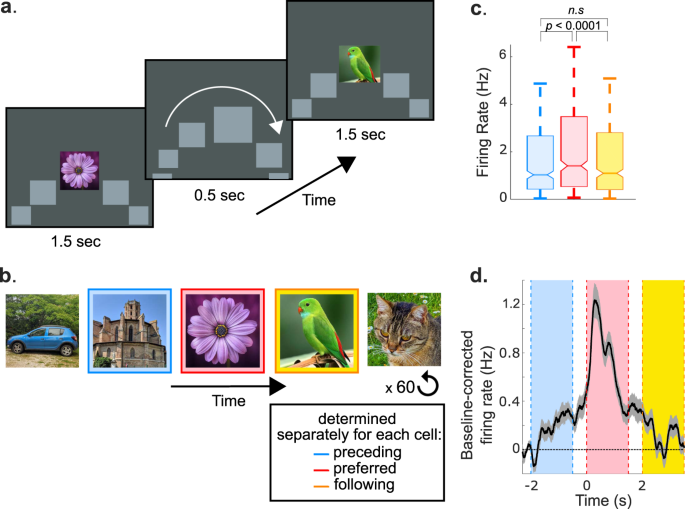
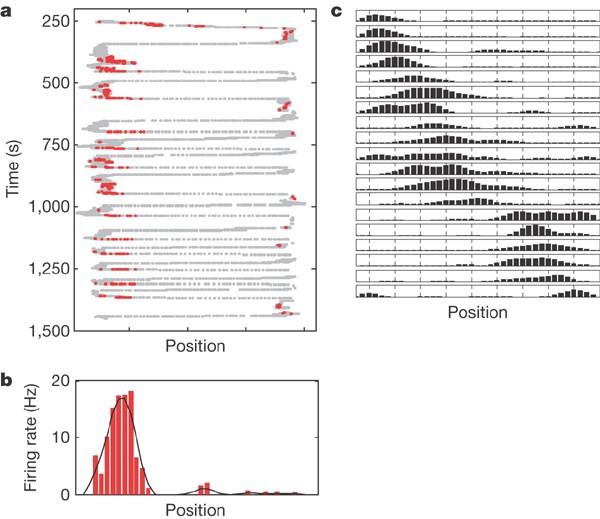
So far, we have one excellent example of this in human beings, in the hippocampus of the human brain - where we find the phase encoded "place cells". Here are some references (pay attention to the pics):
Previous work has shown that in rodents phase precession – the phase of action potentials relative to the theta oscillation – is associated with the representation of sequential locations. Here the authors demonstrate that phase precession also occurs in the human hippocampus using single neuron...

www.nature.com
And hey, "it may be a more general strategy". Well duh.
In the hippocampus, oscillations in the theta and gamma frequency range occur together and interact in several ways, indicating that they are part of a common functional system. It is argued that these oscillations form a coding scheme that is used in the hippocampus to organize the readout from...

pubmed.ncbi.nlm.nih.gov
Here is some math:
Neural codes have been postulated to build efficient representations of the external world. The hippocampus, an encoding system, employs neuronal firing rates and spike phases to encode external space. Although the biophysical origin of such codes is ...

www.ncbi.nlm.nih.gov
So now, earlier I posed the question of how we relate which cause to which effect. Now that you've seen the Hawaiian earring, you should be able to make a pretty good guess. Because "which cause" is encoded in the synthetic dimension we talked about. It is simply the X coordinate in the earring pic.
This information can be phase encoded into the firing pattern of a SINGLE NEURON. And in a complex system with a lot of detail, all you need is more neurons. This way, the "location" of a nerve impulse is mapped to one of the cycles in the earring. It literally becomes as simple as a retina. You have causes on the X axis, and the timing of effects on Y.
Such a system can SELF ORGANIZE in exactly the same way the visual system does. Strict timing is not necessary - the system will learn for itself (the relationship between causes and effects). This is where the Hamiltonian comes in, and why I spent time showing you the Ising model. It's physics, nothing more. Statistical mechanics. The same Boltzmann distribution you find in a cloud of gas.
This is how single cells "adapt" to their environment. Where we see this especially, is in the immune system, and the brain. Nobel laureate Gerald Edelman was the first to make the connection. He pointed out, that the mechanisms are one and the same. (And that was long before biologists knew anything about Peano spaces).
One of the key elements of proof, is that we do in fact see sequences being played BACKWARDS in the hippocampus - a sure sign that the cyclic one point compactification is occurring.
During sleep, neurons in the rat hippocampus are known to replay sequences of activity that took place when the rat was awake. A new study, in rats running around a track, eating and grooming, shows that replay also occurs repeatedly during the awake state, and that behavioural sequences are...
www.nature.com
One of the key researchers in this field is Michael Hasselmo at Boston University.
Behaviors ranging from delivering newspapers to waiting tables depend on remembering previous episodes to avoid incorrect repetition. Physiologically, this requires mechanisms for long-term storage and selective retrieval of episodes based on the time of occurrence, despite variable intervals...
pubmed.ncbi.nlm.nih.gov
He's not a physicist - yet. But he's becoming one. It's inevitable, once you start studying this stuff.
All life is physics. Even consciousness. There's nothing magical about it, it's straightforward topology based on the fundamental symmetries of nature.
To show that it is indeed a ubiquitous mechanism, one need merely look around.
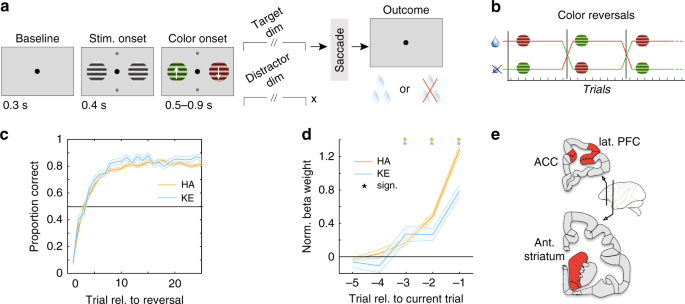
Here it is, happening on the motor side:
The average spiking frequency in the fronto-striatal network encodes multiple types of learning-relevant information. Here, the authors show that populations of neurons in non-human primates also carry significant information in their phase-of-firing when learning-relevant outcomes are processed.
www.nature.com
Here it is from a memory perspective
Here it is in bats
Here it is in the eye movements of goldfish
Monocular organization of the goldfish horizontal neural integrator was studied during spontaneous scanning saccadic and fixation behaviors. Analysis of neuronal firing rates revealed a population of ipsilateral (37%), conjugate (59%), and contralateral ...
www.ncbi.nlm.nih.gov
So far we have it in every life form ever studied, even the lowly sea snail Aplysia discussed earlier.
So now the question becomes, why this mechanism, and not some other?
The answer, oddly enough, comes from AI and quantum computing. The answer is, that phase coding can easily distinguish novel information in related memories, whereas other methods can not. With most AI, changing a single pixel is enough to fool the system. But with phase encoding, the information is reliably stored and retrieved.
A regular rhythm is not necessary for phase coding. Studied in the rat hippocampus have shown clearly that information can be reliably encoded by the local field potential only - which is why it works in single cells. Because that's what you find along the cell membrane of every living cell - local field potentials.
An example comes from honeybees - where local oscillations are generated by... you guessed it... microtubules! The very same microtubules responsible for motility and cell division.
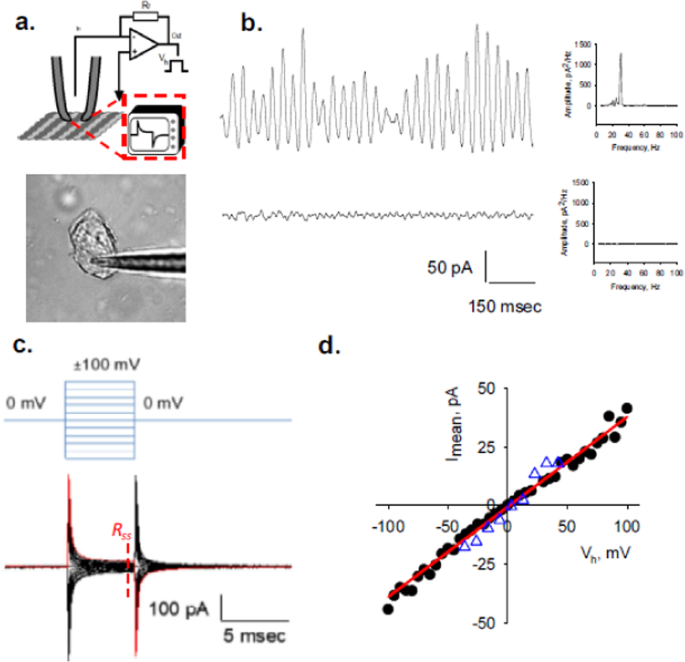
Microtubules (MTs) are important structures of the cytoskeleton in neurons. Mammalian brain MTs act as biomolecular transistors that generate highly synchronous electrical oscillations. However, their role in brain function is largely unknown. To gain ...
www.ncbi.nlm.nih.gov
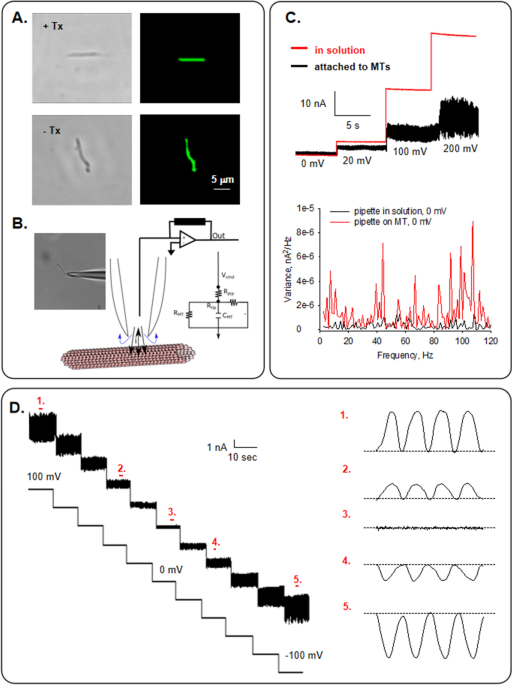
They're only just now starting to study this at a deeper level. Here for instance are some biophysical properties outside of the cellular context:
This study examines the electrical properties of isolated brain microtubules (MTs), which are long hollow cylinders assembled from αβ-tubulin dimers that form cytoskeletal structures engaged in several functions. MTs are implicated in sensory functions in cilia and flagella and cellular...
www.nature.com
Are cells conscious? The answer is not only yes, but hell yes!
The reason brains are conscious, is because the cells themselves are conscious. They are in fact self aware. And this awareness is physical, it comes from the electrical characteristics of the molecules that make up the cell.