Now - compare to MY definition, which is mechanistic.
1. Egocentric reference frame
2. Stateful memory that spans t=0
3. (Continuous) sensory and motor activity around the span.
This is a PHYSICAL definition, it applies equally to any organism, and even an AI or robot. It is independent of the underlying mechanism, whether it new neurons, optics, computer chips, or rocks in a magnetic field.
Each of these three requirements is NECESSARY for "subjective experience", whether you call it feeling, perception, awareness, consciousness,nor anything else.
Number 1, the egocentric reference frame - we just about understand how our brains do that now. We're not quite fully there yet, but we understand "enough" to grasp how it's done. The egocentric frame is RECIPROCAL to physical time - instead of time ticking linearly like a clock, it instead flows "through" the organism. That is why sentient entities have "future" and "past".
Number 2 - stateful memory that spans t=0. I define t=0 as "now, the current moment". Thus, my definition is DIFFERENT FROM the physicist who place t=0 at the big bang or the beginning of the universe. In my definition, the origin of the reference frame is always "now, the current moment". Therefore, this is a MOVING frame, it moves along with physical time, and suddenly concepts like dT/dt start to make a lot of sense.
Number 3 - sensory and motor activity that is continuous within the span - which means specifically IN THE LIMIT AS dt => 0. This in my view is the key requirement. It is a statement about topology. It works this way:
a. Every sensory and motor activity has a DELAY associated with it. In the case of neurons, it might be the time it takes for a nerve impulse to travel down the axon (so, some number of milli-seconds). Whereas in a digital computer, the delay might be very short, maybe the time it takes for current to flow through a wire (with a short wire, maybe nanoseconds). Either way, there is a measurable delay.
b. This means, in any sensory and motor device, there is a SINGULARITY, in a small region around "now". Our brains can never know what's happening "exactly now", because of the delays. For example in our visual system, it takes 50 msec for the visual signal to get from the retina to the visual cortex. (You can see this in the VEP = visual evoked potential). Similarly, there is a 50 msec delay between when the brain commands and when the muscle contracts. So in humans, this singularity (this "gap") is actually quite large, it might be 100 msec or so.
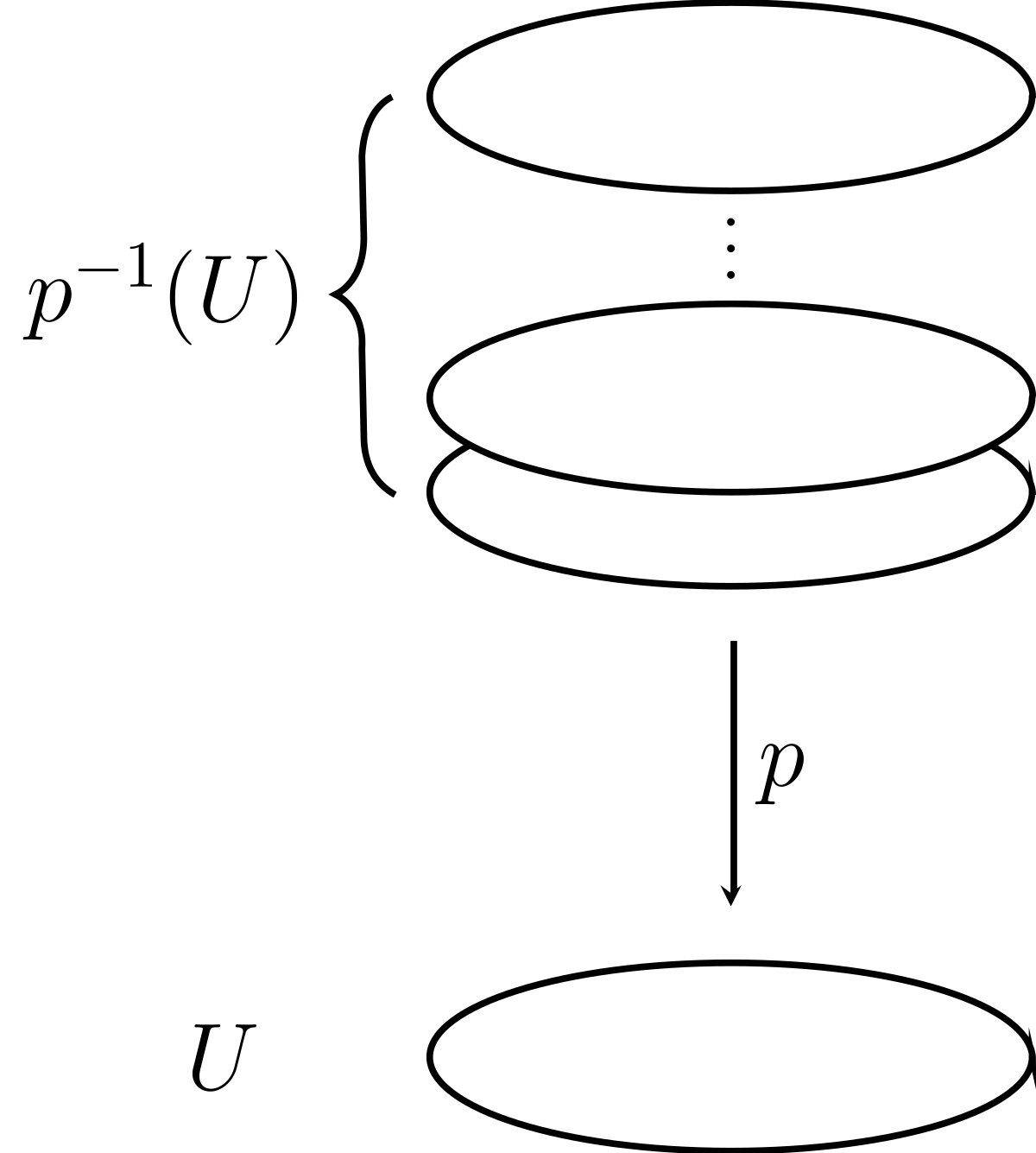
c. The requirement for continuity says the stateful memory must "cover" the singularity, in the topological sense. The easiest way to understand this is a stack of pancakes (called the Lebesgue pancakes by topologists). The concept looks like this and is explained quite nicely in the Wiki.

en.wikipedia.org
In a biological system, the pancakes are not perfectly centered, they are "staggered" because of stochastic delays associated with the opening and closing of ion channels.
Each pancake is its own little patch of the egocentric reference frame, which is assembled exactly the same way it is in the hippocampus of rats, cats, monkeys, and human beings. Even goldfish, have this exact same architecture. It is highly conserved in evolution, it hasn't changed in a hundred million years.
This architecture does something magical to the information flowing through the egocentric reference frame, because it is self-similar ("fractal") at any and every resolution. This is what links distant memories and plans to "dt".
dt is used in the same way as in calculus, it is the smallest discernible interval of physical time, which in a human nerve network is very small indeed, it's considerably less than a microsecond and maybe even approaches a nanosecond. (Because you have 100 billion neurons covering the singularity).
"Sensation" arises because of scale invariance. It has to do with the breaking of symmetry around the singularity.
So you see, this definition is very precise and it is experimentally accessible.