
Doc7505
Diamond Member
- Feb 16, 2016
- 24,303
- 43,214
- 2,430
Antares Mark-0 Becomes First Advanced Nuclear Reactor to Achieve Criticality Under DOE Pilot Program
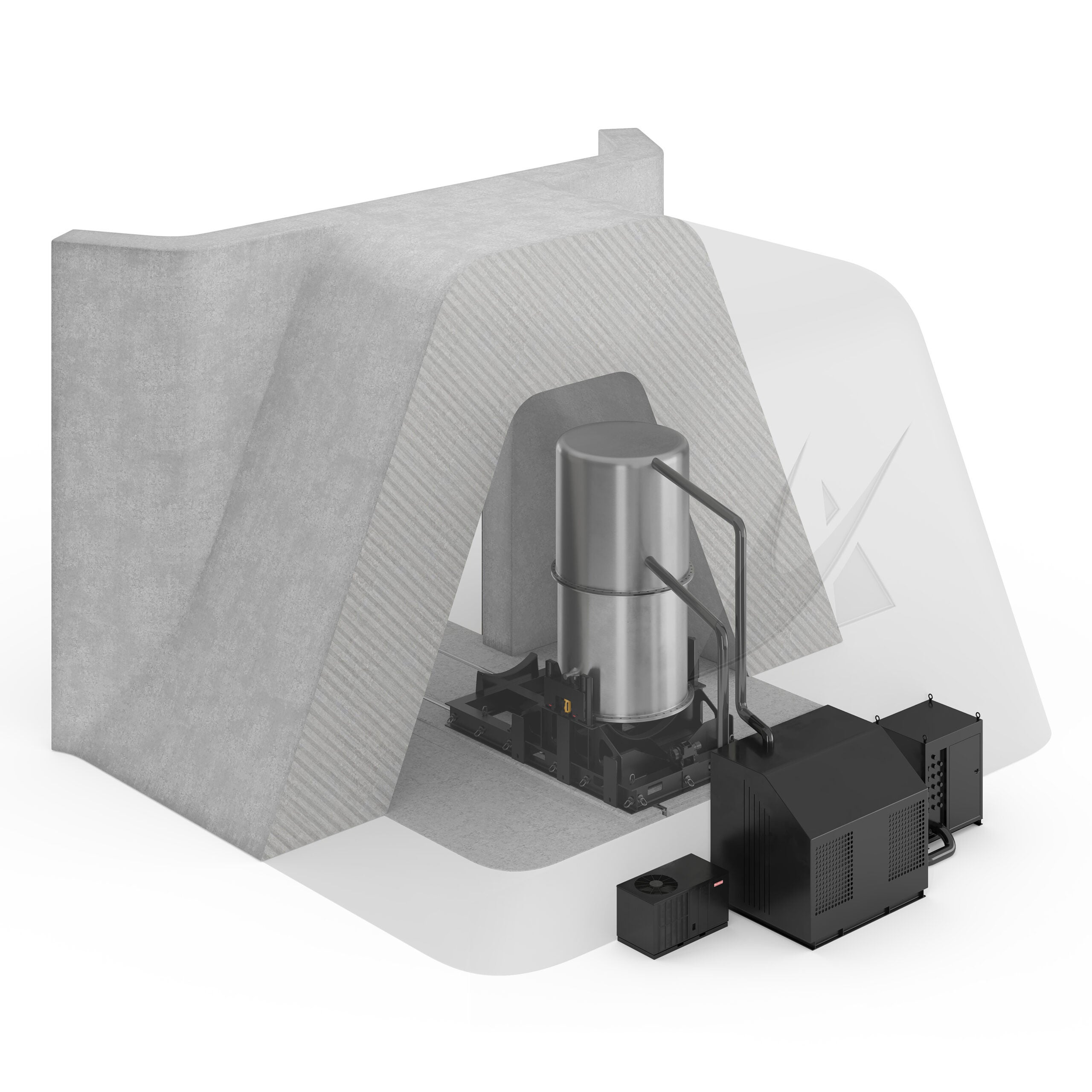
Antares Mark-0 Becomes First Advanced Nuclear Reactor to Achieve Criticality Under DOE Pilot Program
Antares Nuclear Inc.'s Mark-0—a sodium heat-pipe-cooled microreactor fueled by high-assay low-enriched uranium (HALEU) tri-structural isotropic (TRISO)
 www.powermag.com
Antares Nuclear Inc.’s Mark-0—a sodium heat-pipe-cooled microreactor fueled by high-assay low-enriched uranium (HALEU) tri-structural isotropic (TRISO) fuel compacts—has achieved zero-power criticality at Idaho National Laboratory’s (INL’s) Reactor and Critical Experiment (RACE) facility, becoming the first advanced reactor to reach that milestone under the Department of Energy’s (DOE’s) Reactor Pilot Program.
The development, announced on June 4, also marks the 53rd reactor built at the INL site since 1951 and the first novel reactor design to achieve criticality at the laboratory in more than 50 years, according to INL Laboratory Director John Wagner. The much-watched DOE Reactor Pilot Program, established under President Trump’s May 2025 Executive Order 14301, directs the DOE to accelerate reactor testing and to target at least three advanced-reactor criticalities by July 4, 2026.
“Criticality is the condition at which a nuclear fission chain reaction becomes self-sustaining,” Wagner explained in a LinkedIn post. “What Antares achieved is specifically zero-power criticality—the chain reaction was sustained at essentially no measurable energy output. This is not electricity generation. It is not full-power operation. It is proof that the system works: the scientific and engineering validation that every subsequent step depends on,” he wrote. “That distinction matters for context. It should not diminish what happened.”
~Snip~
Following reactor physics experiments, Antares will execute “the next phase of our road-map—sustained electricity production,” Bramble said. Antares is “able to move fast towards this milestone because we’ve already completed over 6 months of full-power thermal testing in an electrical prototype. We will perform version 2.0 of this in 2026. This is an easier, more iterative way to test, because there is no regulatory process, and you can disassemble to examine material effects.”
~Snip~
The work is crucial to feed development of its commercial product, the R1 microreactor, a modular, transportable unit rated at 100 kWe to 1-MWe, designed to operate for six or more years between refueling without connection to the commercial grid. The R1 is slated to use a TRISO-fueled prismatic graphite core, passive sodium heat pipes for primary heat transport, a fin-and-tube primary heat exchanger, and a simple recuperated nitrogen-closed Brayton cycle for power conversion operating at less than 300 psi. As pivotally, Antares has designed the system to ship in an integrated transport cradle that includes shielding, and to condition electricity through a power management and distribution node designed to connect directly to installation microgrids. Antares suggests the architecture is optimized for reliability, uptime, and manufacturability rather than maximum power density.
Commentary:
The dream is to be capable of manufacturing small safe reactors to generate electricity throughout the U.S.
The Antares project is just one of the systems under consideration. Other systems are attempting to use Thorium-232.
More than likely I will not see this happen in my life time,


