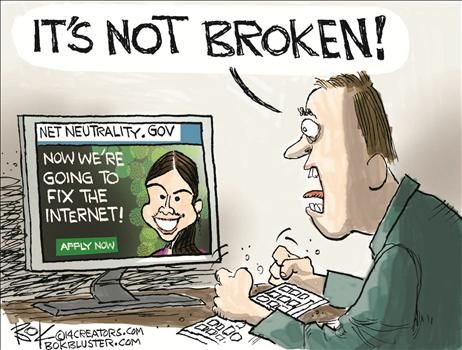
In today's WSJ
Read this and get an education. Cruz's comment is mentioned in the 3rd paragraph below:
"What a Tangled Web Obama Weaves"
By
L. GORDON CROVITZ
Nov. 16, 2014 6:22 p.m. ET
Al Gore didn’t invent the Internet, but Bill Clinton deserves credit for the most important Internet policy: a bipartisan consensus reached during his administration in the mid-1990s to keep the Internet free of regulation. The Web would be permissionless, so that innovators could start sites and other digital offerings without waiting for regulatory approval.
In a surprise speech last week, President Obama demanded the end of the unregulated Internet, ratcheting up his campaign to subject the Internet to century-old regulations written to micromanage public utilities. Mr. Obama pressured the Federal Communications Commission to reclassify the Internet under Title II of the Communications Act of 1934, which was based on railroad regulations from the 1880s and used to oversee
AT&T when it was a telephone monopoly. Regulators set prices, terms and conditions and must approve new products.
Mr. Obama says Internet service providers will “limit your access to a website” without Title II oversight. Pro-regulation lobbyists have made this argument from the beginning of the Web—and every year are proven more wrong. The Internet boomed precisely because it wasn’t regulated. In 1999 the FCC published a paper titled “The FCC and the Unregulation of the Internet.” The study contrasted the dramatic growth of the open Internet with that of the sluggish industries subject to Title II’s more than 1,000 regulations. Sen.
Ted Cruz got it right last week when he tweeted that Title II would be ObamaCare for the Internet.
Amazing as it seems, under these regulations federal bureaucrats in the 1970s decided whether AT&T could move beyond standard black telephones to offer Princess phones in pink, blue and white. A Title II Internet would give regulators similar authority to approve, prioritize and set “just and reasonable” prices for broadband, the lifeblood of the Internet.
When
Apple first offered Internet access on the iPhone,
Steve Jobs didn’t have to ask regulators for permission. Instead of network operators prioritizing traffic based on technical optimization, as they do today, under Title II regulators would prioritize streaming video from
Netflix , pornographers or church services. Title II would invalidate “nonneutral” practices such as
T-Mobile offering mobile phones with free music. Surgeons operating remotely via robotic systems may no longer have access to a latency-free (no lag time) connection to the Internet.
Title II regulation would also be a hidden tax increase: Broadband consumers would pay the 16.1% tax on interstate revenues under the Universal Service Fund. State utility commissioners would also get oversight of the Internet.
Mr. Obama claims that regulators can always “forbear” from the more onerous regulations of Title II. But the nature of regulators is to regulate, not to forbear. And as FCC Commissioner Michael O’Rielly explained at a Free State Foundation policy seminar last week, regulators can’t forbear even if they want to. The law, he said, sets the “bar so high for forbearance that it is nearly impossible to meet, especially when the Commission deals with core common carrier provisions on a nationwide basis,” as with the Internet.
Title II wouldn’t even get net-neutrality advocates what they say they want. They object to “paid prioritization” by Netflix and YouTube, which at peak times account for more than half the broadband capacity in the U.S. These bandwidth hogs couldn’t function without fast lanes on the Internet. They invest in huge networks of computer servers in many data centers to ensure smooth delivery of their content. Title II would bless these different tiers of service.
Everyone agrees that broadband providers should not discriminate based on the content of a website or other digital service, but broadband providers already pledge to their users that they won’t discriminate. If they did, regulators can enforce this version of “neutrality” without the draconian Title II by prohibiting “commercially unreasonable” network management practices.
FCC Chairman Tom Wheeler, who was appointed by Mr. Obama last year, knows that Title II would be a disaster for the Internet. He has never supported it. The
New York Times reported that the pressure from Mr. Obama last week made Mr. Wheeler “testy, defensive and a bit angry that he might be seen as a political pawn.” He deserves to be angry: The president is making him choose either to run his independent agency independently or to become a political lackey for the White House.
Last week, Senate Republicans warned the FCC that Title II is “last century’s rules” and they would fight it. Some Democrats went further, with the Progressive Policy Institute, run by policy advisers from the Clinton administration, questioning Mr. Obama’s motives. They warned that the “likely rationale for imposing Title II is to pursue an aggressive regulatory agenda unrelated to net neutrality.”
The last time net neutrality became a big political issue was in the 2010 midterm elections, when all 95 congressional candidates who campaigned for net neutrality were defeated. Americans like their unregulated Internet, and they want to keep it.