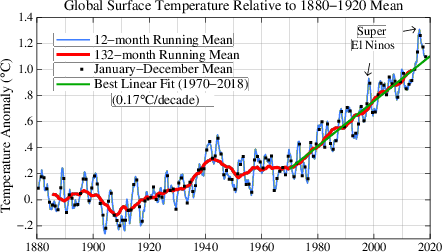
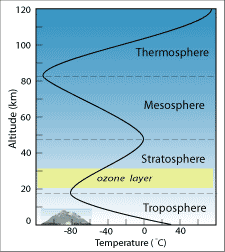
That does not explain why, from 0 to 120 KM above earth, the temperature strongly changes directions three times while the temperature from 50 to 170 KM on Venus changes smoothly just once.
Actually, it doesn't change smoothly just once.
sorry guy, the greenhouse effect as described by climate science doesn't predict the temperature of venus while the ideal gas law does...just as it predicts the temperatures of every planet with an atmosphere.
Venus (at the surface)
P = 92000(mb)
n= 65000 (g/m3)
R= 43.45( g/mole)
Temp =
737 K
92000 (mb) x 1000 (litre/ m3) = 65000 (g/ m3) / 43.45 (g/mole) x 0.082 x T
T = 92000/ (0.082 x 65000/43.45) =
~750 K
Earth (at the surface)
P= 1014 (mb)
n= 1217 (g/m3)
R= 28.97 (g/mole)
Temp =
288 K
1014 (mb) x 1000 (litre/ m3) = 1217 (g/ m3) / 28.97 (g/mole) x 0.082 x T
T = 1014/ (0.082 x 1217/28.97) =
~294 K
Jupiter (at 1 bar)
P= 1000
n= 160 (g/m3)
R=2.22 (g/mole)
Temp =
165 K
PV = nRT
1000 (mb) x 1000 (litre/ m3) = 160 (g/ m3) / 2.22 (g/mole) x 0.082 x T
T = 1000/ (0.082 x 160/2.22) =
~169 K
Saturn (at 1 bar)
P= 1000(mb)
n=160 (g/m3)
R=2.22(g/mole)
Temp =
134 K
PV = nRT
1000 (mb) x 1000 (litre/ m3) = 190 (g/ m3) / 2.22 (g/mole) x 0.082 x T
T = 1000/ (0.082 x 190/2.07) =
~133 K
Uranus (at 1 bar)
P=1000
n=420 (g/m3)
R=2.64 (g/mole)
Temp =
76 K
PV = nRT
1000 (mb) x 1000 (litre/ m3) = 420 (g/ m3) / 2.64 (g/mole) x 0.082 x T
T = 1000/ (0.082 x 420/2.64) =
~77 K
Neptune (at 1 bar)
P=1000
n=450(g/m3)
R=2.69 (g/mole)
Temp =
72 K
PV = nRT
1000 (mb) x 1000 (litre/ m3) = 450 (g/ m3) / 2.69 (g/mole) x 0.082 x T
T = 1000/ (0.082 x 450/2.69) =
~73 K
Now take the basic model for the greenhouse effect and try predicting even close to the actual temperatures of a few of the planets with atmospheres....The incoming solar radiation figures should be easy enough to find for the various planets...how close do you think the greenhouse model will get?