My apologies. I have mixed feelings about your view.
In regards to the single bread winner I agree but think that time has passed us by. We have some new expenses folks in the 50's did not. My wife wants a car and a cell phone, not to mention cable tv so she better work. Not to mention the advances in medical science and associated costs. If my ACL tore in the 50's I think I would have been out of luck. Now they fix it.
This is all fundamental economics and it boils down to one simple dynamic - how do we allocate the wealth in society when it is produced by combining Labor and Capital. You always see liberals yapping on about this topic but they always focus on high taxes and then government benefits to the low income people. That's a completely backwards solution. The most effective solution is to allocate the wealth AS IT'S CREATED and for that to happen we have to change the relative bargaining power of both Capital and Labor. Note this graph, the share of wealth which went to the top 1% was at its lowest point in a century during the exact period when immigration was restricted and labor markets were tightest:
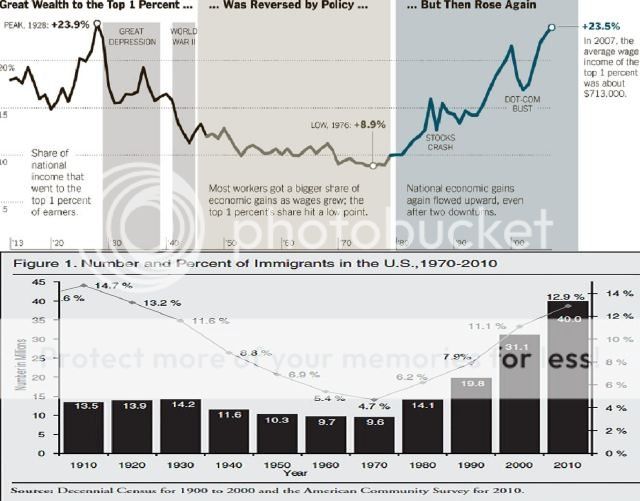
Do you remember what the job market was like in the late 90s? In many places we had employers desperately searching out potential employees, bidding up wages in order to staff their businesses. That's what labor scarcity does, it takes away some of the profits of capital and delivers that wealth to employees in the form of higher wages.
In therms of what that means for you and your wife, we can turn to an interesting natural experiment which is taking place in Alberta, a province which suffered from labor shortages. One would think that labor shortages would induce a massive flow of housewives into the labor market due to the high wages being offered.
Not quite:
Ms. Carvey found refuge from that panic in the manner of any driven Type-A professional: She made a list of the pros and cons of staying home. The pros won out, and she became part of an enigmatic exodus in Alberta.
The working women of the province are disappearing, just as the province's superheated economy is becoming increasingly short-handed. Unemployment has fallen to unimaginably low levels, and help-wanted signs plaster the windows of retail businesses throughout the province. Businesses are scouring Alberta, indeed the entire country, for workers, going so far as to launch recruiting drives in prisons.
And while that desperate search goes on, women such as Ms. Carvey are turning away from work to become not-so-desperate housewives. Ten years ago, Alberta had nearly the highest proportion of working women (or women looking for work) with daycare-age children and a spouse, second only to Prince Edward Island.
In the ensuing decade, those numbers changed dramatically as large numbers of working mothers moved into the work force. Quebec, close to the bottom of the pack, rose to near the top, a change largely coinciding with its introduction of inexpensive and near-universal daycare. But the change was not limited to Quebec: Every Canadian province saw substantial increases in the number of working women with children under 6.
In every province, that is, except Alberta, where that number has been declining steadily this decade. Ten years ago, nearly seven in 10 women in this group were working, or looking for work -- above the national average. Now, it's closer to six in 10, and well below the nationwide average. Statistics Canada has documented this decline, but doesn't have a definitive explanation for it. Differences in daycare -- Alberta has among the lowest public funding in the country -- are likely part of the explanation. The introduction of a flat tax rate and a doubling of spousal deductions in 2001 certainly eased the financial burden on single-income families.
And some researchers believe that conservative social attitudes, and the resulting workplace expectations for women, are to blame.
…
Prosperity has, at a minimum, arrived at the same time as working mothers were dropping out of the work force. Statscan analyst Vincent Ferrao said it is possible that it might be more than mere coincidence: The rising wealth of Alberta could be enabling some women to stay at home without undue financial hardship. "Wages have been increasing quite rapidly," he said. "Is it possible you only need one person working?"
That hypothesis certainly lines up with Ms. Carvey's experience. Ms. Carvey and her husband, Darby Parker, had the relatively unusual luxury of being free from the financial worries of moving to a single income. Her salary of $70,000, while substantial, was lower than the six-figure compensation her spouse brought home from his oil-patch job. With a small mortgage, a modest home and a six-year-old car, the couple had avoided an overhang of debt.
…
And here emerges another paradox: Alberta's prosperity might have given some families the means to live on a single income. But the fact that they are doing so is dampening future growth, as the province's businesses run short of workers. If Alberta women (again those with children under 6) were working at the same rate as their Quebec counterparts, there would be close to another 17,000 female employees on the market -- a godsend in a province running short of everything from oil-patch executives to coffee-house clerks.
…
If the future prosperity of Canada hinges on convincing women like Ms. Carvey to stay in the work force, or at least to return quickly, it might just be time to start sweating. The proud mother of Cadence, now 15 months old, says she might not ever go back to work. "That career used to define me. Now, I'm not so sure."
Far as population I think 500 million could be done here with current tech. Commute legnth in St Louis anyway is a case of poor individual planning. Our jobs are spread out enough there is barely an economic center. Perhaps with our trend towards Suburban campuses here I don't have enough respect for the urban centers.
Immigrants will flock to existing cities. We're not going to see little towns like Grover's Corners turned into new Chicagos. So if you doubled the population of your town or city, what is that going to do to your commute, to the price of getting a ticket for a ball game (same seats but 2x the number of ticket buyers increases the ability of the team to sell tickets for a higher price). Is there a limit to how large you want your city to become? Cities don't continually expand outwards, they almost always increase in density, which means big yards, distance between homes decreases, and instead we get more condo developments, postage stamp sized yards for private homes, etc. Cramming more people into the same space.
Your point about house prices is also valid. I guess I could contend if my home is worth more I can borrow against it to finance a new company. Also if its value goes up predictably I have an easier time moving when I need to for work. It is this weird economy of borrowed money we have that makes home prices important. Plus, my city has tons of lots and homes people just don't value enough to maintain. Google earth shows blocks with only a few homes on them and piles of rubble. New houses get built on farmland....maybe that brings up a rezoning problem...
Do you have kids? If so, are they starting out in life? Back when we had less population our kids go be independent of their parents at an earlier age and be homeowners sooner too.
Take a look:
The average age of a first-time homeowner is 34, according to the most recent American Housing Survey data collected in 2009. Once first-time homeowners made up nearly half of all existing-home sales, but they now make up 35 percent, according to a recently released National Association of Realtors report. Daron Young, project manager at Ivory Homes, said young people are hesitant to buy a home . . .
Other trends such as the average age of marriage may play a role. The average age of marriage is currently 26.1, according to the U.S. Bureau of the Census, a drastic jump from 20.3 in 1960.
In 1960 the average age of a first-time homeowner was 24-25, according to David Berson in the journal Business Economics.
As with Flat Screen TVs, the higher the price the more people who can't afford to buy. So those high home prices are certainly good for the people who are already homeowners but there is no benefit to those young people still out of the market, for many of them the prices are so high that they can't afford to buy in. Look at that 1960 homeowner AGE. ObamaCare still treats 26 year olds as children on their parents health plans while 50 years ago more than half of 26 year olds were already homeowners.
When we increase the population, then we create more demand for finite land. As they say, we're not making any more of it.
The part about people not covering their cost is also true. IMO that is why we have a deficit.
Exactly. If we have, let's simplify it, 10,000 taxpayers "overpaying" and we have 100,000 taxpayers "underpaying" then we have this ration 10/100 now if we continue adding more people to the population and all of them are not pulling their weight, then we get this ratio 10/200. If you, or I, happen to be an "underpayer" and we get subsidized by the "overpayers" then what has happened to our subsidy?
Don't know if putting more folks into the dying city here would really cost that much more. It seems like it would fix the Social Security math if we import young productive workers.
That doesn't work. It's like getting new credit cards to borrow cash advances to pay your existing credit cards. The white physician retiring today is being replaced by a young Hispanic gardener. That Hispanic gardener is not going to be paying enough in taxes to fund the SS of the physician and meanwhile he too will retire one day and unlike the physician who also has independent means to fund his retirement, that Hispanic gardener is going to be looking for more taxpayer support in his old age.Here's what is going on in
Texas:
Today’s Texas population can be divided into two groups, he said. One is an old and aging Anglo and the other is young and minority. Between 2000 and 2040, the state’s public school enrollment will see a 15 percent decline in Anglo children while Hispanic children will make up a 213 percent increase, he said.
The state’s largest county – Harris – will shed Anglos throughout the coming decades. By 2040, Harris County will have about 516, 000 fewer Anglos than lived in the Houston area in 2000, while the number of Hispanics will increase by 2.5 million during the same period, Murdock said. The projection assumes a net migration rate equal to one-half of 1990-2000. . . .
The state’s future looks bleak assuming the current trend line does not change because education and income levels for Hispanics lag considerably behind Anglos, he said.
Unless the trend line changes, 30 percent of the state’s labor force will not have even a high school diploma by 2040, he said. And the average household income will be about $6,500 lower than it was in 2000. That figure is not inflation adjusted so it will be worse than what it sounds.
“It’s a terrible situation that you are in. I am worried,” Murdock said.
What we're doing is this - we're in a full lifeboat and we're adding more and more people to the lifeboat and slowly sinking all of us. The original lifeboat could have stayed afloat but when everyone is in the lifeboat, then we all sink.

 . Jobs like i have now generally will not go to refugee type immigrants and if we somehow import that much skilled labor it is a problem I can deal with.


