Here;
Abstract
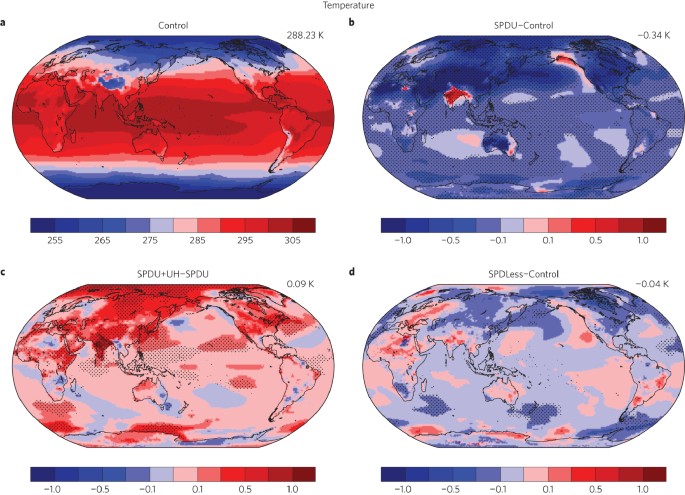
Regardless of the harmful effects of burning fossil fuels on global climate, other energy sources will become more important in the future because fossil fuels could run out by the early twenty-second centuryl, When will fossil fuel reserves be diminished? This implies that sooner or later humanity will rely heavily on renewable energy sources. Here we model the effects of an idealized large-scale application of renewable energy on global and regional climate relative to a background climate of the representative concentration pathway 2.6 scenario (RCP2.6; ref.
5). We find that solar panels alone induce regional cooling by converting incoming solar energy to electricity in comparison to the climate without solar panels. The conversion of this electricity to heat, primarily in urban areas, increases regional and global temperatures which compensate the cooling effect. However, there are consequences involved with these processes that modulate the global atmospheric circulation, resulting in changes in regional precipitation.
This study considers how large-scale application of solar panels will affect climate. Electricity generation leads to regional cooling but this is countered by the power’s use, affecting global circulation patterns with changes in regional rainfall.

www.nature.com


 www.wnd.com