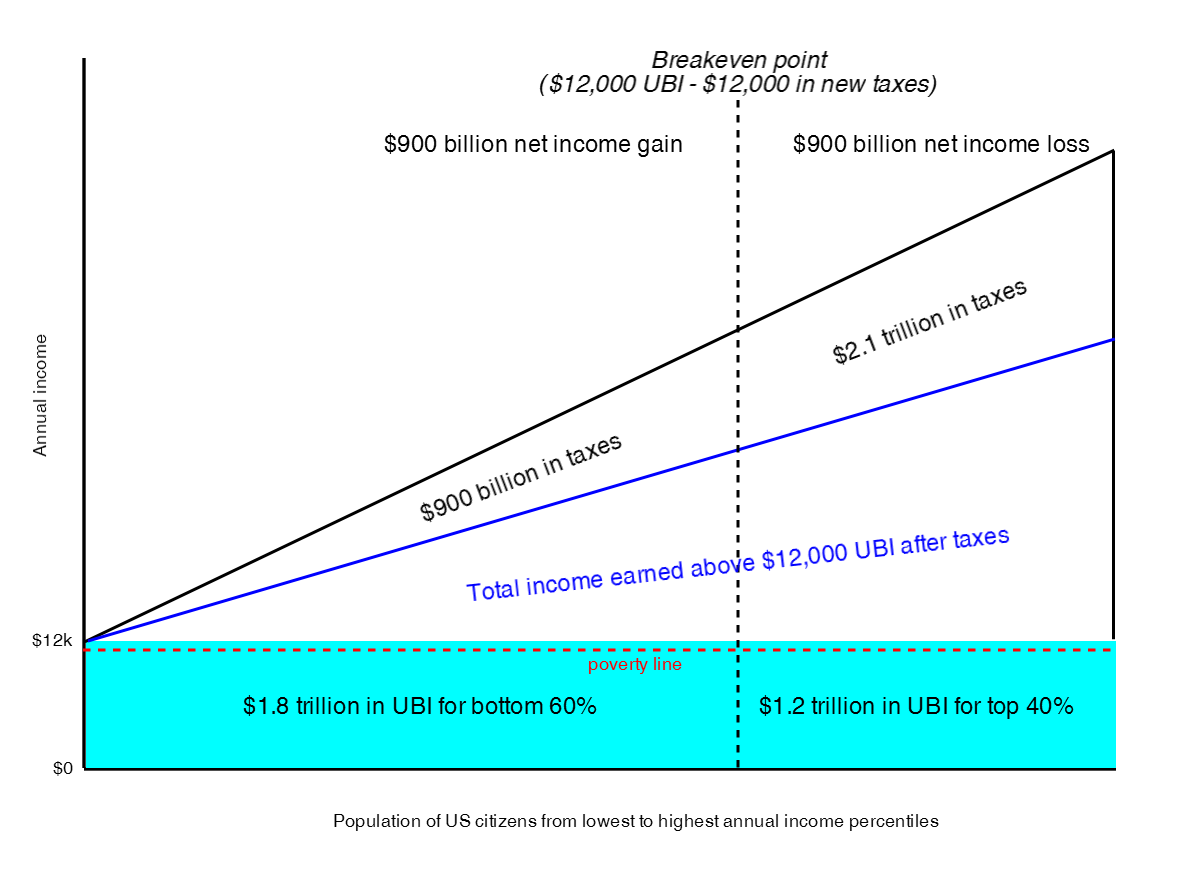
So where do you suggest that this monthly amount come from? Is it going to just magically appear? Do you suggest that we increase taxes to cover the amount. If so then not only do you have to tax a thousand a month but you also need to include the wages of those that are taking in and distributing this new found wealth. So you are talking giving someone $1,000.00 and taxing $1100.00 so a net loss.
Oh let me guess it is the old someone else will pay for my freebies. Yeah the usual stupid bull.
And as usual it may not have worked before but it will this time. Why do so many people always expect a diffrent result from the same input? If you throw a rock into the air, no matter how many times, it still falls down. It will never take flight.
And as usual it may not have worked before but it will this time. Why do so many people always expect a diffrent result from the same input? If you throw a rock into the air, no matter how many times, it still falls down. It will never take flight.
You're making a fatal mistake in reasoning if you are actually equating economics and physics Validation in a hard science like physics comes only through two primary forms, theorems and theories. Gravity is a legitimate theory because it has been confirmed through experiments and observations conducted across centuries. Economics rests on assumptions and not on theories or theorems.
What Makes A Good Model in Economics and Finance - ppt video online download
So you are hoping that someone will not notice that you are trying to somehow produce money that is not there? We are talking a fundamental principle in everything here. Given a finite number of objects you can not slit those objects indefinitely. They do not magically respawn.
I was using gravity as an example of a simple principle called stupidity. If you think that tossing a rock into the air somehow equates to economics you may need more help in fundamentals.
Does this mean those pesky telemarketers will go away...? ~S~
Five Millions Tons of Smoke in the Stratosphere | Nuclear Darkness & Nuclear Famine
"Following a war between India and Pakistan, in which 100 Hiroshima-size (15 kiloton) nuclear weapons are detonated in the large cities of these nations, 5 million tons of smoke is lofted high into the stratosphere and is quickly spread around the world.
"A smoke layer forms around both Hemispheres which will remain in place for many years to block sunlight from reaching the surface of the Earth.
"One year after the smoke injection there would be temperature drops of several degrees C within the grain-growing interiors of Eurasia and North America.
"There would be a corresponding shortening of growing seasons by up to 30 days and a 10% reduction in average global precipitation."
The safest continent on the planet will be the one that is the least inhabitable, Antarctica.
So you are hoping that someone will not notice that you are trying to somehow produce money that is not there? We are talking a fundamental principle in everything here. Given a finite number of objects you can not slit those objects indefinitely. They do not magically respawn.
It sounds like you are confusing a national economy capable of electronically creating its own sovereign currency with a household economy?
If so, you have a lot in common with your rocks.
How to Fund a Universal Basic Income Without Increasing Taxes or Inflation
"The other option is 'qualitative easing,' a form of central bank quantitative easing in which the money flows directly into the real economy rather than simply into banks.
"In Europe, politicians are
taking another look at this once-derided 'helicopter money.'
"A UBI is being proposed as monetary policy that would stimulate productivity without increasing taxes.
"As Nobel prize-winning economist Joseph Stiglitz, former senior vice president of the World Bank,
explains:
"'. . . [W]hen the government spends more and invests in the economy, that money circulates, and recirculates again and again. So not only does it create jobs once: the investment creates jobs multiple times.'
"'The result of that is that the economy grows by a multiple of the initial spending, and public finances turn out to be stronger: as the economy grows, fiscal revenues increase, and demands for the government to pay unemployment benefits, or fund social programmes to help the poor and needy, go down.'
"As tax revenues go up as a result of growth, and as these expenditures decrease, the government’s fiscal position strengthens.'"