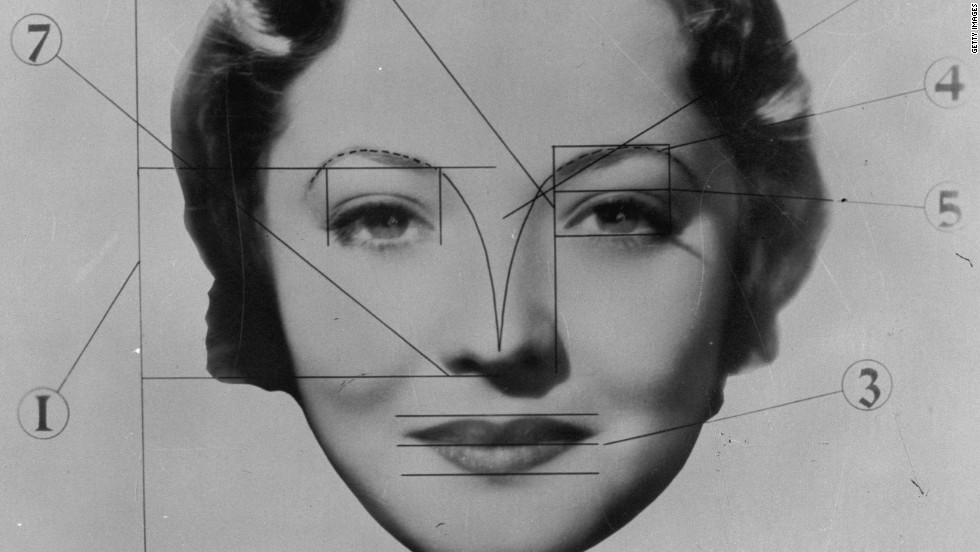
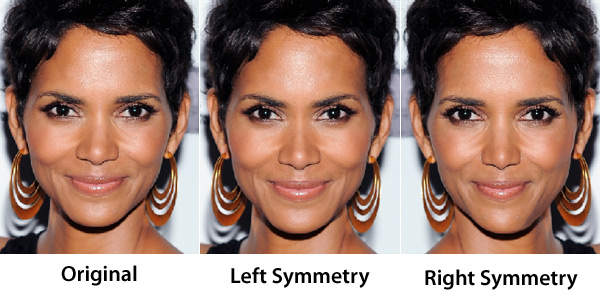
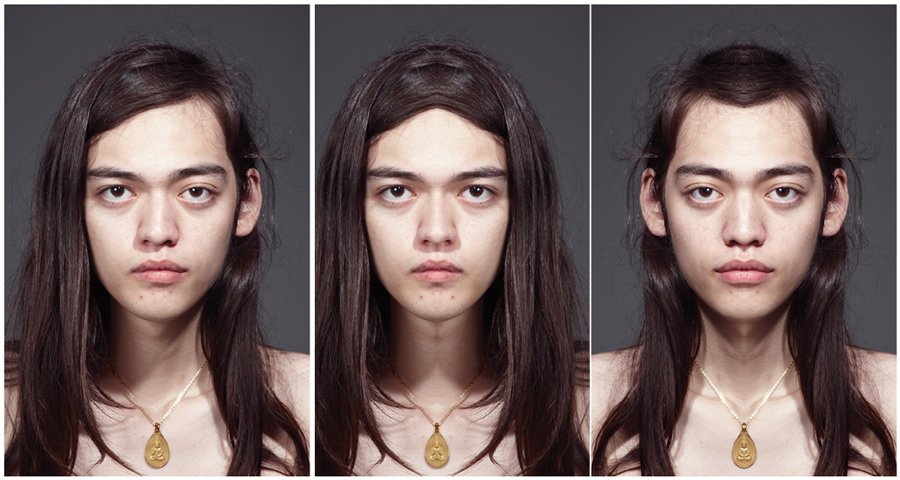
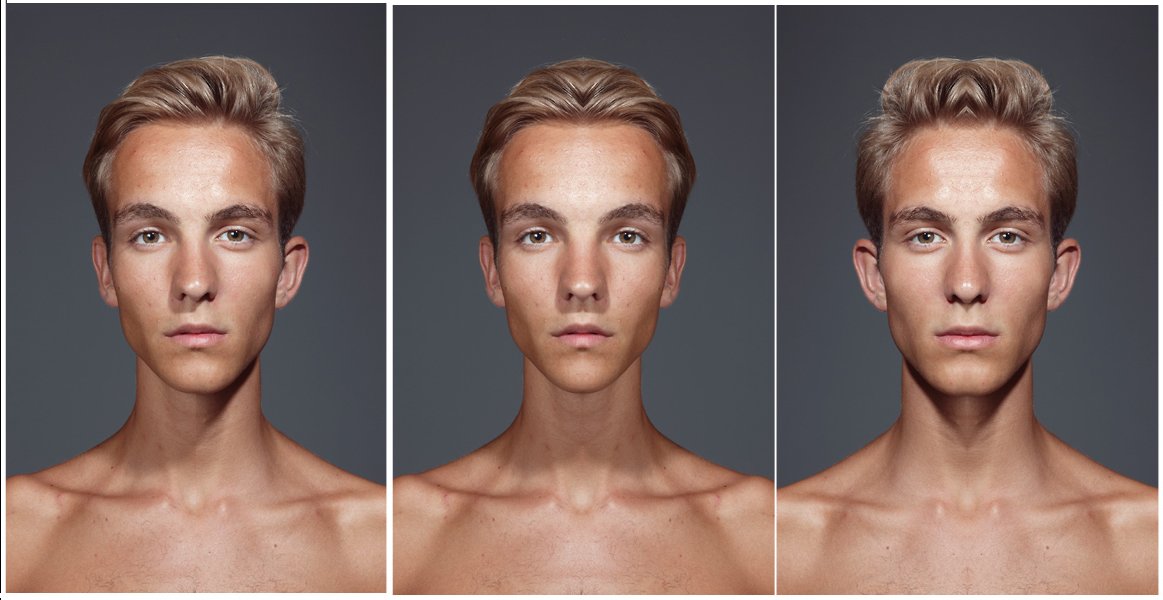
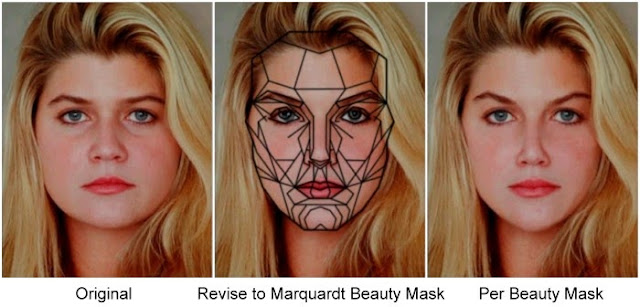
All people -- without regard to gender -- innately understand and recognize the physical traits that make people more or less attractive. The relevant traits that make for attractiveness, furthermore, are universal.
It comes down basically to proportions and symmetry. Eyes, noses, lips, brows, arms, legs, butts, necks, etc. come in a huge variety of specific forms, but it's how they're arranged that drives whether a specific person will be considered good looking or not.
Succinctly,
the more "Golden Mean" conforming the face and body, the more attractive will it be perceived across all cultures and raced.
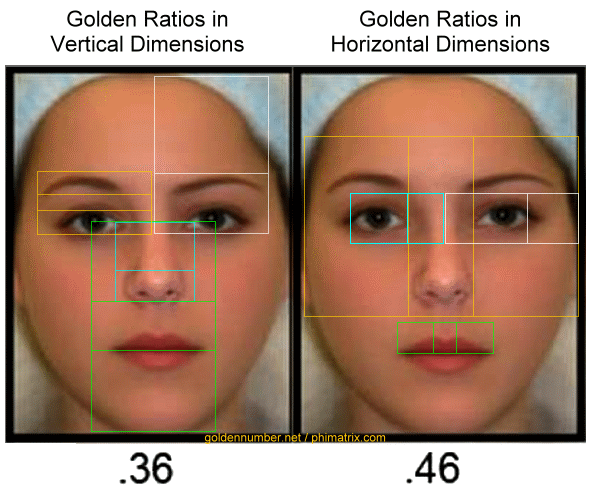
It seems there is an assortment of vertical and horizontal ratios that determine what's hot and what's not. Here are the ones for the face.
- Vertical golden ratios:
- White – Hairline : Eyebrow top : Eye top
- Gold – Eyebrow top : Eyebrow bottom : Eye top : Eye bottom
- Blue – Eye pupil : Nose flair : Nose bottom
- Green – Eye pupil : Nose bottom : Mouth
- Green – Eye pupil : Nose bottom : Chin
- Green – Eye pupil : Mouth : Chin
- Horizontal golden ratios:
- Gold – Face side : Eyebrows : Face side
- Gold – Face side : Eye inside : Face side
- Gold – Face side : Nose width : Face side
- White – Face side : Eye outside : Nose center
- Blue – Eye outside : Eye inside : Nose center
- Green – Mouth outside : Lip cupid’s bow : Mouth outside
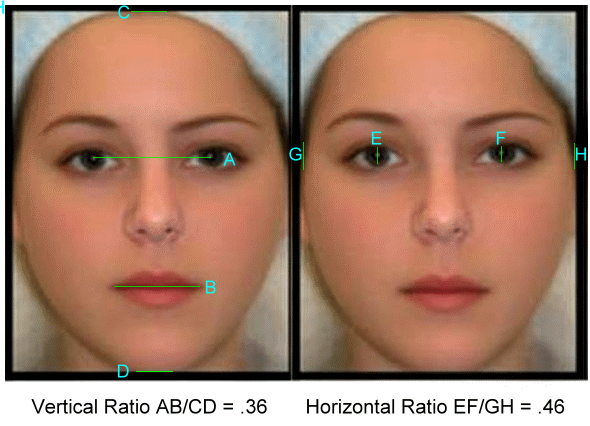
In addition to the "parts ratios" noted above, the researchers also identified an overall horizontal and vertical proportion.
Some might feel these more generalized "full face" ratios are less reliable, for we can find exceptions.
The researchers noted in
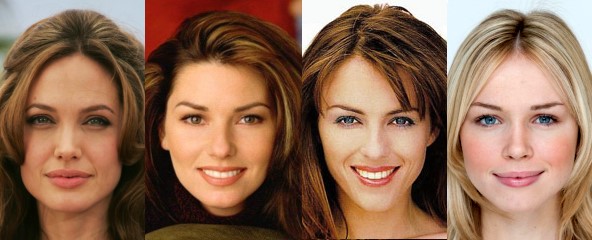
an interview, “Angelina Jolie does not have golden length and width ratios. Elizabeth Hurley gets the golden ratio for length but is different from the width golden ratio by one per cent. But Canadian country pop musician Shania Twain has “both the length and width ratios.” Florence Colgate, voted in 2012 as having the most beautiful face in Britain, also failed to meet both metrics.
For my part, Angelina is the only woman I recognize of the four above. For my part, I think the two women in the middle are better looking than Angelina. Looking at Angie without her "face" on, I think she's a decent enough looking woman, but not exceptionally so.
In any case, I think that the "exception" claim is nothing more than hair-splitting. As alluded to above, it seems to me that what's relevant is not "who's best looking" but rather "is person X good looking or not good looking." I think that while an ideal ratio value can be identified, what's important is whether one's own features are "close enough" to that ideal that one is still good looking.
The discussion above has illustratively used women. I did so because I've been down this line of discussion before and remembered how difficult it is to find images that explain the same concepts using men as the models. I suppose there's a whole other discussion one might have on why that is.
Applying the notions and research findings, it seems very clear to me that men and women are well aware of their own attractiveness (facial and corporeal), that of others and how they compare. What man hasn't of some woman thought or said, "She's out of my league?" Such a statement is a tacit recognition that their own physical attractiveness isn't on par with that of the woman in question, but more to the point of the OP question, it's also a recognition that there are other men who are "in her league." So, yes, men do know.
Now why don't men remark directly upon their own or other men's attractiveness? Well, I have my own views on that, but I haven't researched them to find out if they are spot on. I suspect they are, but I could be mistaken. Anyway, here're what I think are the reasons:
- Cultural evolution -- In modern times -- essentially the period of recorded history -- human culture has increasingly become one wherein physical traits don't indicate a man's ability to be a capable provider for his mate and offspring. The "perfect" aggregation of bodily features may indicate that one is healthier, stronger, possessed of greater endurance, virility and vitality, etc. With the introduction of money, however, one need not be physically exemplary. The outward signs of superiority as a competitor in the natural world just don't matter as much.
Men and women both recognize that is so. Accordingly, we observe the "trophy wife" comes into existence. Trump is a fitting example of that. Though he may have been reasonably fit and handsome in his younger days, by the time he wed Melania, he was just rich. For however he treats her, he's more than able to provide her and any children they have together with the best odds one can give for succeeding, enduring and thriving, and he's able to do so long after his own demise.
Because this is as it is, men are given to remarking upon their own and one another's ability to compete based on monetary measures and their surrogates. Women have come to look for and prefer those cues rather than physical cues of a man's being a good mate. How does that manifest itself among men? Well, IMO, by making good looking men who also manage to become wealthy become the men whom other men love to hate.
Thus men who are not good looking, IMO, don't much care to acknowledge the good looks of other men because doing so necessarily acknowledges, invites and forces a comparison with other men. That can't possibly be something an average or unattractive man wants to do, and if he's also not wealthy, he's going to be even less inclined to do so. Good looking men, on the other hand, know they are and they know just as well that everyone else can see they're good looking. For them, it just goes without saying.
I think there are two exceptions: one has to do with fathers and sons and the other has to do with tragedy. Fathers know damn well whether their sons are handsome.
- Fathers and Sons -- I think a father's awareness of his son's look affects the nature of encouragement and advice he gives his son(s) regarding how they might go about interacting with girls. I know I experienced that with my three sons. My youngest is an embarrassingly good looking kid and girls fawn all over him. My oldest is better looking than average, but not like the youngest. My oldest boy's "game is party looks based, but his not so very handsome that his looks alone are enough.
I suppose, given this thread's theme, it's worth noting that if a father can discern his son's relative looks, he can also discern that of other men. The same is so for guys and their brothers. I know my brothers and I are of basically equal looks, so, blessedly, there was no sibling angst among us in that regard. By comparison, I'm fairly sure my two oldest sons envy their younger brother's "chic magnet" looks.
- Tragedy -- Men, like women, when they observe the great misfortune of another man, will acknowledge his handsomeness. I had a high school friend who had gone rock climbing, fell and died. When I told my dad about it, in addition to reflecting on his character, he commented that Mark was a "nice looking kid." Mark was 22 when he died.
- Cultural Norms -- In every culture I've encountered -- various European ones, Japanese, Chinese, Indian and, of course, American, statements attesting to another's looks are construed as compliments and entreaties for sexual interaction. I think that shallow people are incapable of seeing such comments any other way, and not-so-shallow people just don't want to expose themselves to the risk that a remark about another's looks will be construed thus or as disingenuous. Combine that with the cultural stigmas and stereotypes about homosexuality and you get men who don't openly and publicly remark upon other men's looks. I think insecurity also begins to play a role in that sense.
- Insecurity -- I think there are a lot of insecure men. I don't want to go into why they may be, for I think "why" will vary from man to man. I can say that when I go to the gym, I notice whether other guys' bodies. That I do doesn't mean I want to "get busy" with them; it means I'm not blind.
It also means that I'm aware of how my own body compares with that which women are likely to encounter, and that matters to me when I'm "on the prowl," or at least open to opportunities, so to speak. That manifests itself in my wearing clothing that makes it clear that the six-pack I'm carrying doesn't circumnavigate my waist. Just as I'm aware of the results of my regular gym presence, I think men whose sole relationship with a gym is spelling it are equally aware and choose their attire to mask, as much as possible, that being the case..
So those are the main reasons that come to mind when I consider the question this thread poses. I suppose, at the end of the day, it comes down to men, within the context of intragender competitiveness, merely wanting to accentuate the positive and minimize the negative. Simply saying nothing does that more effectively than does noting that some other dude is good looking.