One of our very best friends here is a doctor at the local VA hospital. She is a caring, competent doctor, but says the VA system is anything but a model of efficiency, and shudders to think what it would be like if the whole system was run like that. She has a chronic heart condition that requires frequent hospitalization and also has had a couple of other surgeries in recent years. She could go to the VA by virtue of her position there, but she opts for other hospitals in town where she knows she will get better care.
And while I 100% support the VA to take care of our service men and women who put their lives on the line on behalf of their country, we can and should do better for them.
You are a piece of work Foxfyre. You accuse me of presenting 'OPINIONS'... and what is your rebuttal??? A OPINION...singular, ONE person. Your typical anecdotal 'I know a doctor' or 'I have a grandma'
I provide facts, studies and CBO reports, but you know a doctor...
The problem with arguing with conservatives is any facts that don't fit their dogmatic mind HAS to be somehow denied, rejected or ignored.
From the first article I posted:
In fact, the VA is used to stretching a buck. It has to deliver all the care that its patients need without exceeding its annual budget set by Congress.
It's a challenge, but Drucker said the VA has figured out a way to do things economically. Like doctors at the Mayo Clinic, most VA doctors receive a salary, so they have no incentive to order unnecessary tests and procedures to make more money. That saves the VA huge sums of money that can be reinvested in necessary care.
Also, the VA has an electronic medical record system that's the envy of many. Drucker said doctors can get detailed information about patients even if they were treated at a VA clinic across the country.
"Staff do not have to transport records," he said. "They don't have to look for them; they're just available on the computer screen in front of the provider who can use that information immediately to make a medical decision about a patient."
The electronic records have allowed them to improve patient quality and eliminate a lot of wasteful spending.
----------------------------------------------------------------------
Do I need to go on Foxfyre? Do I have to completely embarrass you?
Well continue to bask in your grand illusions that anything you say embarrasses me. I offered an opinion of somebody who is actively working in the system. You offer link after link of what. Somebody else's opinion. One says that the VA has improved and I would agree that it has. Sometimes thngs are so bad that improvement is the only direction they can go. I'm sure there are some VA hospitals that do a good job. The one here does pretty well for what it is. But still virtually ALL their medical staff chooses other hospitals in town when they need serious hospitalization/treatment. That should tell you something.
I would like to see a study of VA medical personnel across the country and see how many would choose the hospital they work in for their own care. That could be a revelation, yes? At the same time I am not saying that the Veterans get no care or inadequate care at the VA. I am not suggesting that the VA be dismantled. Go to the local VA at any time of day or night and usually every bed is filled and the emergency room is jammed full. There is a need for it. I am just saying that private facilities are for the most part better.
One of your links compared the VA quality of care with what. . .Medicare. News flash for you, that is another government program. Realistically that is like comparing Dumb with Dumber.
And now let's look at costs. When you can show me that running the VA and Medicare program is more cost efficient than is private healhcare, get back to me.
Your method of debating is why arguing with liberals is so frustrating. You come up with a bunch of links that you think make your point, but you still do not articulate in your own words why you hold the opinions that you do or why your sources should be considered superior to anybody elses. In my opinion, because you are a liberal, you are unable to do that.
Maybe you need to keep reading. Hear what Bill Brody, the former president of John Hopkins University says. He is a market-driven entrepreneur and one of only 14 presidents of John Hopkins since 1875. But he also has the intelligence to learn and evolve. You don't. Your anecdotal beliefs are based on fears and close-minded stereotyping.
BTW, I have posted this before on other threads where I have destroyed your ignorance. But you keep beating your head against the same walls. It is only one of many facts that destroy the dogmatic beliefs you MUST adhere to, because that is what you are told to believe.
In fact, Medicare is very efficient by any objective means:
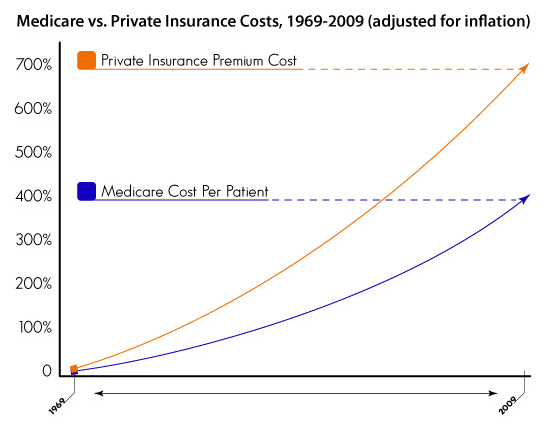
According to the Urban Institute's Marilyn Moon, who testified before the Senate Committee on Aging, Medicare expenditures between 1970 and 2000 grew more slowly than those of the private sector. Initially, from 1965 through the 1980s, Medicare and private insurance costs doubled in tandem. Then Medicare tightened up, and per capita expenditures grew more slowly than private insurance, creating a significant gap. In the 1990s, private insurers got more serious about controlling their costs, and the gap narrowed.
But by 2000, Medicare per capita expenditures remained significantly lower than the private sector.
It has been argued that, in part, Medicare's cost effectiveness arises from the fact that it does not need to expend funds on marketing and sales-functions that are obligatory for the success of competitive, private-sector health plans. Moreover, some argue that the competitive model for health insurance has not been successful. In a market-driven economy, the healthy can and will change health plans for savings of only a few dollars a month, while the sick must remain in their existing plan in order to retain their physicians. Such behaviors lead to asymmetric risk pools and cost inequities.
This was all sobering news to a market-driven entrepreneur such as yours truly. However, given the perverse incentives that frequently drive behavior in health care, my take-home lesson is that there are examples in the success of Medicare we can apply to other sectors of our population.
-------------------------------------------------------------------
Dr. William R. Brody
Dr. William R. Brody, President of the Salk Institute for Biological Studies, an acclaimed physician-scientist, entrepreneur, and university leader, joined the Salk Institute on March 2, 2009 after 12 years as president of The Johns Hopkins University. He is a national figure in efforts to encourage innovation and strengthen the U.S. economy through investments in basic research and education. Most recently, he has written and spoken extensively around the country to promote a fuller discussion of health care reform.
Renowned for his achievements in biomedical engineering, Dr. Brody has over 100 publications and two U.S. patents in the field of medical imaging, and has made contributions in medical acoustics, computed tomography, digital radiography, and magnetic resonance imaging. These contributions have led to his recognition by numerous national and international organizations. Dr. Brody is a member of the Institute of Medicine and the National Academy of Engineering, and a fellow of the Institute of Electrical and Electronic Engineers, the American College of Radiology, the American College of Cardiology, the American Heart Association, the International Society of Magnetic Resonance in Medicine, the American Institute of Biomedical Engineering, and the American Academy of Arts and Sciences. In 2010, he was awarded the Gold Medal of the Radiological Society of North America for his contributions to medical imaging science.
A native of Stockton, California, Dr. Brody received his B.S. and M.S. degrees in electrical engineering from the Massachusetts Institute of Technology, and his M.D. and Ph.D., also in electrical engineering, from Stanford University. Following post-graduate training in cardiovascular surgery and radiology at Stanford, the National Institutes of Health and the University of California, San Francisco, Dr. Brody was associate professor and then professor of radiology and electrical engineering at Stanford University (1977-1986). He has been a co-founder of three medical device companies, and served as the president and chief executive officer of Resonex Inc. from 1984 to 1987.
Dr. Brody serves as a member of the Scientific Management Review Board of the National Institutes of Health and on the board of directors of IBM and Novartis. He is a member of the Board of Trustees of Stanford University. He formerly served on the President's Foreign Intelligence Advisory Board, the Science Board of the Food and Drug Administration, on the Corporation of the Massachusetts Institute of Technology, and was a trustee of the Commonwealth Fund, the Whitaker Foundation, and the Minnesota Orchestra.
Dr. Brody is a private pilot holding airline transport pilot and flight instructor ratings. He and his wife, Wendy, have two grown children.