Well, I am glad the guy from the Ayn Rand Center can tell us with certainty that bank deregulation played no role in the financial crisis. No bias or conflict of interest in promoting reckless pirate capitalism there?
Got it, YOU can't refuter THEIR facts that CLEARLY point out that what happened WASN'T do to not enough regulation, BUT REGULATORS ON THE BEAT WAS THE PROBLEM. Dubya (like Reagan did with Mr Grays warning in 1984 with the S&L crisis) ignored regulator warnings as he cheered on the subprime bubble because he had ZERO growth without it!
all outlined here
FACTS on Dubya s great recession US Message Board - Political Discussion Forum
November 27, 2007
A Snapshot of the Subprime Market
Dollar amount of subprime loans outstanding:
2007 $1.3 trillion
Dollar amount of subprime loans outstanding in 2003: $332 billion
Percentage increase from 2003: 292%
Number of subprime mortgages made in 2005-2006 projected to end in foreclosure:
1 in 5
Proportion of subprime mortgages made from 2004 to 2006 that come with "exploding" adjustable interest rates: 89-93%
Proportion approved without fully documented income: 43-50%
Proportion with no escrow for taxes and insurance: 75%
Proportion of completed foreclosures attributable to adjustable rate loans out of all loans made in 2006 and bundled in subprime mortgage backed securities: 93%
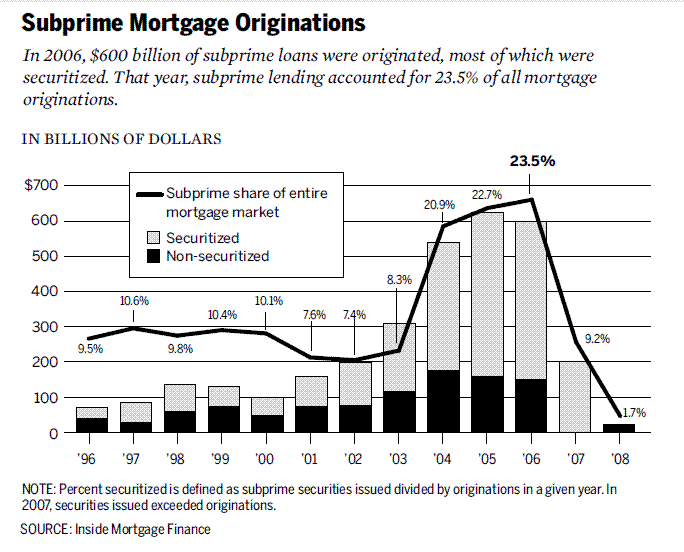
Subprime share of all mortgage originations in 2006: 28%
Subprime share of all mortgage origination in 2003: 8%
Subprime share of all home loans outstanding:
14%
Subprime share of foreclosure filings in the 12 months ending June 30, 2007: 64%
No one is arguing Bush didn't lower lending standards. But you ignore Clinton did the same and helped contribute to the resulting crisis, and the lowering of standards began under Carter through the CRA. Also, the repeal of Glass Steagall and artificially low interest rates of the Federal Reserve played a role.
You are a partisan hack with no perspective.
Got it, YOU are projecting as aa POS...
WEIRD HOW IT TOOK SO LONG FOR CARTER AND CLINTON TO DO THIS:
Q When did the Bush Mortgage Bubble start?
A The general timeframe is it started late 2004.
From Bushs Presidents Working Group on Financial Markets October 2008
The Presidents Working Groups March policy statement acknowledged that turmoil in financial markets clearly was triggered by a dramatic weakening of underwriting standards for U.S. subprime mortgages, beginning in late 2004 and extending into 2007.
Q Did the Community Reinvestment Act under Carter/Clinton caused it?
A "Since 1995 there has been essentially no change in the basic CRA rules or enforcement process that can be reasonably linked to the subprime lending activity. This fact weakens the link between the CRA and the current crisis since the crisis is rooted in poor performance of mortgage loans made between 2004 and 2007. "
http://www.federalreserve.gov/newsevents/speech/20081203_analysis.pdf
Bushs documented policies and statements in timeframe leading up to the start of the Bush Mortgage Bubble include (but not limited to)
Wanting 5.5 million more minority homeowners
Tells congress there is nothing wrong with GSEs
Pledging to use federal policy to increase home ownership
Routinely taking credit for the housing market
Forcing GSEs to buy more low income home loans by raising their Housing Goals
Lowering Invesntment banks capital requirements, Net Capital rule
Reversing the Clinton rule that restricted GSEs purchases of subprime loans
Lowering down payment requirements to 0%
Forcing GSEs to spend an additional $440 billion in the secondary markets
Giving away 40,000 free down payments
PREEMPTING ALL STATE LAWS AGAINST PREDATORY LENDING
But the biggest policy was regulators not enforcing lending standards.
YES, CLINTON HAD A HOMES PUSH, LIKE EVERY OTHER US PREZ SINCE FDR. WEIRD ONLY RONNIE AND DUBYA IGNORED REGULATOR WARNINGS AND HAD MAJOR ISSUES THOUGH???
•Private lenders not subject to congressional regulations collapsed lending standards. Taking up that extra share were nonbanks selling mortgages elsewhere, not to the GSEs. Conforming mortgages had rules that were less profitable than the newfangled loans. Private securitizers — competitors of Fannie and Freddie — grew from 10 percent of the market in 2002 to nearly 40 percent in 2006. As a percentage of all mortgage-backed securities, private securitization grew from 23 percent in 2003 to 56 percent in 2006
These firms had business models that could be called “Lend-in-order-to-sell-to-Wall-Street-securitizers.” They offered all manner of nontraditional mortgages — the 2/28 adjustable rate mortgages, piggy-back loans, negative amortization loans. These defaulted in huge numbers, far more than the regulated mortgage writers did.
Examining the big lie How the facts of the economic crisis stack up The Big Picture
PERHAPS ONE TIME YOU'LL ADMIT YOU ARE WRONG ON THIS??? LOL