What do liberals want the US to be?

So you see the Fairness Doctrine as a method for reducing the influence that wealthy people have on the legislative process.

Is that because you see it as a method for reducing the influence that wealthy station owners have on the message being broadcast? The hope being that a more balanced message will lead to a more informed voting population?That this will then change who the voters elect? That the legislators will then be more free from the influence of wealthy people?

Sorry just trying to follow your train of thought.

Back in the 50s and 60s, people were wise enough to realize that since A.M. bandwidth is limited, that in order to avoid monopolization, it was necessary to implement certain requirements that ensured it served the public interests instead of merely the interests of those owning the stations. The fairness doctrine was the way to preserve that long-standing American tradition of free speech and access to a wide range of ideas so as to enable an informed electorate rather than having such ideas hand-selected for us.

The influence of money as it relates to radio should be obvious. It takes a lot of the stuff to broadcast, and in the years since the 60s, the trend has been towards conglomeration. There are fewer and fewer independent radio stations all the time, having been replaced by giants such as clear channel and cumulus, which have now merged, thus allowing for the monopolization of opinion even further.

The re-implementation of this doctrine that acted to conserve our American valuesin regards to free speech would certainly not end the ability of enormous corporations to control the political climate of this country, but it would at least provide for a little balance in the way this media operates.

That would assume that broadcast is the method of choice for Americans in receiving their news and other content. I would argue that in this day and age that is no longer remotely accurate. I NEVER listen to radio and I am far from alone in that. I much more likely to listen to streaming media, podcasts, etc even in the car. I read news online.

As you said yourself, the Fairness Doctrine was about the limitations on available bandwidth and the avoidance of monopolization. There has been a significant increase in the available means of transmitting and receiving information since that time. Do you still see it as expedient for the government to mandate the content that is broadcast in the current situation?

You CAN'T be honest can you? Without the Fairness Doctrine, right wingers just get to lie. Yes, other media is out there, but fed off of mostly Faux and right wing hate radio bullshit!


Tax cuts will bring in more revenues? lol. Biggest lie. Tax cuts create jobs? Second biggest. Obama a 'leftist, Marxist, Commie, etc' (He's Corp) 3rd biggest ...

What did I say that was dishonest?

Troll on friend. Troll on.

"Fairness Doctrine was about the limitations on available bandwidth and the avoidance of monopolization"


6 Corps own 90% of US media Bubba. Seriously????
 
More reason why our government doesn't work

The idea that compromise is somehow "stealing"
That I am so right in my convictions that any acknowlegement that the other guys beliefs may have merit is defeat

The problem is that the person demanding the chicken thinks he a right to what isn't his. Under what conditions do you think the butcher should have compromised and given up his chicken when demanded?

You don't to call it theft ... And if it just comes down whether or not you think you deserve the chicken ... Get your own chicken. If the butcher wants to help someone feed themselves ... Then the butcher can do it without the person demanding his chicken.

The butcher certainly doesn't need to hand over his chicken ... So the person demanding it can benefit from passing out free chicken.

.

Come back with a realistic analogy and we can talk

Right now, you present a biased analogy reinforcing that your side is always right and the other side is stealing from you

You are just proving my point

Whenever you force one segment of society to provide for another ... And they have equal say-so in the law ... Then theft is the end result no matter what you want to call it.

It doesn't matter how you try and justify the theft ... You are forcing those who have something, to give it to people who don't. The idea you benefit from the ability to give stuff away only diminishes any justification you may pose.

You can put lace on a bowling ball and call it whatever you want ... It is still a bowling ball.

.

Benjamin Franklin, Founding Father, American diplomat, statesman, and scientist; letter to Robert Morris, December 25, 1783:

"All the property that is necessary to a Man, for the Conservation of the Individual and the Propagation of the Species, is his natural Right, which none can justly deprive him of: But all Property superfluous to such purposes is the Property of the Publick, who, by their Laws, have created it, and who may therefore by other laws dispose of it, whenever the Welfare of the Publick shall demand such Disposition. He that does not like civil Society on these Terms, let him retire and live among Savages. He can have no right to the benefits of Society, who will not pay his Club towards the Support of it."
 
More reason why our government doesn't work

The idea that compromise is somehow "stealing"
That I am so right in my convictions that any acknowlegement that the other guys beliefs may have merit is defeat

The problem is that the person demanding the chicken thinks he a right to what isn't his. Under what conditions do you think the butcher should have compromised and given up his chicken when demanded?

You don't to call it theft ... And if it just comes down whether or not you think you deserve the chicken ... Get your own chicken. If the butcher wants to help someone feed themselves ... Then the butcher can do it without the person demanding his chicken.

The butcher certainly doesn't need to hand over his chicken ... So the person demanding it can benefit from passing out free chicken.

.

Gawd you are a moron who substitutes a person for SOCIETY. SHOCKING you are this dense.


Benjamin Franklin, Founding Father, American diplomat, statesman, and scientist; letter to Robert Morris, December 25, 1783:

"All the property that is necessary to a Man, for the Conservation of the Individual and the Propagation of the Species, is his natural Right, which none can justly deprive him of: But all Property superfluous to such purposes is the Property of the Publick, who, by their Laws, have created it, and who may therefore by other laws dispose of it, whenever the Welfare of the Publick shall demand such Disposition. He that does not like civil Society on these Terms, let him retire and live among Savages. He can have no right to the benefits of Society, who will not pay his Club towards the Support of it." THAT MEANS GO TO INDIA OR RUSSIA IF YOU DON'T LIKE OUR RULES!!!!
 
More reason why our government doesn't work

The idea that compromise is somehow "stealing"
That I am so right in my convictions that any acknowlegement that the other guys beliefs may have merit is defeat

The problem is that the person demanding the chicken thinks he a right to what isn't his. Under what conditions do you think the butcher should have compromised and given up his chicken when demanded?

You don't to call it theft ... And if it just comes down whether or not you think you deserve the chicken ... Get your own chicken. If the butcher wants to help someone feed themselves ... Then the butcher can do it without the person demanding his chicken.

The butcher certainly doesn't need to hand over his chicken ... So the person demanding it can benefit from passing out free chicken.

.


"Taxes are what we pay for civilized society.'' — Oliver Wendell Holmes, Jr., U.S. Supreme Court Justice

"The power of taxing people and their property is essential to the very existence of government.'' — James Madison, U.S. President

"No government can exist without taxation. This money must necessarily be levied on the people; and the grand art consists of levying so as not to oppress.'' — Frederick the Great, 18th Century Prussian king
 
More reason why our government doesn't work

The idea that compromise is somehow "stealing"
That I am so right in my convictions that any acknowlegement that the other guys beliefs may have merit is defeat

The problem is that the person demanding the chicken thinks he a right to what isn't his. Under what conditions do you think the butcher should have compromised and given up his chicken when demanded?

You don't to call it theft ... And if it just comes down whether or not you think you deserve the chicken ... Get your own chicken. If the butcher wants to help someone feed themselves ... Then the butcher can do it without the person demanding his chicken.

The butcher certainly doesn't need to hand over his chicken ... So the person demanding it can benefit from passing out free chicken.

.

Come back with a realistic analogy and we can talk

Right now, you present a biased analogy reinforcing that your side is always right and the other side is stealing from you

You are just proving my point

Whenever you force one segment of society to provide for another ... And they have equal say-so in the law ... Then theft is the end result no matter what you want to call it.

It doesn't matter how you try and justify the theft ... You are forcing those who have something, to give it to people who don't. The idea you benefit from the ability to give stuff away only diminishes any justification you may pose.

You can put lace on a bowling ball and call it whatever you want ... It is still a bowling ball.

.

Yea...we get it

You hate poor people and don't want to pay for their support
Others hate wars and don't want to pay to support that

Why are you STEALING my money to pay for wars?
 
Yea...we get it

You hate poor people and don't want to pay for their support
Others hate wars and don't want to pay to support that

Why are you STEALING my money to pay for wars?

I probably do more to help out poor people than you do ... But that would be a guess at best. The only reason I suggest it is because I don't relinquish my responsibilities to help to poor to the government ... And pay my taxes on top of that.

If you have a problem with the government confiscating your wealth to fight wars ... Take it up with them ... Not me.

Your argument doesn't offer an argument at all ... Only speculation and the desire to reward a lack of personal responsibility cobbled to an inefficient, failing and corrupt government bureaucracy.

.
 
These midterms were losses on historic levels. You can write them off if you like without dealing with that, please do.

These midterms were apathy on historic levels. The lowest voter participation rate since 1942. Winning because no one showed up to vote is not a mandate.

Hey about the same number of people voted in 2006 when you people said it was a referendum on Bush, when you people said the people had given Democrats a mandate. OH SNAP!

Your premise is a HUGE lie. Shocking


Voter turnout in 2014 was the lowest since WWII


2014- 36.4 percent of the voting-eligible population cast ballots

2006- 40.4 percent

Voter turnout in 2014 was the lowest since WWII - The Washington Post

OH SNAP

You seem well, insane.
 
Why The Glass-Steagall Myth Persists
Yaron Brook and Don Watkins , Contributor
We're members at the Ayn Rand Center, covering economics and liberty.


There is zero evidence this change unleashed the financial crisis. If you tally the institutions that ran into severe problems in 2008-09, the list includes Bear Stearns, Lehman Brothers, Merrill Lynch, AIG, and Fannie Mae and Freddie Mac, none of which would have come under Glass-Steagall’s restrictions. Even President Obama has recently acknowledged that “there is not evidence that having Glass-Steagall in place would somehow change the dynamic.”

As for the FDIC-insured commercial banks that ran into trouble, the record is also clear: what got them into trouble were not activities restricted by Glass-Steagall. Their problems arose from investments in residential mortgages and residential mortgage-backed securities—investments they had always been free to engage in.

Why The Glass-Steagall Myth Persists - Forbes
Well, I am glad the guy from the Ayn Rand Center can tell us with certainty that bank deregulation played no role in the financial crisis. No bias or conflict of interest in promoting reckless pirate capitalism there?

Got it, YOU can't refuter THEIR facts that CLEARLY point out that what happened WASN'T do to not enough regulation, BUT REGULATORS ON THE BEAT WAS THE PROBLEM. Dubya (like Reagan did with Mr Grays warning in 1984 with the S&L crisis) ignored regulator warnings as he cheered on the subprime bubble because he had ZERO growth without it!


all outlined here

FACTS on Dubya s great recession US Message Board - Political Discussion Forum


November 27, 2007

A Snapshot of the Subprime Market

Dollar amount of subprime loans outstanding:

2007 $1.3 trillion

Dollar amount of subprime loans outstanding in 2003: $332 billion

Percentage increase from 2003: 292%


Number of subprime mortgages made in 2005-2006 projected to end in foreclosure:

1 in 5


Proportion of subprime mortgages made from 2004 to 2006 that come with "exploding" adjustable interest rates: 89-93%


Proportion approved without fully documented income: 43-50%


Proportion with no escrow for taxes and insurance: 75%


Proportion of completed foreclosures attributable to adjustable rate loans out of all loans made in 2006 and bundled in subprime mortgage backed securities: 93%


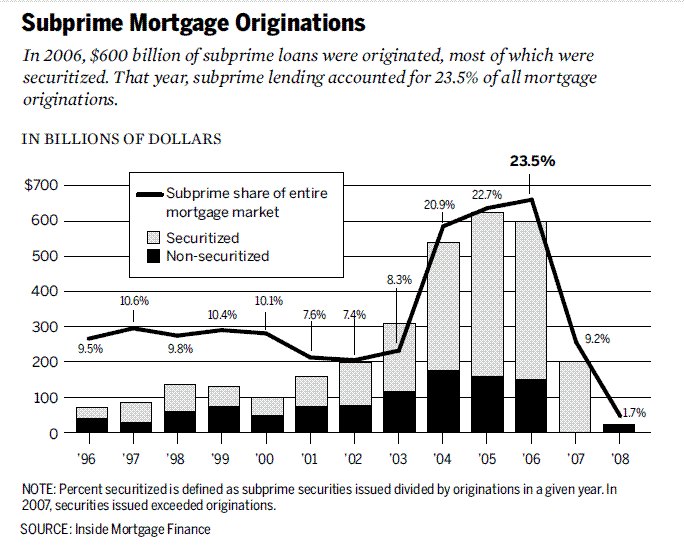
Subprime share of all mortgage originations in 2006: 28%


Subprime share of all mortgage origination in 2003: 8%


Subprime share of all home loans outstanding:
14%


Subprime share of foreclosure filings in the 12 months ending June 30, 2007: 64%


Subprime_mortgage_originations,_1996-2008.GIF
No one is arguing Bush didn't lower lending standards. But you ignore Clinton did the same and helped contribute to the resulting crisis, and the lowering of standards began under Carter through the CRA. Also, the repeal of Glass Steagall and artificially low interest rates of the Federal Reserve played a role.

You are a partisan hack with no perspective.


Got it, YOU are projecting as aa POS...

WEIRD HOW IT TOOK SO LONG FOR CARTER AND CLINTON TO DO THIS:

Subprime_mortgage_originations,_1996-2008.GIF


Q When did the Bush Mortgage Bubble start?

A The general timeframe is it started late 2004.

From Bush’s President’s Working Group on Financial Markets October 2008

“The Presidents Working Group’s March policy statement acknowledged that turmoil in financial markets clearly was triggered by a dramatic weakening of underwriting standards for U.S. subprime mortgages, beginning in late 2004 and extending into 2007.”


Q Did the Community Reinvestment Act under Carter/Clinton caused it?


A "Since 1995 there has been essentially no change in the basic CRA rules or enforcement process that can be reasonably linked to the subprime lending activity. This fact weakens the link between the CRA and the current crisis since the crisis is rooted in poor performance of mortgage loans made between 2004 and 2007. "

http://www.federalreserve.gov/newsevents/speech/20081203_analysis.pdf


Bushs documented policies and statements in timeframe leading up to the start of the Bush Mortgage Bubble include (but not limited to)

Wanting 5.5 million more minority homeowners
Tells congress there is nothing wrong with GSEs
Pledging to use federal policy to increase home ownership
Routinely taking credit for the housing market
Forcing GSEs to buy more low income home loans by raising their Housing Goals
Lowering Invesntment banks capital requirements, Net Capital rule
Reversing the Clinton rule that restricted GSEs purchases of subprime loans
Lowering down payment requirements to 0%
Forcing GSEs to spend an additional $440 billion in the secondary markets
Giving away 40,000 free down payments
PREEMPTING ALL STATE LAWS AGAINST PREDATORY LENDING


But the biggest policy was regulators not enforcing lending standards.

YES, CLINTON HAD A HOMES PUSH, LIKE EVERY OTHER US PREZ SINCE FDR. WEIRD ONLY RONNIE AND DUBYA IGNORED REGULATOR WARNINGS AND HAD MAJOR ISSUES THOUGH???


•Private lenders not subject to congressional regulations collapsed lending standards.
Taking up that extra share were nonbanks selling mortgages elsewhere, not to the GSEs. Conforming mortgages had rules that were less profitable than the newfangled loans. Private securitizers — competitors of Fannie and Freddie — grew from 10 percent of the market in 2002 to nearly 40 percent in 2006. As a percentage of all mortgage-backed securities, private securitization grew from 23 percent in 2003 to 56 percent in 2006


These firms had business models that could be called “Lend-in-order-to-sell-to-Wall-Street-securitizers.” They offered all manner of nontraditional mortgages — the 2/28 adjustable rate mortgages, piggy-back loans, negative amortization loans. These defaulted in huge numbers, far more than the regulated mortgage writers did.

Examining the big lie How the facts of the economic crisis stack up The Big Picture

PERHAPS ONE TIME YOU'LL ADMIT YOU ARE WRONG ON THIS??? LOL
The reason there weren't subprime mortgages to the degree there were in the 2000s that there were in the 90s is because we were in a tech bubble. Mortgage rates were low, but higher yields existed in these artificially highly valued tech companies. The Housing Bubble was artificially pumped up by the Federal Reserve in response to the bursting of the Dot.Com bubble in the Early 2000s.
Here s How The Community Reinvestment Act Led To The Housing Bubble s Lax Lending - Business Insider
Dubya s Double Dip - New York Times


This idea that Clinton lowering standards didn't add to the crisis, only Bush lowering standards did, is objectively absurd on its face, as is claiming the Fed artificially lowering rates and Glass Steagall repeal played no role is. Just because the bubble burst under Bush, doesn't mean he is exclusively responsible. He helped accelerate lax lending standards that were already in place.

The financial collapse is the responsibility of an entire system of government that has been compromised by wall street donors dictating policy through political contributions and a revolving door between the Federal Reserve, the Treasury, and Wall Street.
The ever-revolving door between government and Wall Street

Relativism... it kills viability. And that is what you saw coerce the financial markets into to doing what they should have never accepted, but which it did... .

The chart tells the entire story... everyone was looking out for their own interests, having set aside any concern for objective principle. Lower mortgage standards inevitably caused a run on those highly coveted instruments, which caused the value of the underlying property to increase until the market could no longer sustain those values... then: BOOM! The House of Relativist cards comes crashing down and fascism has once again screwed everyone that have come into contact with it.

And just as the Left has always claimed: That the Right Wing fooled the Leftwing... in reality, the subjectivity overruled the objectivity which was essential to preventing what happened, from happening.

And there is only one ideology which is built upon and around the exclusion of objectivity... so despite all of the endless 'debate' which to some lends the appearance of complexity, there is nothing complex about where the problem started, who started it, who milked it and whose responsible for it.

I'm all for charging the Corporate officers with crimes... but only after those in government who started the process are charged, convicted and have been executed. Then, we can go to work demonstrating the downside to letting government tell you how you'll handle your responsibilities, to the people presently handling their responsibilities... and I bet you that those people will be most forthcoming in the investigations of who in government is telling them how to handle the responsibilities TODAY!

And in the span of a few weeks, this all gets worked out and the cultural train is set right back up on its principled tracks.
 
Sure Bubba, You are to dense to understand since Clinton signed NAFTA, I opposed NAFTA, since that, I must LOVE Clinton, the best conservative Prez since Ike. You are nothing but a bigoted, right winger. Call yourself whatever you want. Believe in fairy tales, I love the spaghetti monster in the sky myself. You wing nutters who want to hold onto 'tradition and custom', lets get a few slaves for you and make sure you strike your wife to make sure she puts you on the pedestal right?

Funny how you can't just simply answer the question: Q - Do you oppose Clinton in signing NAFTA? A - Yes I do.

Simple.

See.

Instead you post gibberish: Q - Do you oppose Clinton in signing NAFTA? A - What do you think? I love spaghetti monsters!
 
Do you want to pretend it didn't happen or wait for me to forget? This is why we'll get no where with fools like you who don't even know/remember what the **** happened to us once Bush got into office.

Remember he took Clinton's SURPLUS and squandered it. Him and his GOP party led by Tom Delay.

If Clinton ran a "surplus" then why did the national debt go up every year he was in office?

I have a secret for you, Beav, politicians lie. Shocking, isn't it?

DON'T KNOW WHAT A YEARLY BUDGET IS HUH? SHOCKING

Q: During the Clinton administration was the federal budget balanced? Was the federal deficit erased?

A: Yes to both questions, whether you count Social Security or not.

FederalDeficit(1).jpg


The Budget and Deficit Under Clinton

Begging the question. Why did the national debt go up every year he was in office if we ran a surplus. That's the first question I asked you, Sparky. There's a reason you're evading it, it shows your lie.

You don't know how a yearly budget works Bubba? SERIOUSLY?

DEFINITION of 'Budget Surplus'

A situation in which income exceeds expenditures. The term "budget surplus" is most commonly used to refer to the financial situations of governments; individuals speak of "savings" rather than a "budget surplus." A surplus is considered a sign that government is being run efficiently.

Budget Surplus Definition Investopedia

LOL, I work in finance, and I own my own business. I also was a math major as an undergrad. I understand numbers. Let's see how you do.

So read what you just wrote. A budget surplus is "a situation in which income exceeds expenditures." So, if income exceeded expenditures every year Clinton was President, how did the national debt go up? That makes no sense.

...

Now walk me through how with a surplus the debt could go up.
I think you are looking at or have looked at GROSS National debt and not NET National debt Kaz...?
i'll quote an in depth response of another member here...Toro

You have posted forecasts by the CBO. I have posted ex post data from the CBO. Do you not see the difference? Forecasting is trying to predict the future. Accounting is determining what happened in the past. Forecasting accurately is extraordinarily difficult. People change forecasts constantly because the future is inherently unknowable.

The CBO data is consistent with the GAO data which is consistent with the Treasury data.

ShaklesOfBigGov said:
I trust the public information found under the Federal Treasury Government Link. I'm not following ideology, but I'm looking to the facts between Federal Government DEBT and DEFICIT Source: Debt to the Penny (Daily History Search Application) (this TreasuryDirect Government site allows you to go into a History search to show you the Outstanding Federal Debt). Why does the public debt continue to go up during the Clinton administration?

Here is a listing of the Public Debt for prior fiscal years under President Bill Clinton:
09/29/1995 .... $4,973,982,900,709.39
09/30/1996 .... $5,224,810,939,135.73
09/30/1997 .... $5,413,146,011,397.34
09/30/1998 .... $5,526,194,008,897.62
09/30/1999 .... $5,656,270,901,615.43

Source: History of the U.S. public debt - Wikipedia, the free encyclopedia


Can you explain the reason behind the INCREASE in the Federal debt ceiling during Clinton's term?
April 6, 1993 .. $4,370,000,000,000
Aug 10, 1993 .. $4,900,000,000,000
Mar 29, 1996 .. $5,500,000,000,000
Aug 5, 1997 .... $5,950,000,000,000
June 11, 2002 . $6,400,000,000,000 (under President George W Bush, the same gradual increase in the debt ceiling is shown to have be made)

Source: United States public debt - Wikipedia, the free encyclopedia
Click to expand...


I'm not arguing that the national debt didn't go down. I'm explaining how the government can run a surplus while the national debt rises, which I do here.

It is factually incorrect to deduce changes in the national debt as indicative of the government's budgetary balance. The national debt is partly a function of inter-governmental accounting, which does not give an accurate assessment of the financial health of the US government because it only looks at one side of the balance sheet.

The national debt is gross debt, not net debt. This is from the link you cite below. As you can see, gross debt rose.

usgs_line.php


The way the government accounts for its books, if there was economic growth and the government spent exactly zero dollars more than the year before, the national debt - which is gross debt - would still rise, all else being equal, because taxes flowing into the trusts automatically trigger buying of government securities. But the net debt would not rise because there would be a concurrent rise in asset value of the trusts, which are government agencies.

ShaklesOfBigGov said:
Yes the deficit went down, but at the cost of the Federal Debt. See Deficit vs Federal Debt Graphs - usgovernment link: United States Debt Deficit History - Charts Following this government link you will see TWO groups of graphs; one that focuses on Government Debt since 1900, followed by a set graphs that shows the Government Deficit. The graphs will show the Deficit did go down, but at the cost of the Federal Debt which continued to go up.
The deficit was eliminated. It wasn't just reduced. There was a surplus. Here is the graph from the link you provided.

usgs_line.php


See?

This is not about whether or not the gross national debt rose. This is about whether or not there were surpluses in the 1990s. And there were.

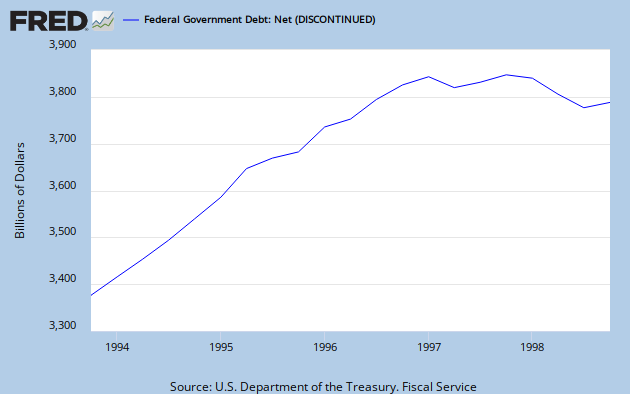
What matters in this discussion is not that gross debt rose in the 1990s. What matters is that net debt fell. If the government was running surpluses, you would expect to see a decline in the national net debt, all else being equal.

And it did.

United States Total Government Net Debt (% of GDP) data, Total Government Net Debt (% of GDP) United States

This is net debt to GDP. Net debt to GDP can fall if GDP is rising faster than the growth of debt. But you can see that net debt to GDP fell from 54% in 1995 to 35% in 2000. That is due both to a rise in nominal GDP and a decline in total net debt.

And, as you can see, total net federal government debt declined in the last years of the 1990s.

fredgraph.png


Last edited: Dec 24, 2010


Republicans Fiscal Sanity Page 19 US Message Board - Political Discussion Forum
 
HERE IS another post that goes in to it from Iriemon:

Ever since I started posting here, I've seen in a number of threads with posts from a number of different people who claim that the budget surplus during the Clinton administration was a "myth," and that in fact there was no surplus.

The "fact" that there was no surplus under Clinton has been "proved" here "over and over and over" according to some like DiamondDave, who as of late taken to neg repping me for even asserting otherwise.

I don't know who was debating this point before I got here, but if it was "proved" over and over that a surplus under Clinton was a "myth" they weren't very knowledgeable. Or they get their information for the Murdoch "news" outlets.

So this thread is to settle the matter once and for all.

Those who claim that the surplus during the Clinton administration was a "myth" can use this opportunity to prove me wrong. And since it apparently has been proved "over and over and over" again to have been a myth it shouldn't be too hard to prove it one more time.

+++

Here' *my* proof that there was in fact a surplus:

The Congressional Budget Office is a non-partisan office that keeps budget records for Congress. You can see CBO reports on historical actual budget information in its website here:

The Budget and Economic Outlook Fiscal Years 2009 to 2019 Congressional Budget Office

Table 1 reports summary budget information, including two measures of the deficit (or surplus). "Total" includes SS surplus tax receipts (and has commonly been used by the Bush administration to measure deficits), and "on-budget" does not (and is therefore the more accurate measure, IMO, since SS taxes are not supposed to be used for general Govt expenditures). Because SS taxes have produced a surplus (about $200 billion) the last couple years, the on-budget surplus is lower than the "total" surplus (and conversely, the on-budget deficit is greater than the "total" deficit).

Follow the table down to the year "2000" and in the third column you can find that the "on-budget" surplus for 2000 was $86.4 billion. In 1999, there was a $1.9 billion surplus. You can see in the next column that the "total" surplus figures are even larger.

The U.S. budget does not include every expenditure -- for example, it has (prior to Obama taking office excludes "non-permanent" expenditures like the Iraq war. By excluding such things, the Bush administration was able to make the deficits look less severe. In 2006 and 2007, for example, the Bush administration claimed deficits of significantly less than $500 billion, while the US Govt actually had to borrow more than $500 billion in each of those years.

So looking at actual borrowing of the US Govt gives another picture of the deficit. For example, last year, the Govt borrowed over a trillion dollars, which is one way of measuring the size of the deficit Obama inhereted.

Did Clinton have a surplus using this measurement?

You can access the total debt of the US Govt from the Treasury Department's website, here:

Debt to the Penny (Daily History Search Application)

Total debt of the US Government:

12/31/1999 $5,776,091,314,225.33
12/29/2000 $5,662,216,013,697.37

The total debt of the US Govt decreased by $114 billion during 2000, Clinton's last year in office.

Showing a true surplus.

+++

So to DiamondDave or anyone else who claims the surplus under Clinton was a "myth," here's a chance to present the "proof" that has been shown "over and over and over" that this surplus is a just a "myth".
 
Yea...we get it

You hate poor people and don't want to pay for their support
Others hate wars and don't want to pay to support that

Why are you STEALING my money to pay for wars?

I probably do more to help out poor people than you do ... But that would be a guess at best. The only reason I suggest it is because I don't relinquish my responsibilities to help to poor to the government ... And pay my taxes on top of that.

If you have a problem with the government confiscating your wealth to fight wars ... Take it up with them ... Not me.

Your argument doesn't offer an argument at all ... Only speculation and the desire to reward a lack of personal responsibility cobbled to an inefficient, failing and corrupt government bureaucracy.

.
I probably do more to help out poor people than you do ... But that would be a guess at best. The only reason I suggest it is because I don't relinquish my responsibilities to help to poor to the government ... And pay my taxes on top of that.


I collect twinkies to feed the homeless, feed puppies and kittens and help old ladies to cross the street

Doesn't mean I don't expect my government to help people who need helping
 
If Clinton ran a "surplus" then why did the national debt go up every year he was in office?

I have a secret for you, Beav, politicians lie. Shocking, isn't it?

DON'T KNOW WHAT A YEARLY BUDGET IS HUH? SHOCKING

Q: During the Clinton administration was the federal budget balanced? Was the federal deficit erased?

A: Yes to both questions, whether you count Social Security or not.

FederalDeficit(1).jpg


The Budget and Deficit Under Clinton

Begging the question. Why did the national debt go up every year he was in office if we ran a surplus. That's the first question I asked you, Sparky. There's a reason you're evading it, it shows your lie.

You don't know how a yearly budget works Bubba? SERIOUSLY?

DEFINITION of 'Budget Surplus'

A situation in which income exceeds expenditures. The term "budget surplus" is most commonly used to refer to the financial situations of governments; individuals speak of "savings" rather than a "budget surplus." A surplus is considered a sign that government is being run efficiently.

Budget Surplus Definition Investopedia

LOL, I work in finance, and I own my own business. I also was a math major as an undergrad. I understand numbers. Let's see how you do.

So read what you just wrote. A budget surplus is "a situation in which income exceeds expenditures." So, if income exceeded expenditures every year Clinton was President, how did the national debt go up? That makes no sense.

...

Now walk me through how with a surplus the debt could go up.
I think you are looking at or have looked at GROSS National debt and not NET National debt Kaz...?
i'll quote an in depth response of another member here...Toro

You have posted forecasts by the CBO. I have posted ex post data from the CBO. Do you not see the difference? Forecasting is trying to predict the future. Accounting is determining what happened in the past. Forecasting accurately is extraordinarily difficult. People change forecasts constantly because the future is inherently unknowable.

The CBO data is consistent with the GAO data which is consistent with the Treasury data.

ShaklesOfBigGov said:
I trust the public information found under the Federal Treasury Government Link. I'm not following ideology, but I'm looking to the facts between Federal Government DEBT and DEFICIT Source: Debt to the Penny (Daily History Search Application) (this TreasuryDirect Government site allows you to go into a History search to show you the Outstanding Federal Debt). Why does the public debt continue to go up during the Clinton administration?

Here is a listing of the Public Debt for prior fiscal years under President Bill Clinton:
09/29/1995 .... $4,973,982,900,709.39
09/30/1996 .... $5,224,810,939,135.73
09/30/1997 .... $5,413,146,011,397.34
09/30/1998 .... $5,526,194,008,897.62
09/30/1999 .... $5,656,270,901,615.43

Source: History of the U.S. public debt - Wikipedia, the free encyclopedia


Can you explain the reason behind the INCREASE in the Federal debt ceiling during Clinton's term?
April 6, 1993 .. $4,370,000,000,000
Aug 10, 1993 .. $4,900,000,000,000
Mar 29, 1996 .. $5,500,000,000,000
Aug 5, 1997 .... $5,950,000,000,000
June 11, 2002 . $6,400,000,000,000 (under President George W Bush, the same gradual increase in the debt ceiling is shown to have be made)

Source: United States public debt - Wikipedia, the free encyclopedia
Click to expand...


I'm not arguing that the national debt didn't go down. I'm explaining how the government can run a surplus while the national debt rises, which I do here.

It is factually incorrect to deduce changes in the national debt as indicative of the government's budgetary balance. The national debt is partly a function of inter-governmental accounting, which does not give an accurate assessment of the financial health of the US government because it only looks at one side of the balance sheet.

The national debt is gross debt, not net debt. This is from the link you cite below. As you can see, gross debt rose.

usgs_line.php


The way the government accounts for its books, if there was economic growth and the government spent exactly zero dollars more than the year before, the national debt - which is gross debt - would still rise, all else being equal, because taxes flowing into the trusts automatically trigger buying of government securities. But the net debt would not rise because there would be a concurrent rise in asset value of the trusts, which are government agencies.

ShaklesOfBigGov said:
Yes the deficit went down, but at the cost of the Federal Debt. See Deficit vs Federal Debt Graphs - usgovernment link: United States Debt Deficit History - Charts Following this government link you will see TWO groups of graphs; one that focuses on Government Debt since 1900, followed by a set graphs that shows the Government Deficit. The graphs will show the Deficit did go down, but at the cost of the Federal Debt which continued to go up.
The deficit was eliminated. It wasn't just reduced. There was a surplus. Here is the graph from the link you provided.

usgs_line.php


See?

This is not about whether or not the gross national debt rose. This is about whether or not there were surpluses in the 1990s. And there were.

What matters in this discussion is not that gross debt rose in the 1990s. What matters is that net debt fell. If the government was running surpluses, you would expect to see a decline in the national net debt, all else being equal.

And it did.

United States Total Government Net Debt (% of GDP) data, Total Government Net Debt (% of GDP) United States

This is net debt to GDP. Net debt to GDP can fall if GDP is rising faster than the growth of debt. But you can see that net debt to GDP fell from 54% in 1995 to 35% in 2000. That is due both to a rise in nominal GDP and a decline in total net debt.

And, as you can see, total net federal government debt declined in the last years of the 1990s.

fredgraph.png


Last edited: Dec 24, 2010


Republicans Fiscal Sanity Page 19 US Message Board - Political Discussion Forum

The "Surplus" was relevant to "The Clinton Budget", not the national debt. And given that such was centered well within Kaz's point, the above post is hysterical.

See how easy this is?
 
DON'T KNOW WHAT A YEARLY BUDGET IS HUH? SHOCKING

Q: During the Clinton administration was the federal budget balanced? Was the federal deficit erased?

A: Yes to both questions, whether you count Social Security or not.

FederalDeficit(1).jpg


The Budget and Deficit Under Clinton

Begging the question. Why did the national debt go up every year he was in office if we ran a surplus. That's the first question I asked you, Sparky. There's a reason you're evading it, it shows your lie.

You don't know how a yearly budget works Bubba? SERIOUSLY?

DEFINITION of 'Budget Surplus'

A situation in which income exceeds expenditures. The term "budget surplus" is most commonly used to refer to the financial situations of governments; individuals speak of "savings" rather than a "budget surplus." A surplus is considered a sign that government is being run efficiently.

Budget Surplus Definition Investopedia

LOL, I work in finance, and I own my own business. I also was a math major as an undergrad. I understand numbers. Let's see how you do.

So read what you just wrote. A budget surplus is "a situation in which income exceeds expenditures." So, if income exceeded expenditures every year Clinton was President, how did the national debt go up? That makes no sense.

...

Now walk me through how with a surplus the debt could go up.
I think you are looking at or have looked at GROSS National debt and not NET National debt Kaz...?
i'll quote an in depth response of another member here...Toro

You have posted forecasts by the CBO. I have posted ex post data from the CBO. Do you not see the difference? Forecasting is trying to predict the future. Accounting is determining what happened in the past. Forecasting accurately is extraordinarily difficult. People change forecasts constantly because the future is inherently unknowable.

The CBO data is consistent with the GAO data which is consistent with the Treasury data.

ShaklesOfBigGov said:
I trust the public information found under the Federal Treasury Government Link. I'm not following ideology, but I'm looking to the facts between Federal Government DEBT and DEFICIT Source: Debt to the Penny (Daily History Search Application) (this TreasuryDirect Government site allows you to go into a History search to show you the Outstanding Federal Debt). Why does the public debt continue to go up during the Clinton administration?

Here is a listing of the Public Debt for prior fiscal years under President Bill Clinton:
09/29/1995 .... $4,973,982,900,709.39
09/30/1996 .... $5,224,810,939,135.73
09/30/1997 .... $5,413,146,011,397.34
09/30/1998 .... $5,526,194,008,897.62
09/30/1999 .... $5,656,270,901,615.43

Source: History of the U.S. public debt - Wikipedia, the free encyclopedia


Can you explain the reason behind the INCREASE in the Federal debt ceiling during Clinton's term?
April 6, 1993 .. $4,370,000,000,000
Aug 10, 1993 .. $4,900,000,000,000
Mar 29, 1996 .. $5,500,000,000,000
Aug 5, 1997 .... $5,950,000,000,000
June 11, 2002 . $6,400,000,000,000 (under President George W Bush, the same gradual increase in the debt ceiling is shown to have be made)

Source: United States public debt - Wikipedia, the free encyclopedia
Click to expand...


I'm not arguing that the national debt didn't go down. I'm explaining how the government can run a surplus while the national debt rises, which I do here.

It is factually incorrect to deduce changes in the national debt as indicative of the government's budgetary balance. The national debt is partly a function of inter-governmental accounting, which does not give an accurate assessment of the financial health of the US government because it only looks at one side of the balance sheet.

The national debt is gross debt, not net debt. This is from the link you cite below. As you can see, gross debt rose.

usgs_line.php


The way the government accounts for its books, if there was economic growth and the government spent exactly zero dollars more than the year before, the national debt - which is gross debt - would still rise, all else being equal, because taxes flowing into the trusts automatically trigger buying of government securities. But the net debt would not rise because there would be a concurrent rise in asset value of the trusts, which are government agencies.

ShaklesOfBigGov said:
Yes the deficit went down, but at the cost of the Federal Debt. See Deficit vs Federal Debt Graphs - usgovernment link: United States Debt Deficit History - Charts Following this government link you will see TWO groups of graphs; one that focuses on Government Debt since 1900, followed by a set graphs that shows the Government Deficit. The graphs will show the Deficit did go down, but at the cost of the Federal Debt which continued to go up.
The deficit was eliminated. It wasn't just reduced. There was a surplus. Here is the graph from the link you provided.

usgs_line.php


See?

This is not about whether or not the gross national debt rose. This is about whether or not there were surpluses in the 1990s. And there were.

What matters in this discussion is not that gross debt rose in the 1990s. What matters is that net debt fell. If the government was running surpluses, you would expect to see a decline in the national net debt, all else being equal.

And it did.

United States Total Government Net Debt (% of GDP) data, Total Government Net Debt (% of GDP) United States

This is net debt to GDP. Net debt to GDP can fall if GDP is rising faster than the growth of debt. But you can see that net debt to GDP fell from 54% in 1995 to 35% in 2000. That is due both to a rise in nominal GDP and a decline in total net debt.

And, as you can see, total net federal government debt declined in the last years of the 1990s.

fredgraph.png


Last edited: Dec 24, 2010


Republicans Fiscal Sanity Page 19 US Message Board - Political Discussion Forum

The "Surplus" was relevant to "The Clinton Budget", not the national debt. And given that such was centered well within Kaz's point, the above post is hysterical.

See how easy this is?
No
 
So you see the Fairness Doctrine as a method for reducing the influence that wealthy people have on the legislative process.

Is that because you see it as a method for reducing the influence that wealthy station owners have on the message being broadcast? The hope being that a more balanced message will lead to a more informed voting population?That this will then change who the voters elect? That the legislators will then be more free from the influence of wealthy people?

Sorry just trying to follow your train of thought.

Back in the 50s and 60s, people were wise enough to realize that since A.M. bandwidth is limited, that in order to avoid monopolization, it was necessary to implement certain requirements that ensured it served the public interests instead of merely the interests of those owning the stations. The fairness doctrine was the way to preserve that long-standing American tradition of free speech and access to a wide range of ideas so as to enable an informed electorate rather than having such ideas hand-selected for us.

The influence of money as it relates to radio should be obvious. It takes a lot of the stuff to broadcast, and in the years since the 60s, the trend has been towards conglomeration. There are fewer and fewer independent radio stations all the time, having been replaced by giants such as clear channel and cumulus, which have now merged, thus allowing for the monopolization of opinion even further.

The re-implementation of this doctrine that acted to conserve our American valuesin regards to free speech would certainly not end the ability of enormous corporations to control the political climate of this country, but it would at least provide for a little balance in the way this media operates.

That would assume that broadcast is the method of choice for Americans in receiving their news and other content. I would argue that in this day and age that is no longer remotely accurate. I NEVER listen to radio and I am far from alone in that. I much more likely to listen to streaming media, podcasts, etc even in the car. I read news online.

As you said yourself, the Fairness Doctrine was about the limitations on available bandwidth and the avoidance of monopolization. There has been a significant increase in the available means of transmitting and receiving information since that time. Do you still see it as expedient for the government to mandate the content that is broadcast in the current situation?

You CAN'T be honest can you? Without the Fairness Doctrine, right wingers just get to lie. Yes, other media is out there, but fed off of mostly Faux and right wing hate radio bullshit!


Tax cuts will bring in more revenues? lol. Biggest lie. Tax cuts create jobs? Second biggest. Obama a 'leftist, Marxist, Commie, etc' (He's Corp) 3rd biggest ...

What did I say that was dishonest?

Troll on friend. Troll on.

"Fairness Doctrine was about the limitations on available bandwidth and the avoidance of monopolization"


6 Corps own 90% of US media Bubba. Seriously????

And?

The purpose of the Fairness Doctrine was "to provide adequate coverage of public issues, and to ensure that coverage fairly represented opposing views."

"Although similar laws are unconstitutional when applied to the press, the Court cited a Senate report (S. Rep. No. 562, 86th Cong., 1st Sess., 8-9 [1959]) stating that radio stations could be regulated in this way because of the limited public airwaves at the time."

Again, the point of the Fairness Doctrine was to avoid "monopolization of the message" by the companies that own the broadcasting networks. At the time it was justified by the limitations on bandwidth that made it difficult or impossible to "get your message out there" without using a network owned by a major corporation.

Now there are many methods for getting your message out there. A YouTube video made by a kid living in a trailer park can be seen by millions. Anyone can make a podcast or write a blog. Satellite radio has hundreds of stations. The limitations that were used as justification for government controlling what must be broadcast are no longer as valid.

Now, there may be other justifications that could be put forth, and some may even have merit, but the justification that radio bandwidth limitations present an opportunity for corporations to monopolize the distribution of information is no longer valid.

Edit: forgot to post the link - Fairness Doctrine - Wikipedia the free encyclopedia
 
Last edited:
this is a serious question, please only reply with serious comments.

what specifically do liberals want the US to become?
Tell us exactly what you want changed, and why.

My take is that the hardcore left is after a solid social democracy, perhaps a step or two to the left of modern-day France.

They do reference Sweden quite a bit, which indeed would be quite a change.

.

They reference many locations stating they like what is being done there. If I didn't like where I was as much as I liked somewhere else, I'd move.
 
15th post
Here it is. What do Liberals want the United States to be.

First and foremost, I, like many Liberals want the United States to be a land that keeps its promises. We want this land to be one place where each and every citizen can enjoy all the rights, inalienable and enumerated. Every sober, law abiding tax paying citizen should be regarded as equal in the eyes of the law and by every other citizen. We do not believe there is a right to discriminate.

We want this nation to be benevolent and not subservient to the wealthy, the greedy and the selfish. If our citizens need a helping hand, they should not be scorned, denied, and belittled due to their circumstances. We Liberals do not see poverty as a character flaw. Rather we recognize the ancillary and systematic causes of poverty, namely lack of education, opportunity and connections to the 'upper classes'.

We Liberals recognize that this is the only planet we have and, because of this, we should be vigilant stewards of our natural resources and environment. Exploitation for profit's sake is a short sighted game advocated only by those without sufficient knowledge to make decisions.

We want the United States to be respected and admired around the globe. We do not advocate abandoning our national sense of morality and ethics in order to mete out revenge in the guise of interrogation. We would not impose a Jeffersonian democracy on a people who do not desire such a system.

We Liberals want the United States to be the envy of every other nation in the important areas such as education, science and technology, arts and literature, standard of living and every measure of security and freedom.

Now, some of these may sound like pleasant platitudes. Some of it may chafe the hides of those who want to keep classes and groups of their fellow Americans in subservient positions in our society. Others will disagree that American citizens deserve a helping hand from time to time. What does all this mean? Liberals desire fairness, equality, freedom and security like every American. Dividing us to conquer us along political lines is the game of the flamethrower, the demagogue, the power mad partisan.
 
Begging the question. Why did the national debt go up every year he was in office if we ran a surplus. That's the first question I asked you, Sparky. There's a reason you're evading it, it shows your lie.

You don't know how a yearly budget works Bubba? SERIOUSLY?

DEFINITION of 'Budget Surplus'

A situation in which income exceeds expenditures. The term "budget surplus" is most commonly used to refer to the financial situations of governments; individuals speak of "savings" rather than a "budget surplus." A surplus is considered a sign that government is being run efficiently.

Budget Surplus Definition Investopedia

LOL, I work in finance, and I own my own business. I also was a math major as an undergrad. I understand numbers. Let's see how you do.

So read what you just wrote. A budget surplus is "a situation in which income exceeds expenditures." So, if income exceeded expenditures every year Clinton was President, how did the national debt go up? That makes no sense.

...

Now walk me through how with a surplus the debt could go up.
I think you are looking at or have looked at GROSS National debt and not NET National debt Kaz...?
i'll quote an in depth response of another member here...Toro

You have posted forecasts by the CBO. I have posted ex post data from the CBO. Do you not see the difference? Forecasting is trying to predict the future. Accounting is determining what happened in the past. Forecasting accurately is extraordinarily difficult. People change forecasts constantly because the future is inherently unknowable.

The CBO data is consistent with the GAO data which is consistent with the Treasury data.

ShaklesOfBigGov said:
I trust the public information found under the Federal Treasury Government Link. I'm not following ideology, but I'm looking to the facts between Federal Government DEBT and DEFICIT Source: Debt to the Penny (Daily History Search Application) (this TreasuryDirect Government site allows you to go into a History search to show you the Outstanding Federal Debt). Why does the public debt continue to go up during the Clinton administration?

Here is a listing of the Public Debt for prior fiscal years under President Bill Clinton:
09/29/1995 .... $4,973,982,900,709.39
09/30/1996 .... $5,224,810,939,135.73
09/30/1997 .... $5,413,146,011,397.34
09/30/1998 .... $5,526,194,008,897.62
09/30/1999 .... $5,656,270,901,615.43

Source: History of the U.S. public debt - Wikipedia, the free encyclopedia


Can you explain the reason behind the INCREASE in the Federal debt ceiling during Clinton's term?
April 6, 1993 .. $4,370,000,000,000
Aug 10, 1993 .. $4,900,000,000,000
Mar 29, 1996 .. $5,500,000,000,000
Aug 5, 1997 .... $5,950,000,000,000
June 11, 2002 . $6,400,000,000,000 (under President George W Bush, the same gradual increase in the debt ceiling is shown to have be made)

Source: United States public debt - Wikipedia, the free encyclopedia
Click to expand...


I'm not arguing that the national debt didn't go down. I'm explaining how the government can run a surplus while the national debt rises, which I do here.

It is factually incorrect to deduce changes in the national debt as indicative of the government's budgetary balance. The national debt is partly a function of inter-governmental accounting, which does not give an accurate assessment of the financial health of the US government because it only looks at one side of the balance sheet.

The national debt is gross debt, not net debt. This is from the link you cite below. As you can see, gross debt rose.

usgs_line.php


The way the government accounts for its books, if there was economic growth and the government spent exactly zero dollars more than the year before, the national debt - which is gross debt - would still rise, all else being equal, because taxes flowing into the trusts automatically trigger buying of government securities. But the net debt would not rise because there would be a concurrent rise in asset value of the trusts, which are government agencies.

ShaklesOfBigGov said:
Yes the deficit went down, but at the cost of the Federal Debt. See Deficit vs Federal Debt Graphs - usgovernment link: United States Debt Deficit History - Charts Following this government link you will see TWO groups of graphs; one that focuses on Government Debt since 1900, followed by a set graphs that shows the Government Deficit. The graphs will show the Deficit did go down, but at the cost of the Federal Debt which continued to go up.
The deficit was eliminated. It wasn't just reduced. There was a surplus. Here is the graph from the link you provided.

usgs_line.php


See?

This is not about whether or not the gross national debt rose. This is about whether or not there were surpluses in the 1990s. And there were.

What matters in this discussion is not that gross debt rose in the 1990s. What matters is that net debt fell. If the government was running surpluses, you would expect to see a decline in the national net debt, all else being equal.

And it did.

United States Total Government Net Debt (% of GDP) data, Total Government Net Debt (% of GDP) United States

This is net debt to GDP. Net debt to GDP can fall if GDP is rising faster than the growth of debt. But you can see that net debt to GDP fell from 54% in 1995 to 35% in 2000. That is due both to a rise in nominal GDP and a decline in total net debt.

And, as you can see, total net federal government debt declined in the last years of the 1990s.

fredgraph.png


Last edited: Dec 24, 2010


Republicans Fiscal Sanity Page 19 US Message Board - Political Discussion Forum

The "Surplus" was relevant to "The Clinton Budget", not the national debt. And given that such was centered well within Kaz's point, the above post is hysterical.

See how easy this is?
No

No surprise there. But without regard to your problem, that's all there is to it.

The Annual Budget does not account for the Federal Debt. The Surplus was purely a function of the annual budget.

Try this:

Let's pretend the world began in 1994. The year prior to the Conservative Revolution, the Clinton Cult was given a budget of $10 and they spent $19.90. Leaving a deficit of $9.90 and a subsequent debt of 9.90.

Which is to say that the budget provided for the Clinton Cult was $10 and they spent MORE than the budget allowed by $9.90, thus they had to borrow money to spend it, leaving a debt of that amount.

After the Conservatives came in and tossed most of the options that the Clinton cabal was spending on, they were again budgeted the $10, but because of the cutting of the programs which were beyond the previous years budget, they only spent $9.98. That left a .02 surplus, meaning that 2 cents of what was budgeted were not spent.

IF that ENTIRE 2 cent surplus were applied to the debt, the debt would then be reduced by .02, leaving a debt of $9.88, before the 10% interests on the debt (~$1.00) is accounted for leaving the total debt at $10.88.

Note that while the annual budget realized a surplus, the debt increased.
 
Here it is. What do Liberals want the United States to be.

First and foremost, I, like many Liberals want the United States to be a land that keeps its promises. We want this land to be one place where each and every citizen can enjoy all the rights, inalienable and enumerated. Every sober, law abiding tax paying citizen should be regarded as equal in the eyes of the law and by every other citizen. We do not believe there is a right to discriminate.

Can you mandate what people think? We all make judgments about other people. Do you look down on people who make bigoted statements or actions based on race or sexuality? Do you regard them as your equal in morality? You can pass laws that make it illegal to "discriminate against people", but to what extent and where can those laws be enforced. Do I have the right to discriminate in who I invite into my home? Do I have the right to discriminate in who I choose to marry? It becomes pretty clear pretty quickly that there is a right to discriminate in some things, and nobody as far as I know will argue that that is not the case. The argument comes in more about when and in what way it is OK to discriminate.

To argue that one side thinks it is always OK to discriminate and the other side thinks it is never OK to discriminate is disingenuous.

We want this nation to be benevolent and not subservient to the wealthy, the greedy and the selfish. If our citizens need a helping hand, they should not be scorned, denied, and belittled due to their circumstances. We Liberals do not see poverty as a character flaw. Rather we recognize the ancillary and systematic causes of poverty, namely lack of education, opportunity and connections to the 'upper classes'.

It is honorable to want people to be benevolent. It isn't realistic to expect everyone to be so, however.

It is honorable to want to help people in need. There are realistic concerns about how it should be accomplished though. If you stand on the street corner handing out $100 bills to people in need, how long do you think it will be before you are thronged by people in "need." If government hands things out indiscriminately, how long will the lines of people waiting for free handouts get?

Should people in need be helped? Sure. If government is going to do the helping, should they be very careful about how that is accomplished? Absolutely.

We Liberals recognize that this is the only planet we have and, because of this, we should be vigilant stewards of our natural resources and environment. Exploitation for profit's sake is a short sighted game advocated only by those without sufficient knowledge to make decisions.

We want the United States to be respected and admired around the globe. We do not advocate abandoning our national sense of morality and ethics in order to mete out revenge in the guise of interrogation. We would not impose a Jeffersonian democracy on a people who do not desire such a system.

We Liberals want the United States to be the envy of every other nation in the important areas such as education, science and technology, arts and literature, standard of living and every measure of security and freedom.

Do you think you are alone in wanting those things? I think from your second to last sentence below that you see that you are not.

Now, some of these may sound like pleasant platitudes. Some of it may chafe the hides of those who want to keep classes and groups of their fellow Americans in subservient positions in our society. Others will disagree that American citizens deserve a helping hand from time to time. What does all this mean? Liberals desire fairness, equality, freedom and security like every American. Dividing us to conquer us along political lines is the game of the flamethrower, the demagogue, the power mad partisan.
 
Back in the 50s and 60s, people were wise enough to realize that since A.M. bandwidth is limited, that in order to avoid monopolization, it was necessary to implement certain requirements that ensured it served the public interests instead of merely the interests of those owning the stations. The fairness doctrine was the way to preserve that long-standing American tradition of free speech and access to a wide range of ideas so as to enable an informed electorate rather than having such ideas hand-selected for us.

The influence of money as it relates to radio should be obvious. It takes a lot of the stuff to broadcast, and in the years since the 60s, the trend has been towards conglomeration. There are fewer and fewer independent radio stations all the time, having been replaced by giants such as clear channel and cumulus, which have now merged, thus allowing for the monopolization of opinion even further.

The re-implementation of this doctrine that acted to conserve our American valuesin regards to free speech would certainly not end the ability of enormous corporations to control the political climate of this country, but it would at least provide for a little balance in the way this media operates.

That would assume that broadcast is the method of choice for Americans in receiving their news and other content. I would argue that in this day and age that is no longer remotely accurate. I NEVER listen to radio and I am far from alone in that. I much more likely to listen to streaming media, podcasts, etc even in the car. I read news online.

As you said yourself, the Fairness Doctrine was about the limitations on available bandwidth and the avoidance of monopolization. There has been a significant increase in the available means of transmitting and receiving information since that time. Do you still see it as expedient for the government to mandate the content that is broadcast in the current situation?

You CAN'T be honest can you? Without the Fairness Doctrine, right wingers just get to lie. Yes, other media is out there, but fed off of mostly Faux and right wing hate radio bullshit!


Tax cuts will bring in more revenues? lol. Biggest lie. Tax cuts create jobs? Second biggest. Obama a 'leftist, Marxist, Commie, etc' (He's Corp) 3rd biggest ...

What did I say that was dishonest?

Troll on friend. Troll on.

"Fairness Doctrine was about the limitations on available bandwidth and the avoidance of monopolization"


6 Corps own 90% of US media Bubba. Seriously????

And?

The purpose of the Fairness Doctrine was "to provide adequate coverage of public issues, and to ensure that coverage fairly represented opposing views."

"Although similar laws are unconstitutional when applied to the press, the Court cited a Senate report (S. Rep. No. 562, 86th Cong., 1st Sess., 8-9 [1959]) stating that radio stations could be regulated in this way because of the limited public airwaves at the time."

Again, the point of the Fairness Doctrine was to avoid "monopolization of the message" by the companies that own the broadcasting networks. At the time it was justified by the limitations on bandwidth that made it difficult or impossible to "get your message out there" without using a network owned by a major corporation.

Now there are many methods for getting your message out there. A YouTube video made by a kid living in a trailer park can be seen by millions. Anyone can make a podcast or write a blog. Satellite radio has hundreds of stations. The limitations that were used as justification for government controlling what must be broadcast are no longer as valid.

Now, there may be other justifications that could be put forth, and some may even have merit, but the justification that radio bandwidth limitations present an opportunity for corporations to monopolize the distribution of information is no longer valid.

Edit: forgot to post the link - Fairness Doctrine - Wikipedia the free encyclopedia

ROFLMNAO! Keep in mind that the word 'fairness' is a misnomer which the Left uses like a bludgeon. It's a relative term which when formally defined, can never mean what the Left implies through its usage of the term.

The term was also central to the coercion to strip the mortgage industry of the application of sound, actuarial lending principle. It turns out that those principles, quite literally executed fairness... in that those who were otherwise qualified to service large amounts of debt over long periods, had access to such debt... and those who were not, did not.

What the Left wanted was unfair lending practices... but, using that term REALLY strangles the means to sell the idea. So, they LIED!

The same is true with the "Fairness Doctrine". Ya see kids, Left-think, which was claiming that it was not being given enough air-time, DOESN'T SELL TO REASONABLE PEOPLE. When it is being sold, people CHANGE THE CHANNEL, or turn off the radio. So in fact, Left-think was being more time than was fair, given that radio stations exist to make money... not to satisfy the needs of sociopaths to have their perverse notions validated through such being aired through public airwaves.

We see this demonstrated time and again, through the consistent failure of every would-be enterprise which was engaged in the sale of that nonsense.
 
Last edited:

New Topics

Back
Top Bottom