What the resulting map shows is that the most “dependent states,” as measured by the composite score, are Mississippi and New Mexico, each of which gets back about $3 in federal spending for every dollar they send to the federal treasury in taxes. Alabama and Louisiana are close behind.
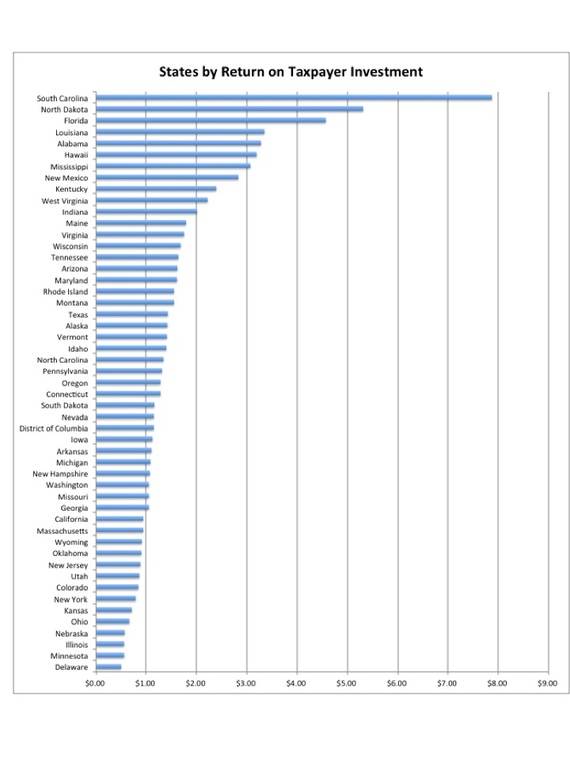
If you look only at the first measure—how much the federal government spends per person in each state compared with the amount its citizens pay in federal income taxes—other states stand out, particularly South Carolina: The Palmetto State receives $7.87 back from Washington for every $1 its citizens pay in federal tax. This bar chart, made from Wallet Hub's data, reveals the sharp discrepancies among states on that measure.
On the other side of this group, folks in 14 states, including Delaware, Minnesota, Illinois, Nebraska, and Ohio, get back less than $1 for each $1 they spend in taxes.
It’s not just that some states are getting way more in return for their federal tax dollars, but the disproportionate amount of federal aid that some states receive allows them to keep their own taxes artificially low. That's the argument Wallet Hub analysts make in their
2014 Report on Best & Worst States to be a Taxpayer.
Part of the explanation for why southern states dominate the “most dependent” category is historical. During the many decades in the 20th century when the South was solidly Democratic, its congressional representatives in both the House and the Senate, enjoying great seniority, came to hold leadership positions on powerful committees, which they used to send federal dollars back to their home states in the form of contracts, projects, installations.
Another part of the explanation is easier to discern.
The reddest states on that map at the top—Mississippi, Alabama, Louisiana, New Mexico, Maine—have exceptionally high poverty rates and thus receive disproportionately large shares of federal dollars. Through a variety of social programs, the federal government disburses hundreds of billions of dollars each year to maintain a “safety net” intended to help the neediest among us. Consider, for example, the percentage of each state’s residents who get “food stamps” through the federal government’s SNAP program. This chart tells the story.
Which States Are Givers and Which Are Takers?
Typical truck driver, not very bright. What the states don't pick up, we taxpayers in other states do.