You mean taxes would have had to be raised in order to have a single-payer system ?
Color me shocked.
What's interesting (and not really being noted here) is
what changed in the last year or two.
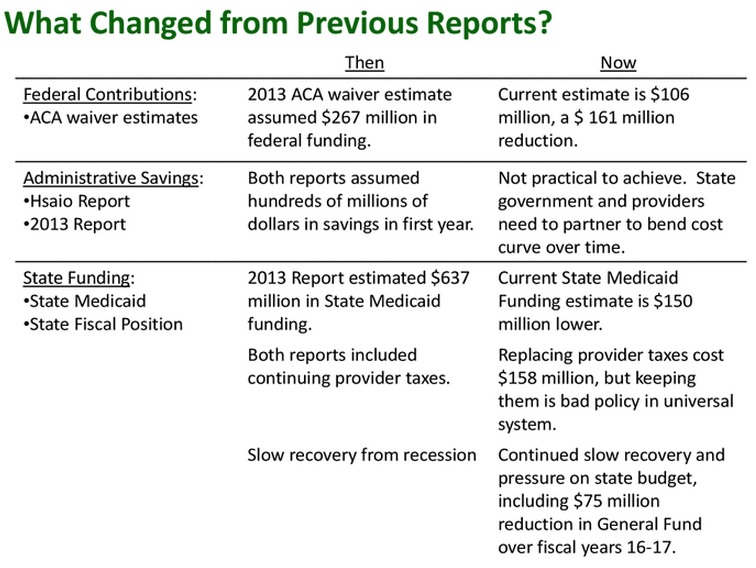
Vermont was counting on re-purposing Medicaid funding to support that new system and it was also counting on getting the value of its ACA exchange subsidies from the federal government (since under the ACA's state innovation waivers, states are given the equivalent of their ACA funding to put toward whatever their alternative model is).
But both of those of those things have dropped substantially from what they were anticipating. In other words, falling per beneficiary Medicaid costs and lower-than-expected ACA exchange subsidies have taken the wind out of their sails.
The premise of Vermont's experiment is that it would be significantly cheaper than the status quo--the more the existing system (under the ACA) comes in under budget expectations the more the financial argument for switching to their pseudo-single payer concept withers.
Record low premium growth (in both the employer space and in the individual commercial markets) and record low spending growth are good news for most people but bad news for Vermont's ambitions. They've taken a huge hit from the financial over-performance of the ACA. Something that's ultimately going to be true for the single-payer movement outside of Vermont.
This is from their explanation of what went "wrong" (though these are actually good indicators of what's going
right with the health care system):


 I said four years ago when they passed this shit it would never get implemented. If Vermont can't afford it how the hell are we supposed to do it nationwide?