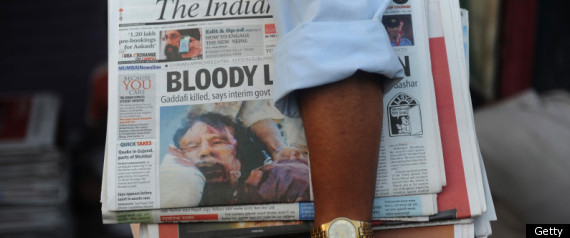
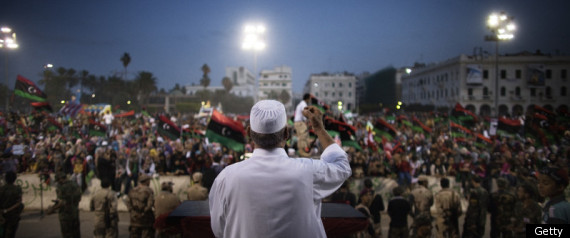
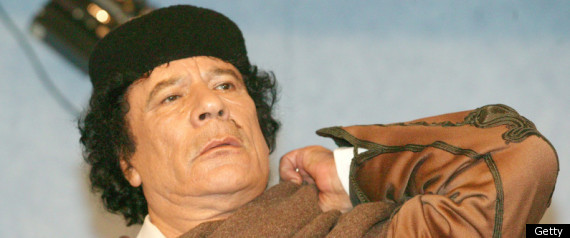
Unrest reported in Libya

Obama On Muammar Gaddafi Death: President Obama Addresses Death Of Libyan Leader

r-OBAMA-MUAMMAR-GADDAFI-DEAD-large570.jpg


President Barack Obama addressed the death of Muammar Gaddafi at a press conference on Thursday.

The AP reports:

U.S. officials already were focused on helping the new Libyan leaders build a stable government before word came Thursday that former dictator Moammar Gaddafi was dead, seven months after the United States and NATO began their bombing campaign in Libya.
The Transitional National Council informed the United States of Gaddafi's death shortly before Prime Minister Mahmoud Jibril's announcement to his nation that the moment so many had waited for had come, a U.S. official said. The White House and State Department were expected to release official responses later Thursday.


Speaking Thursday from the White House Rose Garden, the president said the Libyan people now have the opportunity to determine their own destiny. He said they also have a great responsibility to build a tolerant and democratic Libya.

"The rule of an iron fist inevitably comes to an end," he said.

Obama On Muammar Gaddafi Death: President Obama Addresses Death Of Libyan Leader (LIVE VIDEO)
 
After Muammar Gaddafi, a Perilous Race for Power in Libya

32c3b17397b92317fc0e6a7067006432.jpg


The ignominious end of Col. Muammar Gaddafi may mark a milestone of liberation beyond the wildest dreams and prayers of his long-suffering people just a short year ago, but it also represents a huge headache for Libya's fragile transitional rulers: Gone is the common enemy that bound together a diverse and often fractious coalition of contending tribal, regional and political power centers; the shot that killed Gaddafi was also the starting gun on a potentially perilous race for power in Libya.

Libya's Transitional National Council was recognized as the country's legitimate government by Western and Arab powers long before its legitimacy was an established fact among Libyans themselves, even among many of those bearing the brunt of the fighting against the regime. The Council has struggled, since the fall of Tripoli, to manage an increasingly rowdy post-Gaddafi political environment, with its leadership increasingly challenged by many of the fighting forces — organized on the basis of regional, tribal or Islamist political affinities — who see the group as too dominated by former Gaddafi officials, and deriving its authority from its relations with the West rather than support among Libyans. Indeed, in response to challenges to its legitimacy from within rebel ranks, the Council three weeks ago reiterated a previous pledge to take no part in the election it promised would be held eight months after victory was declared. With Gaddafi dead, the election clock is now ticking, and those currently in power have promised to exist stage left by next summer. Even before that, the transitional government that the NTC has vowed to create within 30 days of declaring victory will likely see an escalation of fierce political infighting among rival rebel factions.Staging a democratic poll in just eight in a country with no contemporary history of party politics or the rule of law — and which is riven by tribal, regional and political schisms — is certainly a tall order. But challenges to the NTC's legitimacy might make delaying the process difficult to countenance without a consensus among some of the rival factions now competing for power.

Only a day before Gaddafi's death, interim prime minister Mahmoud Jibril told TIME he planned to resign this week, citing the emerging power struggle as his reason. "We have moved into a political struggle with no boundaries," explained Jibril, a Western-trained technocrat without an obvious mass base. "The political struggle requires finances, organization, arms and ideologies. I am afraid I don't have any of this."

Jibril had become a lightning rod for mounting antagonism from the Islamist fighters of the Tripoli Military Council, and also of the militias of the city of Misrata who played a key military role in toppling Gaddafi and killing him. Those groups believe they were being shut out of decision-making by an alliance of Western-backed technocrats and former regime officials, and were vowing to fight back. Ali al-Sallabi, a prominent Islamist cleric and ally of Tripoli Military Council leader Abdel Hakim Belhadj, has openly condemned Jibril and demanded his resignation.

Jibril's comment about lacking an ideology is telling: As as has been the case in Egypt and Tunisia, the Islamists have a natural advantage over many of the other groups who took up the fight against Gaddafi in that their political vision — in Libya's case of a moderate Islamic democracy on friendly terms with the West — has no established ideological competitor with mass appeal. Many of the other groups who fought in the frontline were often organized on the basis of tribal or regional affinities, which offer little basis for national electoral appeal. But as TIME's Abby Hauslohner as reported their role in taking down Gaddafi has boosted the claims of the rebels of Misrata, who feel sidelined by the NTC. For similar reasons, the claims for greater representation by the long marginalized Amazigh Berbers of the mountains West of Tripoli can't be ignored.

After Muammar Gaddafi, a Perilous Race for Power in Libya - Yahoo! News
 
Gaddafi Dead: Leader's 42 Years In Power

TRIPOLI, Libya — During nearly 42 years in power, Moammar Gadhafi ruled with an eccentric brutality. He was so mercurial he turned Libya into an isolated pariah, then an oil power courted by the West, then back again. At home, his whims became law and his visions became a warped dictatorship, until he was finally toppled by his own people.

The modern Middle East's longest-reigning figure, Libya's 69-year-old "Brother Leader" became the first ruler killed in the Arab Spring uprisings that swept the region this year.

After rebels overwhelmed the capital Tripoli and drove him into hiding in late August, Gadhafi vowed in messages to fight on until "martyrdom or victory" and to "burn Libya under the feet" of his enemies. And indeed, he met his end Thursday alongside his last heavily armed supporters, cornered by revolutionary fighters in Sirte, the fishing village where he was born and which he transformed during his rule into a virtual second capital city.

In the last images of him alive, a wounded Gadhafi staggered and shouted at fighters dragging him away after pulling him out of a drainage tunnel where he took refuge trying to flee Sirte with loyalists. His goateed face was bloodied, his head balding after the loss of the hairpiece that filled out his trademark bush of curly hair.

"What do you want? Don't kill me, my sons," Gadhafi said to the fighters as they grabbed him, one commander said.

Gadhafi leaves behind an oil-rich nation of 6 million traumatized by a rule that drained it of institutions after four decades when all issues came down to one man and his family. Notorious for his extravagant outfits – ranging from white suits and sunglasses to military uniforms with frilled epaulets to brilliantly colored robes decorated with the map of Africa – he styled himself as a combination Bedouin chief and philosopher king, with titles from "leader of the revolution" to "king of the kings of Africa."

He ruled by mad lurches. He was a sponsor of terrorism whose regime was blamed for blowing up two passenger jets and who then helped the U.S. in the war on terror. He was an Arab nationalist who mocked Arab rulers. He seemed to revel in infuriating leaders, whether in the West or the Middle East.

U.S. President Ronald Reagan branded him a "mad dog" after a 1986 bombing that killed U.S. servicemen in Berlin was blamed on Libya. Former Egyptian President Anwar Sadat, who fought a border war with Libya in the 1970s, wrote in his diary that Gadhafi was "mentally sick" and "needs treatment."

Behind the flamboyance and showmanship, associates say Gadhafi was meticulous in managing the levers of power. He intervened in decisions large and small and constantly met personally with tribal leaders and military officers whose support he maintained through lucrative posts.

The sole constant was his grip on the country. Numerous coup and assassination attempts against him over the years mostly ended with public executions of the plotters, hanged in city squares.

The ultimate secret of his longevity lay in the vast oil reserves under his North African desert nation and in his capacity for drastic changes of course when necessary.

The most spectacular U-turn came in late 2003. After years of denial, Libya acknowledged responsibility – though in a Gadhafi-esque twist of logic, not guilt – for the 1988 bombing of Pan Am Flight 103 over Lockerbie, Scotland, that killed 270 people. He agreed to pay up to $10 million to relatives of each victim.

He also announced that Libya would dismantle its nuclear, chemical and biological weapons programs under international supervision.

The rewards came fast. Within months, the U.S. lifted economic sanctions and resumed diplomatic ties. The European Union hosted Gadhafi in Brussels. Secretary of State Condoleezza Rice in 2008 became the highest-ranking U.S. official to visit the country in more than 50 years. Rice had a special place in the heart for Gadhafi, who in an interview once called her "my darling black African woman ... I love her very much ... Leezza, Leezza, Leezza." Tony Blair, as British prime minister, also visited him in Tripoli.

International oil companies rushed to invest in Libya's fields. Documents uncovered after Gadhafi's fall revealed close cooperation between his intelligence services and the CIA in pursuing terror suspects after the 9/11 attacks, even before the U.S. lifted its designation of Libya as a sponsor of terror in 2006.

Still, Gadhafi's renegade ways did not change. After Swiss police had the temerity to briefly arrest his son Hannibal for allegedly beating up two servants in a Geneva luxury hotel in 2008, Gadhafi's regime arrested two Swiss nationals and raked Switzerland over the coals, extracting an apology and compensation before finally releasing the men nearly two years later. European countries, eagerly building economic ties with Libya, did little to back up Switzerland in the dispute.

But Gadhafi became an instant pariah once more when he began a brutal crackdown on the February uprising in his country that grew out of the "Arab Spring" of popular revolts across the region. The U.N. authorized a no-fly zone for Libya in March, and NATO launched a campaign of airstrikes against his military forces.

"I am a fighter, a revolutionary from tents. ... I will die as a martyr at the end," he proclaimed in one of his last televised speeches during the uprising, pounding the lectern near a sculpture of a golden fist crushing a U.S. warplane.

Gaddafi Dead: Leader's 42 Years In Power
 
Gaddafi Dead: Burial Delayed

r-GADDAFI-DEAD-BURIAL-large570.jpg


TRIPOLI, Libya — The burial of slain leader Moammar Gadhafi has been delayed until the circumstances of his death can be further examined and a decision is made about where to bury the body, Libyan officials said Friday, as the U.N. human rights office called for an investigation into his death.

The transitional leadership had said it would bury the dictator Friday in accordance with Islamic tradition. Bloody images of Gadhafi's last moments in the hands of angry captors have raised questions over his treatment minutes before his death. One son, Muatassim, was also killed but the fate of Gadhafi's one-time heir apparent Seif al-Islam was unclear.

Justice Minister Mohammed al-Alagi said Seif al-Islam was wounded and being held in a hospital in the city of Zlitan. But Information Minister Mahmoud Shammam on Friday that the son's whereabouts were uncertain.

Shammam said Gadhafi's body was still in Misrata, where it was taken after he was found in his hometown of Sirte, and revolutionary forces were discussing where it should be interred.

Thursday's death of Gadhafi, two months after he was driven from power and into hiding, decisively buries the nearly 42-year regime that had turned the oil-rich country into an international pariah and his own personal fiefdom.

It also thrusts Libya into a new age in which its transitional leaders must overcome deep divisions and rebuild nearly all its institutions from scratch to achieve dreams of democracy.

Many Libyans awoke after a night of jubilant celebration and celebratory gunfire with hope for the future but also concern that their new rulers might repeat the mistakes of the past.

Khaled Almslaty, a 42-year-old clothing vendor in Tripoli, said he wished Gadhafi had been captured alive.

"But I believe he got what he deserved because if we prosecuted him for the smallest of his crimes, he would be punished by death," he said. "Now we hope the NTC will accelerate the formation of a new government and ... won't waste time on irrelevant conflicts and competing for authority and positions."

Bloody images of Gadhafi's last moments also cast a shadow over the celebrations, raising questions over how exactly he died. Video on Arab television stations showed a crowd of fighters shoving and pulling the goateed, balding Gadhafi, with blood splattered on his face and soaking his shirt.

Gadhafi struggled against them, stumbling and shouting as the fighters pushed him onto the hood of a pickup truck. One fighter held him down, pressing on his thigh with a pair of shoes in a show of contempt.

Fighters propped him on the hood as they drove for several moments, apparently to parade him around in victory.

"We want him alive. We want him alive," one man shouted before Gadhafi was dragged off the hood, some fighters pulling his hair, toward an ambulance.

Later footage showed fighters rolling Gadhafi's lifeless body over on the pavement, stripped to the waist and a pool of blood under his head. His body was then paraded on a car through Misrata, a nearby city that suffered a brutal siege by regime forces during the eight-month civil war that eventually ousted Gadhafi. Crowds in the streets cheered, "The blood of martyrs will not go in vain."

Libyan leaders said it appeared that Gadhafi had been caught in the crossfire and it was unclear who fired the bullet that killed him.

Shammam said a coroner's report showed that Gadhafi was killed by a bullet to the head and died in the ambulance on the way to a field hospital. Gadhafi was already injured from battle when he was found in the drainage pipe, Shammam said.

"It seems like the bullet was a stray and it could have come from the revolutionaries or the loyalists," Shammam said, echoing an account given by Prime Minister Mahmoud Jibril the night before. "The problem is everyone around the event is giving his own story."

Shammam said that the NTC was expecting a report from Financial Minister Ali Tarhouni who was sent as an envoy to Misrata on Thursday.

The governing National Transitional Council said interim leader Mustafa Abdul-Jalil will formally declare liberation on Saturday in the eastern city of Benghazi, where the revolution against Gadhafi's rule began in mid-February. The NTC has always said it will form a new interim government within a month of liberation and will hold elections within eight months.

Gaddafi Dead: Burial Delayed
 
Libya's Lessons

080202-f-jq435-065.jpg


Moammar Gaddafi's death makes for an interesting punctuation mark in the ever-evolving U.S. approach to war. The key choice: should it be an exclamation point ("We got him! And not a single American died!) or a question mark ("Did we just get lucky? Is this a template for how the U.S. should wage future wars?").

We shouldn't over-learn whatever lessons there are to be gleaned by Gaddafi's demise and the joyful crowds gathering in Tripoli and other Libyan cities. But neither should we be shy about exploring what they might be.

When Operation Odyssey Dawn began seven months ago Wednesday -- with the U.S. taking the lead, its B-1 and B-2 bombers attacking Libyan targets from bases inside the U.S. -- it marked a humanitarian response to Gaddafi's threat to kill rebels in the city of Benghazi like "rats". After two weeks, the U.S. handed off the mission -- renamed Operation Unified Protector -- to NATO, which, in fits and starts, ground down Gaddafi's forces.

Finally -- after the allies insisted they were not targeting the Libyan strongman -- NATO air power apparently played a key role in his capture, wounding and subsequent death Thursday. Alliance warplanes reportedly attacked a convoy in which he was fleeing his hometown of Sirte.

While the campaigns launched by President George W. Bush continue -- vigorously in Afghanistan, winding down in Iraq -- President Obama seems to have split the difference in Libya.

He moved out only with United Nations approval, and an invitation from the Arab League. He let Europe take the lead, and vowed not to put a single U.S. combat boot on Libyan soil. "It is undeniable that the NATO campaign prevented a massacre and contributed mightily to Gaddafi's undoing," said Sen. John Kerry, the Massachusetts Democrat who heads the foreign relations committee, "without deploying boots on the ground or suffering a single American fatality."

Obama's military efforts in Pakistan, Yemen and Uganda also show a lighter touch than the get-tough approach brandished by Bush in the immediate aftermath of 9/11.

Part of it, of course, is due to the passage of time; there's little doubt Obama would have taken down the Taliban inside Afghanistan if he had been in office on September 11, 2001. But that conflict, as well as the troubled Iraq war, have reminded Americans and their leaders once again about the usefulness of military force. It's good for whacking someone -- punishment, vengeance -- but far less helpful when it comes to remaking a foreign land.

That realization -- if it takes root -- has major implications for the future size and shape of the U.S. military. The U.S. armed forces and the government that oversees it are at a crossroads. With budget cuts inevitable, they can choose either to fight to keep everything the U.S. military now has -- in terms of materiel, manpower and missions -- or they can recalibrate their goals.

The U.S. can continue to field a large, land-based Army (never mind the Marines), and keep it in reserve like a holstered gun. Potential foes -- we mean you, Pyongyang -- will know we have the wherewithal to deal with them on the ground.


Read more: What are the lesssons for the U.S. military following Gaddafi's death in Libya? - Battleland - TIME.com
 
1960s Libya: A Glimpse of Life Before Gaddafi

07x.jpg


My father is used to waiting.

In one form or another, he has spent 41 years doing just that. My earliest memories of my dad are of him sitting on the sofa glued to the TV, watching the news while my brother and I grew around him. In a room housed inside one of the many hotels that became our family’s temporary nest, life resembled that of a normal family’s for a few days. On occasion, in our home in London, he would appear and drift away like a spirit — something we learned to live with. In some ways, I think he was waiting for a glimmer on the horizon, a memory that had fallen deep inside him and hadn’t been seen since the fall of 1969. It’s as if his watch had stopped that September, and like him, it waited for time worth telling to resume.

In the 1960s, my father was the owner of a hotel and casino named the Uaddan, which overlooked the coast in Tripoli. In my early years, I remember hearing stories of life inside the hotel before Muammar Gaddafi spearheaded the September revolution of 1969. As I got older, I began to see a pattern in the stories my father told. Seldom did he reminisce about moments that postdated his ownership of the Uaddan or share experiences that included my family. The birth of my brother or our family trips to various islands never made the cut. Nor did he talk much about the years he spent with my mother or how they met. My brother and I always joked that it were as if my father didn’t have the ability to record time that came after the hotel — I think there’s some truth in that.

What I have learned over the years is that to my father, the Uaddan was no longer a hotel but rather a demarcation for a period when his light glowed the strongest. The allure to return to those times never lost its potency. He lamented the loss of that light and would spend the next four decades lost in reveries that brought him closer to those days.

My relationship with Libya has always been mixed. To me, the country, and especially Tripoli, played as active a role in our family dynamic as any of us did. It was also a source of friction after my brother and I grew up in the U.K. We had little to no attachment to Libya, though it was more our country than anywhere else. My father resented us for not having spent more time there, although he understood that we had to leave for our safety in the early 80s. A greater distance developed between father and son because I had trouble relating to the life in Libya he held so close.

I think most Libyans who were around during those days have their own Uaddan — a safe house built for the purpose of storing away those memories and desires beneath the surface, locked away and preserved until a time would come when they could be ignited into flight.

I always knew that Libya was not a camera culture. On my many trips back to Tripoli, I never saw people taking photos. My father never bothered to take photos after 1969 in the same way he used to. Those earlier days were recorded diligently: parties and beach trips and everyday life. The colors that once jumped out of the pictures from those days are now washed away and faded. I have spent a lot of time looking at these photos over the years. Now more than ever, they speak to me and give me a clear picture of what was extinguished for so many in 1969. Those chapters hold such an important role in the lives of not only the Libyans but also many of the internationals who were living in Tripoli at the time. My mother worked in Libya in 1969 as a schoolteacher and still talks fondly about those days, in the same way that people speak of the 1960s in the U.S.

To my father, the Uaddan was orphaned rather than simply taken by Gaddafi’s government. He knew that nobody would love or care for the place as much as he had all those years. The government had no use for the building and allowed it to succumb to the effects of long-term neglect. I have visited the hotel several times over the past few years, less out of curiosity than a need to see for myself the place that had taken on a life of mythological proportions in my upbringing. Still a hotel — although more a lifeless shell of what it once was — I never saw anyone inside during my visits. My father refused to go because I think it would have broken his heart to see its condition. To him, the hotel was sacred and forever preserved in his mind at its prime. My father’s memories of the Uaddan burst the actual boundaries of the building. He made it into something it may never quite have been — at least not as he boasted. But that’s what happens to memories: they become what you need them to be. Who he was during the Uaddan days, and what was taken from him with the coming of Gaddafi, would pull apart anyone. And into that chasm poured memories that have solidified to make up his past.

Read more: Pictures of 1960s Libya: Cosmopolitan Life Before Gaddafi - LightBox
 
NATO says it didn't know Kadafi was in targeted Libyan convoy

6a00d8341c630a53ef0162fbd0701f970d-600wi


REPORTING FROM LONDON -- NATO said Friday it was not aware that Moammar Kadafi was in a convoy targeted by NATO warplanes as it headed out of the former Libyan leader's hometown of Surt.

The alliance said in a statement that it dropped bombs on the convoy of Kadafi loyalists because the vehicles were "carrying a substantial amount of weapons and ammunition" which could be used against civilians.

"At the time of the strike, NATO did not know that Kadafi was in the convoy. NATO's intervention was conducted solely to reduce the threat toward the civilian population," the statement said.


NATO first struck about 8:30 a.m. on Thursday after taking note of a group of about 75 vehicles maneuvering around Surt, the statement said. The convoy was leaving the coastal city "at high speed." NATO aircraft attacked 11 of the vehicles, destroying one of them.


After that, about 20 vehicles broke away from the main convoy and kept moving south, "continuing to pose a significant threat," NATO said. A second airstrike damaged or destroyed 10 of the vehicles.

NATO says it didn't know Kadafi was in targeted Libyan convoy - latimes.com
 
Africa muted on death of Kadafi, its self-proclaimed 'king of kings'

6a00d8341c630a53ef0154364f4905970c-600wi


REPORTING FROM JOHANNESBURG, SOUTH AFRICA -- He was embraced by former South African President Nelson Mandela as his “brother leader" in 1997, had himself proclaimed the "king of kings" in Africa in 2008 and was voted in as head of the African Union in 2009.

Libya's Moammar Kadafi maintained his influence across the continent through a strong patronage network, scattering his petrodollars to African friends.

African leaders were happy to accept Kadafi’s largess when he funded liberation movements and governments, and offered a polite display of loyalty in return -- even as the Libyan leader faced a liberation struggle from many of his own people, whom he called "rats."

(They were less enthusiastic when he had himself proclaimed Africa’s king of kings, assembling 200 tribal chiefs and traditional leaders in Benghazi who duly voted him No. 1. Nor did African Union leaders embrace his grand vision of a United States of Africa, with one gigantic army and himself as leader and commander in chief. When he tried to cling on as AU leader in January 2010, he was forced to face a vote and a new leader was elected.)

South Africa’s African National Congress remained grateful to Kadafi for his support of the movement during its liberation struggle, and in 2009 South Africa sold weapons to Libya for about $10 million, despite a law banning sales to governments that systematically abuse human rights.

When Kadafi violently suppressed anti-regime protests in February, sparking international outrage, African leaders were conspicuously silent.

South African President Jacob Zuma twice traveled to Tripoli this year to try to broker a negotiated compromise between rebel forces and Kadafi. The African Union proposal was rejected by the insurgents, who demanded Kadafi’s unconditional departure.

After initially backing the U.N. Security Council resolution allowing NATO to use force to protect Libya’s civilians, Zuma later accused the alliance of overstepping its mandate. The South African government said NATO was bombing to force regime change.

In August, Zuma declared the African Union would not recognize the Transitional National Council that took over after Kadafi fled Libya's capital, at least not until there was peace in the North African country. But as fighting dragged on, the AU and South Africa did finally recognize the council a month ago.

Though Kadafi apparently imagined himself much loved in Africa, it turned out he was not much mourned. The headline about his death in Nigeria's Guardian newspaper ran: "Quit notice ... to bad leaders!"

Africa muted on death of Kadafi, its self-proclaimed 'king of kings' - latimes.com
 
Libya rejoices at Moammar Kadafi's death

65558571.jpg


Reporting from Tripoli, Libya, and Beirut— The spectacle of Moammar Kadafi's capture at the mouth of a drain pipe and death in the custody of those he long oppressed thrilled Libyans but left a sense of unease about the nation's ability to emerge from his violent legacy.

Kadafi's death Thursday in his hometown, the coastal city of Surt, spared Libyans the prospect that the only leader most had ever known would continue exhorting die-hard followers to fight. Few believed that, two months after he had been chased from his capital, Kadafi was in a position to make a comeback. But he remained a charismatic figure capable of instigating guerrilla war.

Exultant Libyans celebrated by firing rifles into the air, a practice that highlights one of the nation's great challenges as it tries to build the democracy its new leaders and foreign allies say they desire — how to collect thousands of weapons and rein in the militias that now impose order.

Besides being awash in guns, post-Kadafi Libya has a provisional government that is struggling to accomplish its most basic functions and must surmount regional and tribal divisions. Its advantages are vast oil wealth and a relatively small population.

"We have been waiting for this moment for a long time," Mahmoud Jibril, the transitional government's de facto prime minister, told reporters in the capital, Tripoli. "Moammar Kadafi has been killed."

In Washington, President Obama added his voice to those of Western European leaders whose military power was crucial to ending Kadafi's nearly 42 years in power. "This marks the end of a long and painful chapter for the people of Libya, who now have the opportunity to determine their own destiny in a new and democratic Libya," Obama said.

But the question remains: Can the nation remain united now that its larger-than-life, common adversary is gone?

Most agree that Libya's provisional ruling body, the Transitional National Council, has earned a degree of legitimacy, despite its struggles to impose its authority and the fact that its members were not elected.

"We all now face the challenge of building a new Libya," Tripoli's erstwhile military commander, Abdel-Hakim Belhaj, told reporters.

The prominence of Belhaj, a former Islamist fighter in Afghanistan who says he was tortured by the CIA and handed over to the Kadafi regime for imprisonment, has unnerved some. Rival militia brigades have resisted Belhaj's calls to vacate the capital.

Belhaj and his Islamist allies say they, too, seek a democratic Libya, albeit one where Islam has a political voice. Kadafi long viewed Islamists as the chief threat to his power and jailed hundreds, including Belhaj.

Islamists in Libya, as in neighboring Tunisia and Egypt, appear to be among the most organized political forces in the aftermath of the revolutions that swept the region this year.

Kadafi was the third long-ruling leader to fall since the outbreak of the so-called Arab Spring protests. But he became the first to lose his life. Zine el Abidine ben Ali, the ousted president of Tunisia, where elections will be held this weekend, fled into exile. In Egypt, former President Hosni Mubarak is facing criminal charges.

That lesson is likely to resonate in Syria and Yemen, where rulers are clinging to power despite months of pressure from the streets.

Months ago, a censorious Kadafi chastised the Tunisians and Egyptians for having toppled their strongman leaders — and, later, when the protests came to Libya, he vowed to die "a martyr" in his homeland.

His death lacked the glory Kadafi appears to have imagined.

It came more than eight months after demonstrations triggered a revolt that ultimately cost more than 30,000 lives and destroyed several cities.

For months, the conflict languished in a stalemate, with rebels holding the eastern city of Benghazi and making slow gains in the west. But Kadafi's remaining power unraveled suddenly in August, when he and his closest supporters were chased from Tripoli.

Libya rejoices at Moammar Kadafi's death - latimes.com
 
Gaddafi Dead: Body Kept In Freezer In Misrata Market

Former Libyan leader Muammar Gaddafi's body is being held in a commercial freezer in a Misrata market, Reuters and the Associated Press report.

Video footage shows the bloodied body of the ousted Libyan leader lying on a mattress in a shopping center in Misrata, the coastal city where Gaddafi's body was brought after he was captured and killed in Sirte on Thursday. His body shows bruises and bullet wounds to the chest and the temple.

Libya's transitional government said on Thursday that Gaddafi would be buried within 24 hours, in accordance with Muslim rites. Yet on Friday, the NTC announced that Gaddafi's burial had been delayed because of investigations and a pending decision on where to bury the body.

Earlier today, UNHCR called for an investigation into the circumstances of Gaddafi's death. "We believe there is a need for an investigation," said Rupert Colville, a spokesman for the U.N. High Commissioner for Human Rights. "More details are needed to ascertain whether he was killed in some form of fighting or was executed after his capture."

"The two cell phone videos that have emerged, one of him alive, and one of him dead, taken together are very disturbing," Colville told reporters.

Also on Friday, there were rumors of a dispute between the National Transitional Council and a group of Misrata fighters over the site of Gaddafi's grave, Reuters reports. "They are not agreeing on the place of burial," an NTC official who declined to be named told the news organization. "Under Islam he should have been buried quickly but they have to reach an agreement whether he is to be buried in Misrata, Sirte, or somewhere else," he said.

Muammar Gaddafi was killed on Thursday after the capture of his hometown Sirte by Libyan fighters. The precise circumstances of the former leader's death remain unclear. Libyan officials said it appeared that Gaddafi was caught in the crossfire, and it was unclear who fired the bullet that killed him.

Gaddafi Dead: Body Kept In Freezer In Misrata Market (VIDEO)
 
Libya After Gaddafi: Leader Mustafa Abdul-Jalil Declares Liberation

TRIPOLI, Libya — Libya's interim rulers declared the country liberated on Sunday after an 8-month civil war, launching the oil-rich nation on what is meant to be a two-year transition to democracy. But they laid out plans with an Islamist tone that could rattle their Western backers.

The joyful ceremony formally marking the end of Moammar Gadhafi's 42-year tyranny was also clouded by mounting pressure from the leaders of the NATO campaign that helped secure victory to investigate whether Gadhafi, dragged wounded but alive out of a drainage ditch last week, was then executed by his captors.

The circumstances of Gadhafi's death remain unclear. In separate accounts late Sunday, two Libyan fighters said Gadhafi was hurt after being captured, but was able to stand. One said that when he and others placed Gadhafi in an ambulance, the former Libyan leader had not yet suffered what Libya's chief pathologist said was a fatal gunshot to the head.

Critics said the gruesome spectacle of his blood-streaked body laid out as a trophy for a third day of public viewing in a commercial freezer tests the new leadership's commitment to the rule of law.

Britain's defense secretary, Philip Hammond, said the Libyan revolutionaries' image had been "a little bit stained" by Gadhafi's violent death. Both he and U.S. Secretary of State Hillary Rodham Clinton said a full investigation is necessary.

Gadhafi's capture and the fall of his hometown of Sirte, the last loyalist stronghold, set the stage for the long-awaited declaration of liberation, delivered by the head of the National Transitional Council, Mustafa Abdul-Jalil.

He did not mention the circumstances surrounding Gadhafi's death – mobile phone videos showed the wounded leader being taunted and beaten by a mob after his capture. But he urged his people to avoid hatred.

"You should only embrace honesty, patience, and mercy," Abdul-Jalil told a flag-waving crowd of several thousand at the declaration ceremony in the eastern city of Benghazi, the birthplace of the uprising against Gadhafi.

Abdul-Jalil laid out a vision for a new Libya with an Islamist tint, saying Islamic Sharia law would be the "basic source" of legislation, and that existing laws that contradict the teachings of Islam would be nullified.

He outlined several changes to align with Islamic law, including putting caps on interest for bank loans and lifting restrictions on the number of wives Libyan men can take. The Muslim holy book, the Quran, allows men up to four wives.

Abdul-Jalil thanked those who fought and fell in the war, saying they "are somewhere better than here, with God." Displaying his own piety, he then stepped aside from the podium and knelt to offer a prayer of thanks.

Using Sharia as the main source of legislation is stipulated in the constitution of neighboring Egypt. Still, Egyptian laws remain largely secular as Sharia does not cover all aspects of modern life.

Libya's revolt erupted in February as part of anti-government protests spreading across the Middle East. Islamist groups stand to gain ground in neighboring Tunisia and Egypt, which shook off their dictators several months ago. Tunisia has taken the biggest steps so far on the path to democracy, voting Sunday for a new assembly, while Egypt's parliamentary election is set for next month.

Libya's struggle has been the bloodiest so far in the region. Mass protests turned into a civil war that killed thousands and paralyzed the country. Gadhafi loyalists held out for two more months after the fall of the capital of Tripoli in late August. Gadhafi's hometown of Sirte fell last week, but Gadhafi's son and one-time heir apparent, Seif al-Islam, apparently escaped with some of his supporters.

Libya After Gaddafi: Leader Mustafa Abdul-Jalil Declares Liberation
 
Gaddafi Death Questioned

r-GADDAFI-DEATH-large570.jpg


TRIPOLI, Libya — Libya's interim leader said Monday he has ordered an investigation into Moammar Gadhafi's death in response to strong international pressure to determine how the ousted leader was killed by a bullet to the head shortly after he was captured alive.

Mustafa Abdul-Jalil told a news conference in the eastern city of Benghazi that the National Transitional Council has formed a committee to investigate Thursday's killing amid conflicting reports of how the dictator who ruled Libya for 42 years died. Government officials have said initial findings suggest Gadhafi was killed in the crossfire as his supporters clashed with revolutionary forces seizing control of his hometown of Sirte.

But Abdul-Jalil raised a new possibility on Monday, suggesting that Gadhafi could have been killed by his own supporters to prevent him from implicating them in past misdeeds under his regime.

"Let us question who has the interest in the fact that Gadhafi will not be tried. Libyans want to try him for what he did to them, with executions, imprisonment and corruption," he said. "Free Libyans wanted to keep Gadhafi in prison and humiliate him as long as possible. Those who wanted him killed were those who were loyal to him or had played a role under him, his death was in their benefit."

The U.S., Britain and international rights groups have called for an investigation into whether Libya's former rebels killed a wounded Gadhafi after pulling him out of a drainage pipe in his hometown of Sirte, the last city to fall to revolutionary forces after an 8-month civil war.

Critics also have said the gruesome spectacle of his blood-streaked body laid out as a trophy for a fourth day of public viewing in a commercial freezer raises questions about the new leadership's commitment to the rule of law.

Abdul-Jalil said the transitional government has established a committee to determine what ultimately to do with Gadhafi's body and the decisions will be governed by a fatwa, or religious edict, by the head of the Islamic Fatwa society.

Libya's revolt erupted in February as part of anti-government protests spreading across the Middle East. But Libya's struggle has been the bloodiest so far in the region. Mass protests turned into a civil war that killed thousands and paralyzed the country. Gadhafi loyalists held out for two more months after the fall of the capital of Tripoli in late August.

Abdul-Jalil declared the country liberated on Sunday, launching the oil-rich nation on what is meant to be a two-year transition to democracy. But he also laid out plans with an Islamist tone that could rattle their Western backers. He said Islamic Sharia law would be the "basic source" of legislation, and that existing laws that contradict the teachings of Islam would be nullified.

Using Sharia as the main source of legislation is stipulated in the constitution of neighboring Egypt. Still, Egyptian laws remain largely secular as Egypt's interpretation of Sharia does not cover all aspects of modern life, while Saudi Arabia and Iran apply much more strict interpretations.

Abdul-Jalil also outlined several changes to align with Islamic law such as banning banks from paying interest and lifting restrictions on the number of wives Libyan men can take. The Muslim holy book, the Quran, allows men up to four wives.

Mindful of the concern, Abdul-Jalil said Monday he was referring to a temporary constitution and said he wanted to "assure the international community that we as Libyans are moderate Muslims."

He also said there will be a referendum on a new constitution after it is drawn up.

Islamist groups stand to gain ground in neighboring Tunisia and Egypt as well, after they shook off longtime dictators.

Libyan leaders have said they will form a new interim government within a month of liberation and hold elections for a constitutional assembly within eight months after that.

Concern about human rights violations clouded the declaration of liberation by Libya's new leaders on Sunday.

The New York-based Human Rights Watch warned Monday of a "trend of killings, looting and other abuses" by those who fought Gadhafi after finding 53 decomposing bodies, apparently of Gadhafi loyalists, some of whom it said may have been executed by revolutionary forces.

The bodies were found on the lawn of the abandoned Mahari hotel in Sirte, and some had their hands bound. HRW researcher Peter Bouckaert said the hotel had come under the control of fighters from Misrata before the killings took place.

Gaddafi Death Questioned
 
I don't think his death should be stressed over.
I understand the reasons for looking at the legalities but he's dead and a new country is about to emerge.
Just draw a line under it all and start afresh.
 
15th post
I don't think his death should be stressed over.
I understand the reasons for looking at the legalities but he's dead and a new country is about to emerge.
Just draw a line under it all and start afresh.

Really, you think Libya should not be held to the same standards as the rest of the world do you? That will be well helpful to all those not in the favourite group.

Now we have pictures of 53 men executed in Sirte with their hands tied.


BBC News - Bodies of Gaddafi supporters 'found executed' in Sirte
 

Attachments

  • $execution.webp
    $execution.webp
    10.8 KB · Views: 64
Gaddafi Buried: Burial Of Gaddafi, Muatassim And Abu Bakr Younis In Secret Location

r-GADDAFI-DEAD-BURIAL-large570.jpg


MISRATA, Libya -- Longtime Libyan dictator Moammar Gadhafi, his son Muatassim and a top aide were buried in an Islamic ceremony at dawn Tuesday in a secret location, with a few relatives and officials in attendance, officials said.

The burial closed the book on Gadhafi's nearly 42-year rule and the 8-month civil war to oust him, but did not silence international calls for an investigation into whether the widely despised tyrant was executed by his captors.

Meanwhile, a government spokesman said an explosion rocked a fuel depot near Gadhafi's hometown of Sirte on Monday and that there were casualties. Col. Ahmed Bani said the blast is being treated as an accident, but that an investigation has been launched.

A human rights researcher, Tirana Hassan, said that while in Sirte on Monday, said she saw 11 people with severe burns arrive at the city's Ibn Sina hospital. Nurses said the injuries were from the blast.

The bodies of Gadhafi, Muatassim and former Defense Minster Abu Bakr Younis were removed overnight from the commercial freezer in Misrata where they'd been on display for four days. They were then buried at dawn Tuesday, according to Ibrahim Beitalmal, a spokesman for the military council in Misrata. Bani also confirmed the burial.

In a text message, Beitalmal said Islamic prayers were read over the bodies and that relatives and members of the local and military councils of Misrata attended the funeral. Beitalmal could not immediately reached by phone Tuesday to provide further details.

On Monday, Beitalmal said the three would be buried in unmarked graves to prevent vandalism. Presumably, the location would also be kept hidden to prevent it from turning into a shrine for Gadhafi loyalists.

International organizations asking to see the burial site would be given access, Beitalmal said.

The three bodies had been held in cold storage in Misrata since the dictator and members of his entourage were captured near his hometown of Sirte on Thursday after their convoy came under attack by NATO. For days, Misratans had lined up to see the bodies, donning surgical masks to cover the stench from the bodies.

Over the weekend, Libya's chief pathologist, Dr. Othman el-Zentani, performed autopsies on the three bodies and also took DNA samples to confirm their identities. El-Zentani has said Gadhafi died from a shot to the head, and said the full report would be released later this week, after he presents his findings to the attorney general.

Gadhafi and Muatassim were captured alive, with some injuries, but died in unclear circumstances later that day.

Responding to mounting international pressure, Libya's interim leaders have promised an investigation to establish whether Gadhafi was killed in an execution-style slaying after being captured alive Thursday by fighters in his hometown of Sirte or whether he died in the crossfire as government officials have suggested. Video footage showed him being beaten and abused by a mob after his capture.

The New York-based Human Rights Watch said there are strong indications that Gadhafi was killed in custody.

Hassan, a researcher for the group, said she spoke Monday to a 30-year-old Sirte resident who had traveled in the convoy that tried to smuggle Gadhafi out of Sirte.

Gaddafi Buried: Burial Of Gaddafi, Muatassim And Abu Bakr Younis In Secret Location
 
I don't think his death should be stressed over.
I understand the reasons for looking at the legalities but he's dead and a new country is about to emerge.
Just draw a line under it all and start afresh.

I agree 100%.
 
Gaddafi Dead: Former Leader Lived Desperate Final Weeks

r-GADDAFI-DEAD-FINAL-WEEKS-large570.jpg


MISRATA, Libya — Moammar Gadhafi, Libya's all-powerful leader for four decades, spent his final weeks shuttling from hideout to hideout in his hometown of Sirte, alternating between rage and despair as his regime crumbled around him, said a regime insider now in custody.

Gadhafi, his son Muatassim and an entourage of two dozen die-hard loyalists were largely cut off from the world while on the run, living in abandoned homes without TV, phones or electricity, using candles for light, said Mansour Dao, a member of the Gadhafi clan and former chief bodyguard.

Gadhafi would spend his time reading, jotting down notes or brewing tea on a coal stove, Dao said late Monday in a conference room – now serving as a jail cell – of the revolutionary forces' headquarters in the port city of Misrata. "He was not leading the battle," Dao said of Gadhafi. "His sons did that. He did not plan anything or think about any plan."

The uprising against Gadhafi erupted in February and quickly escalated into a civil war that formally ended Sunday, with a declaration of liberation by Libya's new leaders. Gadhafi's capture and death Thursday, along with the fall of Sirte, the last regime stronghold, paved the way for that milestone.

On the day of Gadhafi's capture, a loyalist convoy, including an olive-green Toyota Landcruiser carrying the former Libyan leader and Dao, sped out of Sirte to try to escape. But the convoy was hit by a NATO airstrike. Gadhafi and Dao were wounded and captured, and Gadhafi died in unclear circumstances later that day.

Libya's interim government has agreed under mounting international pressure to open an investigation.

Libyan officials claim Gadhafi was killed in crossfire between revolutionary fighters and loyalists. However, video footage has emerged showing Gadhafi being beaten, taunted and abused by his captors. Peter Bouckaert of Human Rights Watch said Monday that there are strong indications that Gadhafi and Muatassim were killed in custody. He said a Libyan woman in the convoy told the rights group that Gadhafi was only lightly hurt in the NATO strike.

Dao, who was one of more than a dozen loyalists captured at the time, said he fell unconscious from his injuries before Gadhafi's capture and does not know what happened to his boss.

The bodies of Gadhafi, Muatassim and Abu Bakr Younis, Gadhafi's defense minister, were put on public display in a commercial refrigerator in the port city of Misrata for four days, before being buried at dawn Tuesday in unmarked graves in an undisclosed location. A Misrata official said they were given an Islamic burial, with some relatives in attendance.

Dao said Gadhafi fled his residential compound in Tripoli around Aug. 18 or 19, just before revolutionary forces swept into the city. After the capital's fall, Dao said Gadhafi headed directly to Sirte, accompanied by Muatassim. Gadhafi's former heir apparent, Seif al-Islam, sought refuge in Bani Walid, another loyalist stronghold, Dao said.

Dao joined Gadhafi in Sirte a week later, while Libya's former intelligence chief, Abdullah al-Senoussi, shuttled between Sirte and the southern city of Sabha, the third remaining pro-Gadhafi bastion at the time. Al-Senoussi and Seif al-Islam, wanted by the International Criminal Court on war crimes charges, remain at large.

Gadhafi's aides repeatedly urged him to step aside and leave the country, but he refused, saying he wanted to die in the land of his ancestors, according to Dao.

"I feel sorry for him because he underestimated the situation," Dao said. "He could have left and gotten out of the country and lived a happy life."

Dao had worked for Gadhafi since 1980, including as chief of his personal security in the 1990s. Later, he assumed command of the so-called Peoples' Guards, whose main aim was to hunt down Gadhafi's opponents.

In Sirte, Gadhafi and his entourage switched hideouts about every four days, as the city was pounded by NATO airstrikes and revolutionary forces advanced. The group stayed within the confines of District 2, seeking shelter in homes residents had abandoned as they fled the fighting.

"We were scared of the airstrikes and shelling," Dao said, adding that he did not believe Gadhafi was afraid.

Gaddafi Dead: Former Leader Lived Desperate Final Weeks
 
Back
Top Bottom