The Young Turks were the perpetrators of the Armenian Genocide. The Young Turk Movement emerged in reaction to the absolutist rule of Sultan Abdul-Hamid (Abdulhamit) II (1876-1909). With the 1878 suspension of the Ottoman Constitution, reform-minded Ottomans resorted to organizing overseas or underground. The backbone of the movement was formed by young military officers who were especially disturbed by the continuing decline of Ottoman power and attributed the crisis to the absence of an environment for change and progress.
Echoes of the Jewish Holocaust
The remarkable thing about the following events is the virtually complete cooperation of the Armenians. For a number of reasons the Armenians did not know what was planned for them and went along with "their" government's plan to "relocate them for their own good".
The Turks began by disarming the entire Armenian population under the pretext that the people were naturally sympathetic toward Christian Russia who Turkey was at war with. First the Armenians were asked to turn in hunting weapons for the war effort. Every last rifle and pistol was forcibly seized, with severe penalties for anyone who failed to turn in a weapon
Turks seem to rejoice watching a massacred Christian family. Even babies were tortured and massacred
Mass deportations of the the civilian Armenian population was carried out in the spring and summer of 1915 and were completed by the fall, the systematic slaughter of the Armenians had started earlier with the murder of the 40,000 able-bodied males already drafted into the Ottoman armed forces. These able bodied Armenian men were then drafted and told it was to help Turkey's wartime effort. In the fall and winter of 1914, all of the Armenian soldiers had their weapons taken from them before they were put into slave labor battalions, building roads. Under the brutal work conditions they suffered a very high death rate. Those soldiers who survived were shot outright.
By stealing the movable and immovable wealth of the Armenians, the CUP looked upon its policy of genocide as a means for enriching its coffers and rewarding its cohorts.
In 1908, Bulgaria was finally liberated from Turkish rule by Russia. In that same year, the "Young Turk Revolution" began. It was led by three young Turkish military officers: Mehmed Talat Pasha, Ismail Enver and Ahmed Djemal, were responsible for these policies. These three formed the governing triumvirate which had concentrated dictatorial powers in their own hands after the January 1913 coup. They divided the governance of the Ottoman Empire among themselves. Soon these three dictators began promoting the idea of a homogeneous Turkish state of one race and one religion (Islam). They decided to expel or exterminate all non-Muslim, non-Turkish ethnic groups, specifically the Greek and Armenian Christians. During World War I the western world was focused on Germany, France and England. This provided Turkey with the perfect opportunity to carry out their premeditated massacre of its ethnic minorities.
Enver was a young 26 year old military hero who married into the Ottoman dynasty. He provided the most public face of the CUP. As Minister of War he coordinated the buildup of the Turkish armed forces with German financial, logistical, and planning support. In an ill-conceived plan of attack, he precipitated land warfare against Russia in the Caucasus in the dead of winter. His December 1914 campaign cost an entire army lost in a period of four weeks. In his capacity as the Deputy Commander-in-Chief, Enver exercised ultimate control over the Ottoman armies which carried out major atrocities, first in 1915 and then with renewed vigor when Turkish forces broke the Russian line in 1918 and invaded the Caucasus. The forces under the command of Enver's brother, Nuri, and uncle, Halil, spread devastation through Russian Armenia and carried out massacres of Armenians all the way to Baku. Talaat was the Minister of the Interior in Istanbul who ran the government for a figurehead grand vizier. Talaat was the mastermind of the Armenian Genocide and coordinated the various agencies of the Ottoman government required for the deportation, expropriation, and extermination of the Armenians.
The decision of Genocide:
The decision to annihilate the entire Armenian population came directly from the ruling triumvirate of ultra-nationalist Young Turks. The actual extermination orders were transmitted in coded telegrams to all provincial governors throughout Turkey. Armed roundups began on the evening of April 24, 1915, as 300 Armenian political leaders, educators, writers, clergy and dignitaries in Constantinople (present day Istanbul) were taken from their homes, briefly jailed and tortured, then hanged or shot. In May of 1915 claiming that the Armenians were untrustworthy, the Minister of Internal Affairs (Talaat) ordered their deportation to relocation centers in the deserts of Syria and Mesopotamia
Armenians from Kesaria in front of jail one hour before all were killed
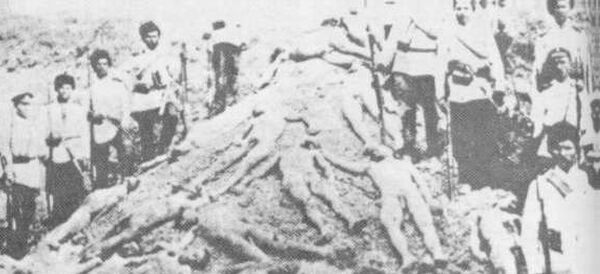
Next, there were mass arrests of Armenian adult men and teenagers throughout the country by Turkish soldiers, police agents and bands of Turkish volunteers. The men were tied together with ropes in small groups then taken to the outskirts of their town and shot dead or bayoneted by death squads. Local Turks and Kurds armed with knives and sticks often joined in on the killing.
Turkish soldiers posing proudly with the
decapitated heads of Armenian community
leaders, 1915
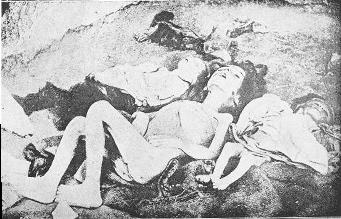
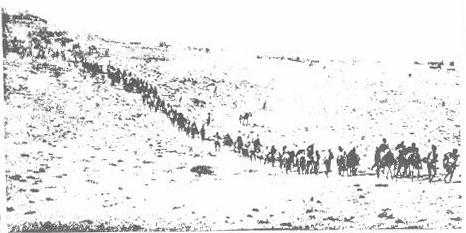
Then it was the turn of Armenian women, children, and the elderly. On very short notice, they were ordered to pack a few belongings and be ready to leave home, under the pretext that they were being relocated to a non-military zone for their own safety. They were actually being taken on death marches heading south toward the Syrian Desert. The death marches would lead across Anatolia and the purpose was clear. The Armenians were being raped, starved, dehydrated, murdered and kidnapped along the way
At the center of the Young Turk Revolution stood the Committee of Union and Progress (CUP) formed in 1895. Its members came to be known as Ittihadists or Unionists. The most ideologically committed party in the entire movement, the CUP espoused a form of Turkish nationalism which was xenophobic and exclusionary in its thinking. The CUP seized power in a coup d'etat in January 1913. Armenians in Turkey were delighted with this sudden turn of events and its prospects for a brighter future. Both Turks and Armenians held jubilant public rallies attended with banners held high calling for freedom, equality and justice. But things were not as they seemed to those jubilant Armenians.
Along with the Young Turk's newfound "Turanism" there was a dramatic rise in Islamic fundamentalist agitation throughout Turkey. Christian Armenians, who had always been one of the best-educated and wealthy communities within the old Turkish Empire were once again branded as infidels (non-believers in Islam). Young Islamic extremists, staged anti-Armenian demonstrations which often led to violence. During one such outbreak in 1909, two hundred villages were plundered and over 30,000 persons massacred in the Cilicia district on the Mediterranean coast. Throughout Turkey, sporadic local attacks against Armenians continued unchecked over the next several years.
To consolidate Turkish rule in the remaining territories of the Ottoman Empire and to expand the state into the so-called Turanian lands in the east, most held by Iran and Russia, the CUP devised in secret a program for the extermination of the Armenian population. From the viewpoint of its ideology and its new and ambitious foreign policy, the Armenians represented a completely vulnerable population straddling an area of major strategic value for its Pan-Turanian goals. The traditional historic homeland of Armenia lay right in the path of their plans to expand eastward. And on that land was a large population of Christian Armenians totaling some two million persons, making up about 10 percent of Turkey's overall population. Somewhat surprisingly to many, Armenians and Turks lived in relative harmony in the Ottoman empire for centuries. Armenians were known as the "loyal millet". During these times, although Armenians were not equal and had to put up with certain special hardships, they were pretty well accepted and there was relatively little violent conflict.
During World War I, the Ottoman Turks, were allied with Germany and Austria-Hungary, and an enemy of czarist Russia. The Armenians fought with the Russians, and both the Germans and Ottomans considered Turkey's Armenian citizens as "the enemy within". When the world's attention fixed upon the battlegrounds of France and Belgium, the Turks decided it was time to solve their "Armenian Problem" by exterminating them. The cover the Islamic Turks used was the lie that during the war that Armenians had been, for their own safety, evacuated to strategic hamlets so they would not be caught between Turkey and Russia.