Come again? Sure ... you're a dumb ******* retard. Again, wikipedia is not an authoritative site by any stretch of the imagination.
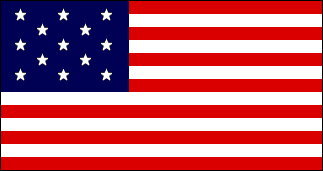
The first flag of the United States was adopted by the Continental Congress in 1777. Before then, there was no official flag representing the United States. Read AND learn ...
The Truth About Betsy Ross
Ross is so beloved and so deeply embedded in the nations memory that somehow it seems unpatriotic, if not vaguely treasonous, to cast doubt on her story. The truth, however, is that nobody can prove that Betsy Ross had anything to do with the first official Stars and Stripes.
[...]
Opinions may differ on Rosss contribution to the creation of the national colors. Yet all parties agree that American revolutionaries were using a variety of flags during the early 1770s to express their distaste for British rule. Some colonists made one that featured a British Union Jack sitting in the upper-left corner of a red field with the words Liberty and Union emblazoned in white along the fields lower half. The tea-tossing Sons of Liberty flew a simple standard with alternating red and white stripes. Another popular ensign sported a coiled rattlesnake on a yellow or red-and-white striped background with the words Dont tread on me. Immediately before the Declaration of Independence, probably the most used unofficial flag of revolution was the Continental Colors. This ensign had a Union Jack in the upper-left corner and alternating red and white stripes. Although unofficial, this banner saw service with American forces. It also had the distinction of being the first American flag saluted by a foreign power.
The Continental Colors, however, had a practical and a symbolic flaw. Because it contained the Union Jack, the flag could create confusion in a battle. When American soldiers raised it outside Boston, British troops thought the conflict was almost over. By this time, I presume, they begin to think it strange that we have not made a formal surrender of our lines, George Washington wrote. In addition, this flag did not represent reality. It implied a continuing tie to Great Britain just as a complete break was pending.
Congress recognized that the new nation needed a flag. On June 14, 1777, it passed the countrys first flag law. As legislation goes, it was refreshingly brief: Resolved. That the flag of the United States be thirteen stripes, alternate red and white; that the union be thirteen stars, white in a blue field, representing a new constellation. From a twenty-first-century perspective, the Continental Congresss lack of guidance on the flags appearance seems extraordinary. The law said nothing about the flags size, shape, or ordering of stripes or the size, type, or arrangement of stars. The legislation implicitly gave flag makers latitude for the creation.
So the fledgling United States probably could have used somebody like Betsy Ross to get things organized. The first hint that she did, however, did not surface nationally until almost a century after America declared independence from England. In 1870, her grandson, William Canby, told her story publicly for the first time, delivering a paper titled The History of the Flag of the United States to the Historical Society of Pennsylvania. According to Canby, Rosss involvement with the flag began in 1776, a year before Congress passed its first flag resolution.




 Thats why I have that retard stalker- NLT on ignore.


