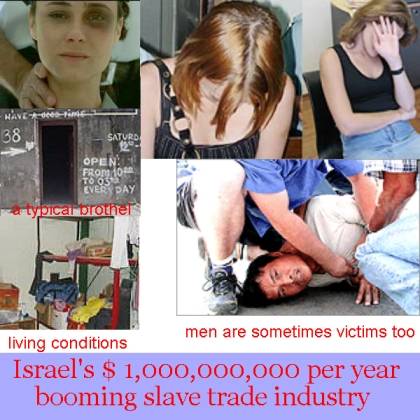
Human trafficking to Israel has been beaten. Let’s now tackle prostitution
Why aren’t the authorities bothered by a prostitution industry that has flourished over the past decade and relies on the weakest groups in society?
By
Vered Lee | Mar. 17, 2014 | 2:18 AM |
5
From the early
1990s until the mid-2000s, the Israeli sex industry was based on the trafficking of women from the former Soviet Union. Not until a 2001 U.S. State Department report on human trafficking, in which Israel ranked at the third and lowest level, did the state begin taking serious steps to suppress the industry.
Otherwise Israel could have lost vital economic aid.
One move was Section 203A of the penal code, which mandates 16 years in prison for anyone who sells or buys a human being, or acts as a mediator in the sale of a human being for the purposes of prostitution. Trafficked women were now considered victims, not criminals, and enforcement was increased.
The blue-and-white prostitution industry is thriving compared to the days when trafficking in women was at a high. In Tel Aviv, between 250 and 300 brothels are operating. Meanwhile, Eilat, Haifa, Jerusalem, Be’er Sheva, Holon, Rishon Letzion, Ashkelon and other cities have lively prostitution scenes. Prostitution occurs unhindered at hotels, bed and breakfasts, apartment buildings, industrial zones and nightclubs, as well as on the street and on websites.
Israeli crime lords, pimps and brothel operators saw that the rules had changed and adapted; no more trafficking in women and importing them from the former Soviet Union, at risk of imprisonment.
Instead, they invested in “recruiting” local women and underage girls in distress. They marketed prostitution to the public as a choice and a profession, and tried to make pimping a “legitimate field of endeavor” by promoting discussion of “the institutionalization of prostitution.”
One building in Tel Aviv serves as the headquarters of an escort service where, 14 years ago, the women had been forcibly brought to Israel from the former Soviet Union. Their passports were taken away and they were enslaved to serve Israeli sex consumers.
Nowadays, eight or nine Israeli women can be found on each 12-to-14-hour shift, during which they each have to supply sex services to 10 to 20 clients.
Advertisement
Sounds like its still a booming business, just done under pretense.