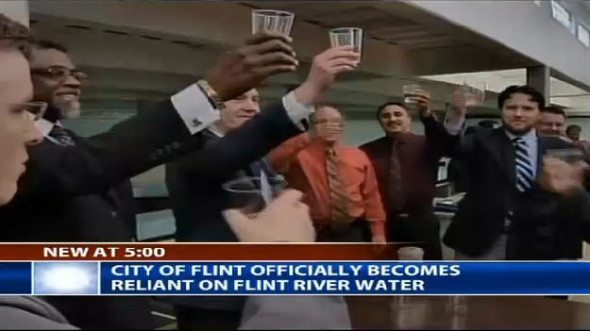
She was among about 100 residents who protested Monday in front of Flint's city hall. They burned paper and ripped up water bills as symbolic gestures. Signs reading "Don't Poison My Daughter," "Killed by Toxic Water" and "Why Pay For Poison?" were waved at passing cars on Saginaw Street. Many people carried monthly water bills of about $100. Free bottled water and filters have been offered from city fire stations as concerns of contamination persist. The concerns date to April 2014, when the city's water source was temporarily switched from the Detroit water system to the Flint River, and improperly treated water caused lead to leach into the system.
Amanda Hughes, 36, of Flint holds a photograph of her seven-year-old daughter during a rally in downtown Flint on Monday, January 25, 2016 where about 100 people demanded not to have to pay for water that was tainted with lead.
Many residents say they've been buying their own bottled water for months and are outraged that they continue to be billed. Flint residents pay some of the highest water bills in Michigan, and many advocates and residents have said it's wrong that the bills haven't been stopped or reduced since officials acknowledged the water is unsafe to drink without filtering. On Monday, Michigan Attorney General Bill Schuette repeated statements that it is "an outrage" that Flint residents are being billed for water they can't drink. And contradicting a statement Gov. Rick Snyder made in an interview, he said: "I would certainly not bathe a newborn child or a young infant in this bad water."
The protest was the latest of many in Flint's downtown as people continue to be frustrated by a problem that has no easy fix in sight. Aaron Mason, 62, of Flint said at Monday's rally that the bottled-water handouts are "like putting a Band-Aid on a bullet wound. What are you going to do with all these plastic bottles?" The protest stayed peaceful; a few papers were burned and dropped into a metal trash can, and a fire truck and police vehicles were parked on the street, helping to protect people from passing cars. But the frustration was palpable.
MORE