The tech bubble wasn't caused by "artificial interest rates". Urban legend. Look at the Goldilocks economy. Our trade deficit skyrocketed and there was a public sector surplus.This was a bad idea as far as stock flow consistency. The private sector naturally went into deficit as the public sector was in surplus. Private debt loads increased and housed savings evaporated. This is what caused the bubble.
The circular flow of income accounting identity you're using (S+T+C+M=C+I+G+X) does not say anything about a causal relationship (hence one really good reason it's insufficient as a model for determining policy). An identity statement necessarily does not indicate causality. In a closed economy, saying the private sector went into deficit is identical to saying that the public sector went into surplus. Saying the private sector deficit CAUSED the public sector surplus is not derived or warranted from the sectoral balances identity statement.
Right, that's a fair and accurate point. I kept it brief since I posted from my tablet.

I'll try to clear up any confusion I may have caused.
Let's line up our ducks: (S - I ) = (G - T) + (X - M)
(S) minus private investment, (I) must be equal to the public sector deficit, (G) minus (T) , including net exports (X-M) which gives us the net savings of the foreign sector. In the event we have an external deficit (X-M) < 0 and a surplus (G - T) < 0, naturally, as matter of accounting alone, there will be a private sector deficit. This is why surpluses run by the public sector will result in the private sector running a deficit.
(G - T) = ( S-I ) is just doing some basic math for two sides of one transaction. (G - T) is our our public savings while (S - I) is the identical within the private sector. Both of these entities cannot be in deficit or surplus at the same time.
What I'm saying isn't really that shocking. An increase in the $$$$ supply can only occur with the creation of base $$$$ into the banking system. The only way to inject funds into the monetary base is through the FED.
Let's get back to the Clinton surpluses. We still have some lingering effects. If the government is running a surplus, this means the government is taking in more $$$$ than its spending. This has the opposite effect of a stimulus. The trade deficit also massively increased during the 90s, which resulted in (X-M) dampening GDP during this time period.
The trade deficit was taking away from GDP, and the government sector was talking more $$$$ away from the private sector than it was sending out so to speak.
This resulted in private consumption compensating for the dampening effects from the trade deficit and government. Household savings also tanked during this time period.
If you're interest in a great analysis of this time period, you should check out the awesome stuff Wynne Godley was churning out. Pure genius. The CBO was saying we'd have surpluses up to twenty years down the road. Wynne said they were delusional. The private sector simple cannot operate, year after year, spending more than its total income. It can't operate like United States government by running deficits on an indefinite basis. Eventually something will give, the private sector will reorient itself, an the government will go back to running deficits.
This surplus helped aid the Fannie and Freddie boom of the late 90s. This is where I differ with Toro in my analysis, even though he raises some valid points. During the surplus, the government didn't have to issue a whole lot of debt. But US bonds are a HUGE part of portfolios for every type of large financial institution, and for the average investor that enjoys the safety and risk-free aspects of US Treasuries. During this time, let's not forget, yields on the ten year bond were over five percent. That's not too shabby if you're looking towards some payouts during retirement.
Fannie and Freddie issuance went through the roof when the late 90s. The government slowed down debt issuance and Fannie and Freddie picked up the pace.
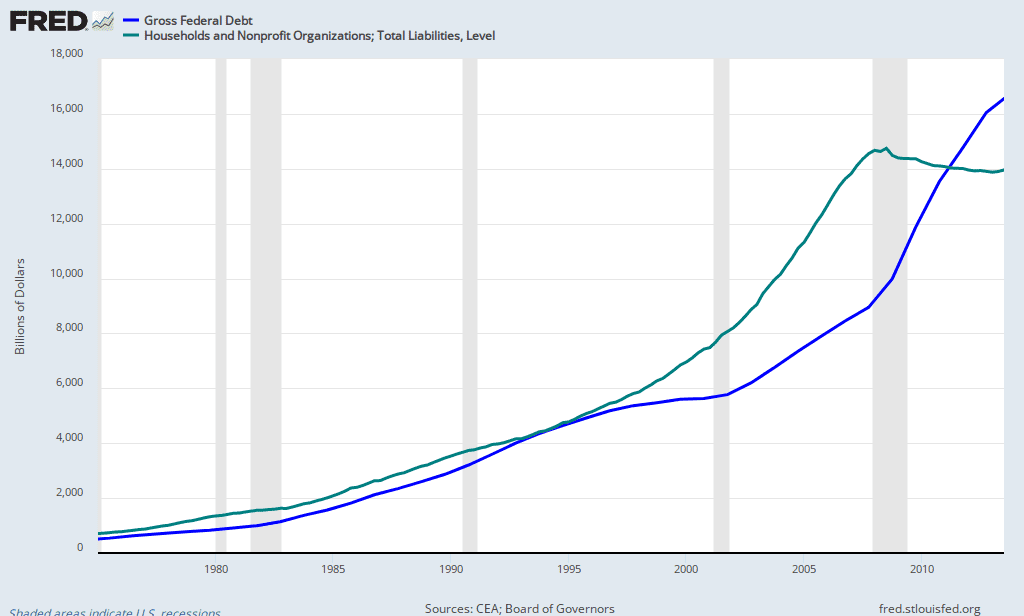
The most celebrated achievement of the Clinton era turned out to have been a macroeconomic turd. The dampening of GDP was counterbalanced by massive increases in household debt, decreases in household savings, and the winding up of the Fannie and Freddie debt bonanza which was a huge contributing factor in causing the real estate bubble and subsequent collapse.
Ironically, despite the surplus, interest rates were higher, and it weakened households in a significant way.