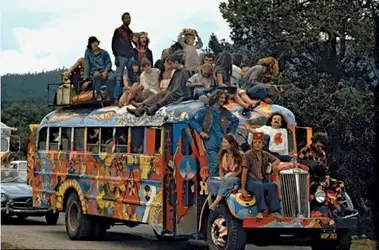
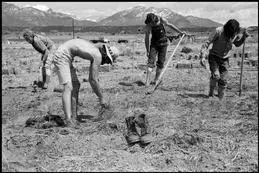
Actually, it came from the Dippy Hippies of the Free Speech Movement, one of whom gave away FOR FREE the BSD version of UNIX that is the backbone of the internet and TCP/IP.
The Network Is the Company | Fast Company | Business + Innovation
Other movement veterans have attempted to bring their previous beliefs into line with their current activities. John Gage, a veteran of the Free Speech Movement, went on to become chief scientist at Sun Microsystems, blending, in his words, "'90s technology with '60s activism." Explaining business at Sun (where cofounder Bill Joy is also a veteran of The Movement), Gage notes that "The whole thing has a '60s flavor to it. Theres a populist ethic. You dont like the news? Make some of your own. Put it on the Net." Describing Sun, New Economy champion Fast Company has noted: These days, 'Power to the People' sounds like the quaint rallying cry of a bygone era. But it's a way of life at young companies like Sun where information flows freely and people aren't afraid to express their opinions and in the explosion of activity around the Internet. For Gage, the Net - and in particular the World Wide Web - is an electronic frontier that marries technology and democracy, the last best hope for an economy built around grassroots participation and personal expression.
Here we see the New Left's vision of true democracy through technology finally realized.
OLD-COMPUTERS.COM : HISTORY / detailed info
In March 1978, Bill Joy, who studied at the University of California at Berkeley, released the first free version of UNIX operating system which is now known as BSD UNIX. (Berkeley Software Distribution)
The history of UNIX starts back in 1969, when Ken Thompson, Dennis Ritchie and others started working on a Digital Equipment PDP-7 computer at Bell Labs. The first edition was launched in 1971 and was mainly used for text processing. It had a kernel, an assembler for the DEC PDP-11/20, a file system and some vital tools, including the 'ed' (editor for mortals) text editor written by Bill Joy.
Two years later, the Fourth Edition was totally rewritten in C language with multi-platform support in mind, allowing it to be used on a wide range of computers. In 1975, the Sixth Version, widely known as 'Version 6' was the first UNIX version really available outside the Bell Labs. The first BSD version was derived from this V6.
The second BSD version was launched a few months later with the full kernel source codes. This version became the backbone of the Internet and introduced the "open source" concept.
From this time, the various flavours of UNIX were divided in two different families, the BSD based types and those derived from the SYSTEM V.
The Berkeley version of UNIX became the standard in education and research and was notable for introducing using TCP/IP to UNIX (later Bill Joy will be nicknamed the "Edison of the Internet"). BSD was widely distributed in source form so that others could learn from it and improve it.
After having been involved in the BSD project, Bill Joy co-founded Sun Microsystems in 1982 and led technical strategy of the company. He designed Sun's Network File System (NFS), parts of the SPARC microprocessor architecture as well as basic pipeline used in all of Sun's SPARC microprocessors.
Later, he was the co-author of the specification for the Java programming language.
In 1998, Bill was appointed as Chief Scientist of the company.