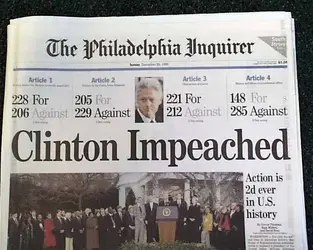
And the Senate Democrats disagreed with the house on the matter, and voted to not remove Clinton not because they believed him innocent, but because they believed the felonies of perjury and obstruction rose to the level of an impeachable offense.
Which is irrelevant to who decides on impeachment. Its still just the House.
If the senate disagrees on if an offense is impeachable, it does not matter what the house said.
Again, irrelevant. If the senate agrees, if the senate disagrees.....a president is still impeached.
The impeachment charges only sticks if he was convicted in the Senate, he remained in office afterwards, which means the Impeachment charges FAILED!
It means that the president was acquitted. He's still impeached.
You are contradicting yourself,
since acquittal shows that Impeachment charges was a failure, the charges are then dropped. From
Wikipedia is this simple to understand statement about what Impeachment is:
Impeachment is the process by which a
legislative body levels charges against a government official. Impeachment does not in itself remove the official definitively from office;
it is similar to an indictment in criminal law, and thus it is essentially the statement of charges against the official.
bolding mine
===========================
Impeachment is simply a process to charge someone of something illegal.
If the charges fails in court or in the senate, indictment charges, and impeachment charges have failed.
No conviction means criminal charges fails, end of story.
===========================
Straight from the
U.S House of Representatives website:
"The House's Role
The House brings impeachment charges against federal officials as part of its oversight and investigatory responsibilities. Individual Members of the House can introduce impeachment resolutions like ordinary bills, or the House could initiate proceedings by passing a resolution authorizing an inquiry. The Committee on the Judiciary ordinarily has jurisdiction over impeachments, but special committees investigated charges before the
Judiciary Committee was created in 1813. The committee then chooses whether to pursue articles of impeachment against the accused official and report them to the full House.
If the articles are adopted (by simple majority vote), the House appoints Members by resolution to manage the ensuing Senate trial on its behalf. These managers act as prosecutors in the Senate and are usually members of the Judiciary Committee. The number of managers has varied across impeachment trials but has traditionally been an odd number. The partisan composition of managers has also varied depending on the nature of the impeachment, but the managers, by definition, always support the House’s impeachment action"
bolding mine
This shows it is the HOUSE members who prosecute the accused in the Senate, thus when they fail to back up the impeachment charges, it can be said that Impeachment charges failed when the Senate members vote no for conviction. All you have left is that the accused was charged with something (for the history books), which becomes meaningless when the accused is found not guilty.
This is what I am talking about.