Charlie Bruce was a Texas police chief of the old school. In more than four decades on the force he gave homegrown criminals good reason to steer clear of Del Rio, his small town on the United States's southern border, but held no grudge against the steady flow of Mexicans across the frontier in search of opportunity. He admired them for their hard work and the chances they took to better themselves. Besides, some of them built his house. What happened on the other side of the border, in Mexico, was another matter. There, Bruce unashamedly admits that for years he used his authority as a Texan police officer to run a lucrative smuggling racket. Mostly he dealt in duty-free whisky and cigarettes shipped in to Mexico, bribing officials with tens of thousands of dollars a time to avoid taxes, and then promptly selling the contraband on to Americans who brought it back across the border.
Occasionally Bruce branched out. He laughs when he recalls the handsome profit made from exploiting a sugar shortage in the 70s by paying off an official to illegally sell him a stock of subsidised sugar sitting in a Mexican government warehouse, which he shipped to a pie-maker in Philadelphia. Now 75 and retired to a new house a stone's throw from the border, he recounts his years as a smuggler with undisguised pride and admits that it was all made possible by being a police officer. "That's exactly why I got by with it, because I was well known over there. My shield was law enforcement. I got by with murder more than other people," he says. "Other people may think it's wrong but the border's its own world."
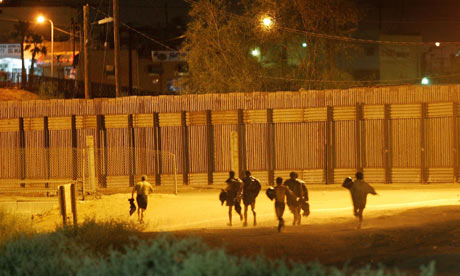
Bruce laughs derisively at Washington's grand scheme to change that world. In the coming weeks, the US department of homeland security expects to complete the final parts of a nearly 700 mile (1,100km) fence and wall along the Mexican border intended to curb the perpetual flow of Latin Americans in search of work, and to block the ceaseless caravan of drugs feeding a very demanding American habit. The spur, though, was 9/11 and the ever-present fear of terrorist infiltrators. The barrier covers one-third of the US's entire southern frontier with Mexico. In parts it is a fence about 5 metres (17ft) high built of a strong steel mesh and painted the same rust colour as the surrounding earth. In some places it is topped by coils of barbed wire; in others it is a solid steel wall. The fence cuts through towns and divides the desert. Its length is patrolled by thousands of armed border, drug enforcement and FBI agents. In Arizona they are complemented by an armed vigilante militia, the Minutemen.
The remaining 1,300 miles of border will be protected by a "virtual fence" – a network of electronic sensors, cameras, towers and high-flying drones that can see for more than 300 miles – that's already in place along parts of the frontier, setting off border patrols in pursuit of figures seen scurrying across screens or picked up by the motion detectors. The whole project is costing more than $4bn (£2.6bn), with the border fence alone working out at about $5m a mile. The barrier's supporters say it is good value for money in the face of what they portray as an onslaught of illegal immigrants – increasingly scapegoats for economic blight and unemployment as they are accused of "stealing our jobs" – drug traffickers and the threat of terrorism. Others back the fence as a means to discourage what they describe as a flood of Mexican women pouring in to the US to have "anchor babies" – children who automatically gain American citizenship by being born inside the country.
Arizona's governor, Jan Brewer, has backed the fence because, she says, her state has become "the gateway to America for drug trafficking, extortion, kidnapping and crime". Fear in the state was stoked by the death in March last year of an Arizona rancher who authorities believe was shot on his farm by a drug-smuggling scout. In December, a border patrol agent was murdered by smugglers.
MORE


