LOLOLOL...yeah, two quick points that are quite wrong. You obviously have no idea what you're talking about. Do you get this pseodo-scientific crap off of a denier cult blog or do you just make it up on your own? I notice that you never seem to be able to come up with any supporting evidence or citations to back up your foolishly mistaken claims.
I see you don't go in for peer reviewed science either. Understandable, but I am afraid that it puts you behind the 8 ball.
You are such an idiot, wirehead. My post that you're responding to contained references to articles in two peer reviewed journals -
Geology and
Science. And that, to you, means that I "
don't go in for peer reviewed science", eh? LOLOLOL. Moron!!!
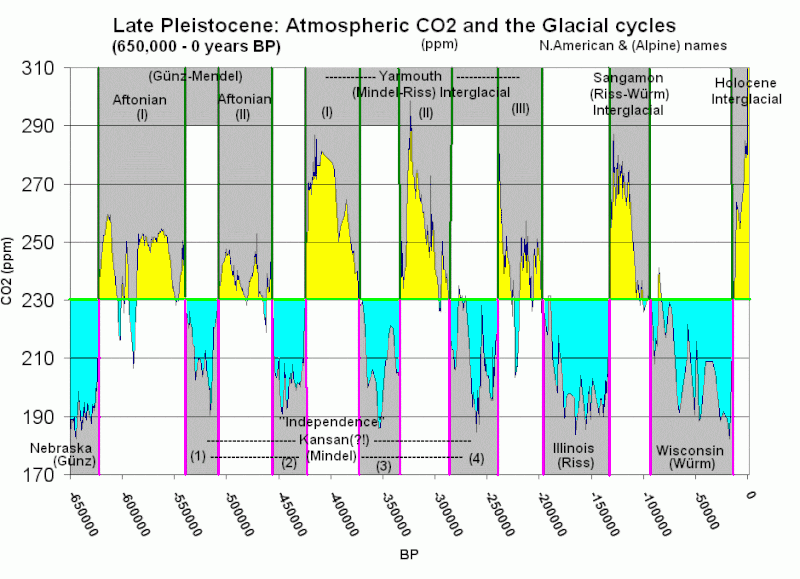
Here is some peer reviewed science for you that states quite clearly that atmospheric CO2 increases have historically followed temperature increases clearly indicating that increased CO2 is the result of increased temperature, not the cause.
The scientific studies you cite
do not indicate that the current increased CO2 is the result of increased temperatures as you imagine that they do. You're just a scientifically illiterate denier cultist clinging to another one of the long ago debunked myths of your ginned up cult of dupes and stooges. I strongly suspect that you're not intelligent enough to comprehend just why you're wrong or open minded enough to even consider evidence that contradicts your cherished denier cult delusions and myths. But for the possible readers here who actually have an above room temperature IQ, here are the facts.
Anti-global heating claims a reasonably thorough debunking
Scholars and Rogues
DENIER MYTH#21: Ice core data illustrates that CO2 has previously always risen after temperature increases, not before as scientists are claiming is happening now. Therefore any global heating weve experienced is already over and we should start cooling down soon. (sources: Multiple)
Debunking: There are a number of problems with this argument a logical fallacy, an inaccuracy with regard to the time scales involved, and a misunderstanding of how the transitions in question (deglaciation, or going from an ice age to an inter-glacial period) are understood to work.
First, the logical fallacy is known as predictive appeal to history, and it relies on the its always happened this way in the past, so it will always happen this way. Or, to steal an analogy that a commenter on Digg used, if you push your foot down on the gas 10 times and the car accelerates each time, you can realistically expect that the next time you put your foot down on the gas the car will accelerate again. Thats science. But what if you put your foot on the gas and nothing happens? Assuming that that car would have accelerated was a reasonable scientific expectation, but once the car didnt accelerate, you have to leave your prediction behind and actually figure out whats busted in the car. Or, to put this analogy in terms that more directly parallel global heating, what if youre sitting in the car and it accelerates even before you put your foot on the gas? Did you accidentally put your foot on the gas and not realize it? Or has something broken under the hood that youll fix before you can slow down again? In the case of global heating, the Earths atmospheric CO2 took off before the temperature started rising, and scientists have identified that the differences this time around are human-caused, or anthropogenic (See Myth #3).
CO2 over last 1000 yearsRelying on prior history to generate predictions only works when everything is equal and the situations are substantially identical. What we have today in the case of global heating is not substantially identical in a scientific sense to prior episodes of heating in the past. Without CO2 produced by the burning of fossil fuels, the natural atmospheric CO2 concentration would be approximately 280-290 ppm instead of the approximately 383 ppm it is today. As the image at right shows, modern human civilization itself has made the situation substantially different from prior climatic cycles.

The second problem is that proponents of this myth are confusing different time scales. It is true that the Vostok ice core has illustrated that there is a delay of between 200 and 800 years between a change in temperature and the lagging change in CO2. However, this change is only observable at transitions between periods of glaciation and interglacial periods where the changes are of sufficient magnitude to overcome the uncertainties in the measurements and proxies used to estimate temperature, CO2 concentration, and age. Part of the lag is due to the fact that gas bubbles are trapped in ice that is older than the air trapped. Another part of the lag is due to the time required to heat up the ocean enough to start outgassing CO2 (see Myth #2). Other sources of lag could be the time required for the ocean to mix vertically, for sea-ice to melt, for oceanic biological productivity to change, and/or for the concentrations of atmospheric dust to change (Timing of Atmospheric CO2 and Antarctic Temperature Changes Across Termination III, Science Magazine #299). However, even then the lag is but a small percentage of the total time required to deglaciate the planet, specifically between 200 to 800 years in a deglaciation that lasts 5000 to 6000 years.
But the time scales are even more impressively different when you consider the magnitude of the changes and how fast theyve occurred. Across Termination III described above, the concentration of CO2 increased from 240 ppp to 280 ppm over the course of approximately 5000 years, or at an average rate of 0.008 ppm CO2 year. Since 1850, the concentration of CO2 has increased from about 280 ppm to about 383 ppm, or at an average rate of 0.656 ppm CO2 per year.
Finally, its understood that prior climate changes were not driven by human activity since there was no human activity to drive them. However, as the article linked above shows, this doesnt change the fact that CO2 is believed to have played a significant role in the very same transitions used to support this myth. According to the article, deglaciation Transition III in the Vostok ice core started with the melting of Antarctic ice driven by some change in solar forcing, followed by an increase in global CO2, and then by the melting of Northern Hemisphere glaciers. The papers authors clearly state the implication:
This confirms that CO2 is not the forcing that initially drives the climatic system during a deglaciation. Rather, deglaciation is probably initiated by some insolation forcing (1, 31, 32), which influences first the temperature change in Antarctica (and possibly in part of the Southern Hemisphere) and then the CO2. This sequence of events is still in full agreement with the idea that CO2 plays, through its greenhouse effect, a key role in amplifying the initial orbital forcing. First, the 800-year time lag is short in comparison with the total duration of the temperature and CO2 increases (~5000 years). Second, the CO2 increase clearly precedes the Northern Hemisphere deglaciation (Fig. 3)
.
The sequence of events during this Termination is fully consistent with CO2 participating in the latter ~4200 years of the warming. The radiative forcing due to CO2 may serve as an amplifier of initial orbital forcing, which is then further amplified by fast atmospheric feedbacks (39) that are also at work for the presentday and future climate.
In other words, even if prior changes in climate werent started by increased CO2 concentrations, more CO2 in the air continued the deglaciation.
Has CO2 concentrations lagged temperature in the past? Yes, the ice cores show this quite specifically on a glacial/interglacial timescale (hundreds of thousands of year). But whats happening to the atmosphere today has no analogue in the past. Deglaciation transitions occur due to changes in CO2 concentrations that are both smaller in magnitude than modern anthropogenic changes (40 vs. 103 ppm) and slower in duration (~5000 vs. 157 years). Because the rate of change in CO2 concentration appears to be unprecedented, we cannot rely exclusively on paleoclimatic data to explain whats happening today. Instead climate scientists have developed scientific predictive techniques (aka computer climate models) that are informed by the paleoclimatic data we have, but that also incorporate the differences between the climate of modern humanity and the analyzed paleoclimates into their analyses.
In essence, human civilization jammed the climate accelerator and the usual planetary brakes arent enough yet to keep us from accelerating. (Other sources: Atmospheric CO2 Concentrations over the Last Glacial Termination, New constraints on the gas age-ice age difference along the EPICA ice cores, 0â50 kyr)
At one point or another, each of these claims represented a real problem with the science of global heating. But no longer the scientific evidence has become overwhelming. However, its the minority composed of global heating deniers who continue to hunt for flaws in climate science, so the deniers serve a valuable scientific purpose when they find a real hole, or just think they have, addressing their claims are what has made the science of global heating as bullet-proof as it now is.
It comes down to this simple fact: the overwhelming majority of the scientific evidence points to human-induced global heating, and every claim made by global heating deniers has been effectively debunked. And because the consequences of doing nothing are so severe, we must act now even as the data continues to improve we can no longer afford to wait.
This site - Scholars and Rogues © 2007-2011
(In accordance with Title 17 U.S.C. Section 107, this material is distributed without profit to those who have expressed a prior interest in receiving the included information for research and educational purposes.)
[ame=http://www.youtube.com/watch?v=hWJeqgG3Tl8]YouTube - Climate Denial Crock of the Week - The Temp leads Carbon Crock[/ame]
Oh Yeah, lots more. Far more than you could ever provide from your stock of debunked denier cult lies, misinformation and fossil fuel industry propaganda.