??? Say what?
- How are those two things incompatible? I realize that nobody who does not demonstrate a 10th grade reading competency cannot expect to graduate from the 12th grade. I don't see how graduating from the 12th grade is incompatible with demonstrating a 10th grade reading level. Achieving both those things for 99% of the relevant segment of the population is undoubtedly difficult, but as goals incompatible, conflicting? Not at all.
- Since when is achieving a 10th grade reading comprehension level for 99% of our student citizenry, all of whom must complete school through the 12th grade, a "high standard?" It seems to me a standard that is two grade levels below what is expected of graduating from the 12th grade. A high standard, IMO, would be expecting that students demonstrate a collegiate freshman level of reading comprehension/ability prior to being a college freshman.
Reading your post, I must wonder whether deeming and expecting a 10th grade reading proficiency from people who must graduate from the 12th grade is part and parcel, perhaps even causal, of the "dumbing down" of America that
Foxfyre writes of in her
The Dumbing Down of America thread.
Just as a point of reference/perspective with regard to my remarks and question in second bullet above,
the remarks above correspond to a "high school" reading level, in fact, a ~10th grade reading level. Are you really suggesting that something fewer than 99% of high school graduates would have difficulty comprehending this post? I should hope not.
At the bottom tail end of the bell curve for intelligence, there is most likely more than 1% of the population that will never be able to achieve a 10 grade reading level.
Yes, I am suggesting that fewer than 99% of high school graduates would have difficulty reading your post. You may want to research
IEPs: Individual Education Plans.
Red:
With all due respect for the mentally disabled folks in our nation, I truly did not develop this thread nor offer any remarks in it with their exceptional needs or (dis)abilities in mind. I realize that learning
disabilities range over a wide spectrum and that some of them absolutely will prevent affected individuals from ever achieving a 10th grade reading level.
Of the various learning disabilities, I am currently unqualified to address which of them make achieving a 10th grade reading level impossible and which do not, to say nothing of not being in a position to attest to whether, even if they don't make that accomplishment impossible, what impact they have in making it impossible to attain prior to graduating from high school.
Individualized Education Program - Wikipedia, the free encyclopedia
- Was anyone here, other than perhaps you, assuming the proposal I made in my OP applicable to intellectually disabled people?
- Did I miss something in the discussion you and oldsoul were having about reading as a goal whereby it was made clear that leaning deficient students, and most especially those with significantly hobbling maladies such as Down's or Fragile X Syndromes, were among the population of people for whom the "99%" standards noted are expected to apply?
- Do you have some specific point you want to make re: learning disabled people and that is contextually relevant to this discussion, be it the general one broached in my OP or the specific one pertaining to reading skills?
- Are you instead being deliberately obtuse, or perhaps obtusely and deliberately pedantic is more what I mean to ask, by introducing factors that pertain to the ~10% of the population who have learning disabilities of some sort?
- Would you please clarify objectively for me at what point your, in this thread's discussion, raising the matter of IEPs, and the people who need them, moves from being reductio ad absurdum to being a legitimate reason to forestall identifying a free college education for qualified (as per the OP) as a goal to which our nation should aspire because some share of the students, a share that likely never will be able to read at all much less at a 10th grade level, indeed cannot read?
My comments were not directed to your proposal. They were directed at the counter proposal of achieving a 99% graduation rate with 99% of graduates achieving a ten grade reading level or better.
Probably
more than 1% of students in high school have accommendations as part of IEPs. One very common accommendations is that tests are read aloud to them. Many students get 50% more time to take tests. These accommendations are often a good thing because there are cases in which a student who may never achieve a high reading level may be brilliant in math. Or the converse may be true in that a student that struggles in math may have excellent reading and writing skills.
These accommendations allow students to achieve in areas in which they are capable
Red:
Okay. I suspected that may be the case. TY for the confirmation that it is.
Still, please see question #2 above. I just don't think
oldsoul was considering learning disabled folks when he cited the 99% figure. Indeed, I think that because, until you mentioned them, they were among the farthest things from my mind as goes the discussion.
Blue:
Okay. I have no issue with that. I think it a very good thing that educators and education funding entities are willing and able to make those accommodations available to people who need them.
If you are saying that the 99% measure
oldsoul stated is unrealistic and unrealizable because of the mere existence of learning disabled people, okay. Yes, that's conceivably true. If, instead, your key point is that his proposed goal of achieving a 10th grade reading level for 99% of students who have no learning disability is unrealistic and unrealizable, I have to disagree. However hard it be to achieve, whether it's indeed already been achieved, how far we have to go to achieve it, I believe it is an achievable goal and I believe it's a goal worth achieving.
P.S./Edit:
FWIW, the reason I thought your introduction of folks having learning disabilities might have been obtuse/pedantic is because from what I could tell, the conversation about reading was "rolling along" smoothly enough, and then you "chimed in" talking about IDPs and people who need them. Your doing so at the eleventh hour, so to speak, make that remark seem akin to your "ace up a sleeve" to ensure the accuracy of your implied earlier assertion about the preposterousness of the 99% achievement rate throughout the U.S. population of a 10th grade reading skill level.
Had you raised that limiting factor with regard to the 99% from the get go, it would not have come across, at least not to me, as in any way obtuse or pedantic. It's a legit factor that must be accounted for in the defining of any nationwide human capital development goals. It's a matter of timing affecting, in this case adversely, the tone/connotation of one's remarks.
Almost 5 present of students have some sort of learning disability that qualifies for an accommendation at school. These people are not necessary mentally challenged. Some are well above average intellenge and do just fine in school when accommodated. Some students may not have disabilities but never achieve a high reading level because of other reasons.
They may come from unstable homes or their parents may not instill in them the importance of a good education. Other
students may simply be on the lower end of the bell curve for intelligence without specific disabilities.
Red:
Actually, if the figures in the references I provided earlier remain accurate, the figure is ~10% to ~12%. Of them, only 0.2% of them are intellectually disabled. I certainly agree that needing an accommodation for certain disabilities does not, in and of itself, militate against one's ability to achieve a 10th grade reading level.
In my mind, that means that for the remaining 9.8%+ of the folks who have some sort of learning disability, there is no inherent reason why they are incapable of achieving a 10th grade reading level. It is likely so that the folks in the 9.8%+ group may take longer than 15-16 years to achieve that level of reading proficiency; however,
oldsoul's proposal doesn't stipulate a time frame within which he'd expect the "relevant segments" of the population to achieve that reading level. Seeing as most 10th graders are between 15 and 16 years old, I'd imagine that expecting them to have achieved a 10th grade reading comprehension capability by the 12th grade (or in order to obtain a GED certificate or graduate from the 12th grade) is reasonable.
Blue:
Social factors, like certain learning disabilities, certainly can slow the rate at which one achieves a 10th grade reading comprehension level.
Pink:
Undoubtedly, some students will be on the lower end of the intelligence curve.
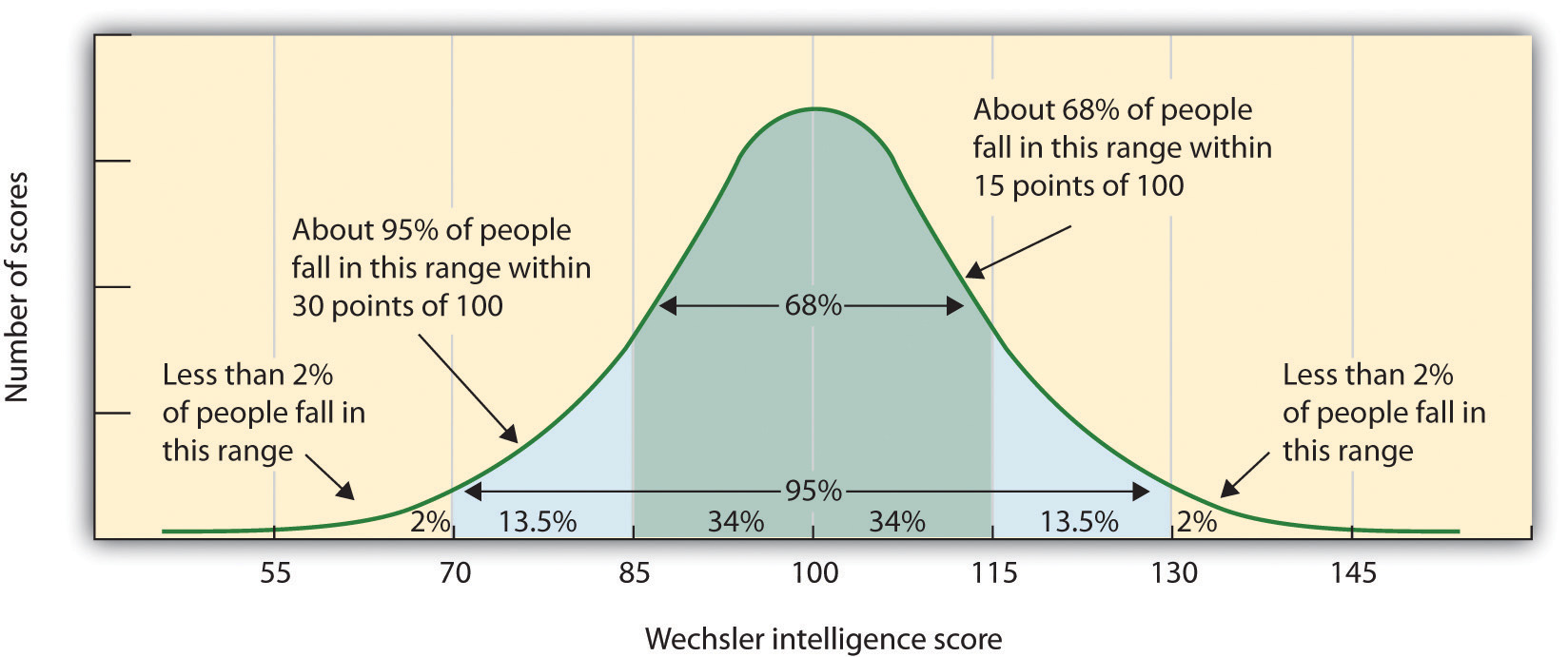
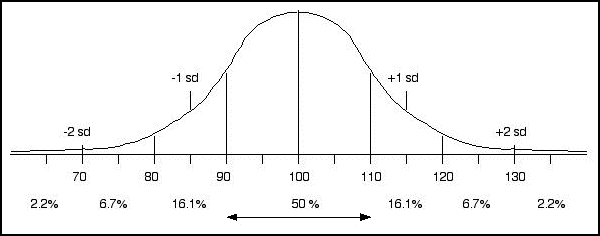
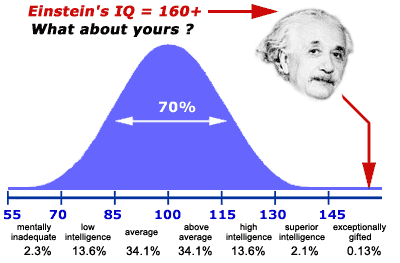
As one can see from the human intelligence curve above, ~95% of people fall at or above two
standard deviations from "average" intelligence (an intelligence score of 100). Given that one must earn a "C" or better (weighted GPA of 2.0 or higher) to graduate from high school, it stands to reason that everyone who does graduate from high school should also have achieved a 10th grade reading level.
As my earlier shared anecdote illustrates, it's quite likely that not all high school graduates have in fact achieved a 10th grade level of reading proficiency upon completing the 12th grade. Assuming that is so, one must ask why is it so? How do those people manage to get high school diplomas?
- Grade inflation?
- Academic insouciance and disinterest on the part of teachers and school administrators/systems?
- Social drivers that force schools to graduate students?
- Economic drivers that prevent schools from allowing the rolls to grow overly large due as they might were students failed instead of being graduated?
- Something else?
At public schools, I suspect one or several of those factors may apply to any or all students who fail to achieve a 10th grade reading level prior to graduating. (I can't posit one or which ones may have more or less significance as I have little firsthand knowledge of any public school system regarding those matters.) At the handful of private schools with which I'm quite familiar, I can safely say none of those things is in play; students who don't perform "up to snuff" are either held back or flunked out.
Why that isn't what happens in public schools is beyond me, but seeing as most folks attend public schools, and clearly not all of them graduate do so with a 10th grade reading competency, something's going on other than students being held back or expelled. It seems to me that public schools have an obligation to keep kinds enrolled until they become 18 (maybe 19 if that's how someone's birthday works out). After that, they should expel or refuse to re-enroll them even if the student fails to achieve, among other things, a 10th grade reading level. When that happens, the student will be forced to pass a GED exam in order to show that they've achieved a high school equivalent level of academic mastery. That, or never obtain any certification indicating they have attained that level of academic achievement.
Given the above range of scenarios and impacts, one must then consider
oldsoul's "99%" criterion in terms of whether it must apply to people who actually do graduate from high school or obtain a GED certificate, or whether it applies to all people. In my mind, it should apply to the former group not the latter because the former application of the standard he's proposed means that a diploma/GED certificate necessarily means a number of objectively measured/determined things. Plus, whereas it's actually possible to guarantee that all high school graduates have achieved (at least at the time of their graduating) a specific level of academic and functional ability, it's not possible to make people want to achieve that same level of accomplishment and thereby do so were they flunked out of school and never afterward to pursue getting a GED certificate.