Again... plants need CO2. Less CO2 = less growth, less life.How is preventing more CO2 promoting deforestation? Again you are not making sense and I know you are smarter than that. We can only prevent the CO2 we cause. There is enough CO2 in the air to support plants worldwide as indicated before we started dumping more CO2 in the air and clearing forests.Your post doesnt make sense. If there are less plants to deal with more CO2, how is that a good thing? CO2 doest produce plants. It just helps the plants that are there as long as water is available. If there is more CO2 existing than O what do you think about our prospects for breathing look like? The cycle of CO2 vs O is out of whack. Humans have done this on both sides of the equation by adding CO2 to the atmosphere and removing the variable that reduces CO2Cause and effect are different issues. Deforestation: bad. CO2: good. One way to do deforestation, is to freeze the plants out , reduce the amount of CO2 in the atmosphere, and route water away from the plants.. Don't you think it even remotely odd that some scientists are claiming that CO2 is bad when CO2 is one of the main components of what plants need? They might as well be saying man made water is causing global warming.I guess you are forgetting that deforestation is also a man made contribution to the ppm of CO2 in our atmosphere? Not only are we adding CO2 we are taking away the variable that reduces the ppm of CO2 in our atmosphere.You are conflating cause and effect and we are not living on Venus. Life on Earth has evolved to produce and consume a large range of ppm of CO2. Your concern is that humans are not unlike a large asteroid or comet impact on the Earth's atmosphere. In the case of deforestation, killing off entire species of whales and such, you are not far off. However, when you start talking about the minor effect that humans have on ppm of CO2 in our atmosphere, from my view, you have gone off the deep end. We are going to warm up... and the primary driver is the mere fact that the ice age is ending, which is a solar / planetary event / cycle, get used to it.
This whole global warming crusade is ludicrous.
No one, AND I REPEAT, no one ever said DEFORESTATION IS GOOD. Yet the global warming nut cases are actually promoting DEFORESTATION by demanding that humans stop helping plants out, by generating CO2.
No. The "cycle" of co2 is A PART OF the cycle of life. More CO2 = more life. LESS CO2 = LESS LIFE. Saying more life is bad is ridiculous. We are not over populated that's just another myth.
Navigation
Install the app
How to install the app on iOS
Follow along with the video below to see how to install our site as a web app on your home screen.
Note: This feature may not be available in some browsers.
More options
Style variation
You are using an out of date browser. It may not display this or other websites correctly.
You should upgrade or use an alternative browser.
You should upgrade or use an alternative browser.
Scientists confirm basic physics - CO2 makes it hotter.
- Thread starter Delta4Embassy
- Start date

Asclepias
Diamond Member
Are you claiming there was no CO2 until man started putting it into the atmosphere?Again... plants need CO2. Less CO2 = less growth, less life.How is preventing more CO2 promoting deforestation? Again you are not making sense and I know you are smarter than that. We can only prevent the CO2 we cause. There is enough CO2 in the air to support plants worldwide as indicated before we started dumping more CO2 in the air and clearing forests.Your post doesnt make sense. If there are less plants to deal with more CO2, how is that a good thing? CO2 doest produce plants. It just helps the plants that are there as long as water is available. If there is more CO2 existing than O what do you think about our prospects for breathing look like? The cycle of CO2 vs O is out of whack. Humans have done this on both sides of the equation by adding CO2 to the atmosphere and removing the variable that reduces CO2Cause and effect are different issues. Deforestation: bad. CO2: good. One way to do deforestation, is to freeze the plants out , reduce the amount of CO2 in the atmosphere, and route water away from the plants.. Don't you think it even remotely odd that some scientists are claiming that CO2 is bad when CO2 is one of the main components of what plants need? They might as well be saying man made water is causing global warming.I guess you are forgetting that deforestation is also a man made contribution to the ppm of CO2 in our atmosphere? Not only are we adding CO2 we are taking away the variable that reduces the ppm of CO2 in our atmosphere.
This whole global warming crusade is ludicrous.
No one, AND I REPEAT, no one ever said DEFORESTATION IS GOOD. Yet the global warming nut cases are actually promoting DEFORESTATION by demanding that humans stop helping plants out, by generating CO2.
No. The "cycle" of co2 is A PART OF the cycle of life. More CO2 = more life. LESS CO2 = LESS LIFE. Saying more life is bad is ridiculous. We are not over populated that's just another myth.
Are you claiming there was no CO2 until man started putting it into the atmosphere?Again... plants need CO2. Less CO2 = less growth, less life.How is preventing more CO2 promoting deforestation? Again you are not making sense and I know you are smarter than that. We can only prevent the CO2 we cause. There is enough CO2 in the air to support plants worldwide as indicated before we started dumping more CO2 in the air and clearing forests.Your post doesnt make sense. If there are less plants to deal with more CO2, how is that a good thing? CO2 doest produce plants. It just helps the plants that are there as long as water is available. If there is more CO2 existing than O what do you think about our prospects for breathing look like? The cycle of CO2 vs O is out of whack. Humans have done this on both sides of the equation by adding CO2 to the atmosphere and removing the variable that reduces CO2Cause and effect are different issues. Deforestation: bad. CO2: good. One way to do deforestation, is to freeze the plants out , reduce the amount of CO2 in the atmosphere, and route water away from the plants.. Don't you think it even remotely odd that some scientists are claiming that CO2 is bad when CO2 is one of the main components of what plants need? They might as well be saying man made water is causing global warming.
This whole global warming crusade is ludicrous.
No one, AND I REPEAT, no one ever said DEFORESTATION IS GOOD. Yet the global warming nut cases are actually promoting DEFORESTATION by demanding that humans stop helping plants out, by generating CO2.
No. The "cycle" of co2 is A PART OF the cycle of life. More CO2 = more life. LESS CO2 = LESS LIFE. Saying more life is bad is ridiculous. We are not over populated that's just another myth.
No. I'm claiming CO2 is part of the cycle of life.
Asclepias
Diamond Member
I think we all know that. I'm talking about your claim that man preventing more CO2 is helping deforestation. Care to address that or are you going to continue to feign ignorance.?Are you claiming there was no CO2 until man started putting it into the atmosphere?Again... plants need CO2. Less CO2 = less growth, less life.How is preventing more CO2 promoting deforestation? Again you are not making sense and I know you are smarter than that. We can only prevent the CO2 we cause. There is enough CO2 in the air to support plants worldwide as indicated before we started dumping more CO2 in the air and clearing forests.Your post doesnt make sense. If there are less plants to deal with more CO2, how is that a good thing? CO2 doest produce plants. It just helps the plants that are there as long as water is available. If there is more CO2 existing than O what do you think about our prospects for breathing look like? The cycle of CO2 vs O is out of whack. Humans have done this on both sides of the equation by adding CO2 to the atmosphere and removing the variable that reduces CO2
No one, AND I REPEAT, no one ever said DEFORESTATION IS GOOD. Yet the global warming nut cases are actually promoting DEFORESTATION by demanding that humans stop helping plants out, by generating CO2.
No. The "cycle" of co2 is A PART OF the cycle of life. More CO2 = more life. LESS CO2 = LESS LIFE. Saying more life is bad is ridiculous. We are not over populated that's just another myth.
No. I'm claiming CO2 is part of the cycle of life.
I think we all know that. I'm talking about your claim that man preventing more CO2 is helping deforestation. Care to address that or are you going to continue to feign ignorance.?Are you claiming there was no CO2 until man started putting it into the atmosphere?Again... plants need CO2. Less CO2 = less growth, less life.How is preventing more CO2 promoting deforestation? Again you are not making sense and I know you are smarter than that. We can only prevent the CO2 we cause. There is enough CO2 in the air to support plants worldwide as indicated before we started dumping more CO2 in the air and clearing forests.No one, AND I REPEAT, no one ever said DEFORESTATION IS GOOD. Yet the global warming nut cases are actually promoting DEFORESTATION by demanding that humans stop helping plants out, by generating CO2.
No. The "cycle" of co2 is A PART OF the cycle of life. More CO2 = more life. LESS CO2 = LESS LIFE. Saying more life is bad is ridiculous. We are not over populated that's just another myth.
No. I'm claiming CO2 is part of the cycle of life.
Again, and I'm not sure what part of this is confusing you about my statement. More CO2 in the atmosphere = more and bigger plants. REDUCING CO2 in the atmosphere is equivalent to REMOVING mass from the aggregate amount of plant life on the planet.
Plants store and use the CO2 they get from the atmosphere to grow. Less CO2 in the atmosphere means the plants have to work harder to grow. And not just "vines." That's a silly myth.
Last edited:
Asclepias
Diamond Member
The part thats confusing me is your illusion we can remove anything but our contribution of CO2 and the claim you made saying it helped deforestation by doing so?I think we all know that. I'm talking about your claim that man preventing more CO2 is helping deforestation. Care to address that or are you going to continue to feign ignorance.?Are you claiming there was no CO2 until man started putting it into the atmosphere?Again... plants need CO2. Less CO2 = less growth, less life.How is preventing more CO2 promoting deforestation? Again you are not making sense and I know you are smarter than that. We can only prevent the CO2 we cause. There is enough CO2 in the air to support plants worldwide as indicated before we started dumping more CO2 in the air and clearing forests.
No. I'm claiming CO2 is part of the cycle of life.
Again, and I'm not sure what part of this is confusing you about my statement. More CO2 in the atmosphere = more and bigger plants. REDUCING CO2 in the atmosphere is equivalent to REMOVING mass from the aggregate amount of plant life on the planet.
Plants are made up of mostly CO2 (95%?) which they get from the atmosphere. Less CO2 in the atmosphere means the plants have to work harder to grow. And not just "vines." That's a silly myth.

mamooth
Diamond Member
RK, here's evidence that flat out refutes your mythology. If you disagree, post your evidence now. And remember, whining is not evidence.
How d They Do That Poison Ivy and Carbon Dioxide Studies - Boing Boing
---
Both trees and poison ivy grew faster, when exposed to higher concentrations of CO2, than their oxygen-only counterparts. But poison ivy grew faster than the trees--150% faster, in fact, compared to a 20% increase in tree growth. The difference, according to Jackie Mohan, is that poison ivy, like all vines, is a bit lazy.
"Vines don't need to devote so much of their CO2 resources to growing these big, woody trunks," she says. "Instead, they can devote that to growing more green leaves, which increase photosynthesis some more. And it becomes a cycle."
---
Study Vines crowding out trees in tropics harming CO2 balance
---
The report, published online last week in the journal Ecology Letters, surveyed eight studies on the state of woody vines in tropical forests from the Savannah River system and the Congaree National Park in South Carolina to an area in the central Amazon about 50 miles north of Manaus, Brazil. They found that in all forests, vines were increasing in abundance, biomass or both.
---
Carbon dioxide could reduce crop yields
---
The plants, which ensure our basic food supply today, have not been bred for vertical growth but for short stalks and high grain yields. Scientists from the Max Planck Institute of Molecular Plant Physiology and the University of Potsdam have now discovered that an increase in carbon dioxide levels could cancel out the beneficial effects of dwarf varieties.
---
High CO2 Makes Crops Less Nutritious
---
In the largest study yet, Samuel Myers of Harvard University and colleagues report that the CO2 levels expected in the second half of this century will likely reduce the levels of zinc, iron, and protein in wheat, rice, peas, and soybeans. Some two billion people, the researchers note, live in countries where citizens receive more than 60 percent of their zinc or iron from these types of crops. Deficiencies of these nutrients already cause an estimated loss of 63 million life-years annually.
---
Climate myths Higher CO2 levels will boost plant growth and food production - environment - 16 May 2007 - New Scientist
---
However, while experiments on natural ecosystems have also found initial elevations in the rate of plant growth, these have tended to level off within a few years. In most cases this has been found to be the result of some other limiting factor, such as the availability of nitrogen or water.
---
Climate change surprise High carbon dioxide levels can retard plant growth study reveals 12 02
---
But an unprecedented three-year experiment conducted at Stanford University is raising questions about that long-held assumption. Writing in the journal Science, researchers concluded that elevated atmospheric CO2 actually reduces plant growth when combined with other likely consequences of climate change -- namely, higher temperatures, increased precipitation or increased nitrogen deposits in the soil.
---
How d They Do That Poison Ivy and Carbon Dioxide Studies - Boing Boing
---
Both trees and poison ivy grew faster, when exposed to higher concentrations of CO2, than their oxygen-only counterparts. But poison ivy grew faster than the trees--150% faster, in fact, compared to a 20% increase in tree growth. The difference, according to Jackie Mohan, is that poison ivy, like all vines, is a bit lazy.
"Vines don't need to devote so much of their CO2 resources to growing these big, woody trunks," she says. "Instead, they can devote that to growing more green leaves, which increase photosynthesis some more. And it becomes a cycle."
---
Study Vines crowding out trees in tropics harming CO2 balance
---
The report, published online last week in the journal Ecology Letters, surveyed eight studies on the state of woody vines in tropical forests from the Savannah River system and the Congaree National Park in South Carolina to an area in the central Amazon about 50 miles north of Manaus, Brazil. They found that in all forests, vines were increasing in abundance, biomass or both.
---
Carbon dioxide could reduce crop yields
---
The plants, which ensure our basic food supply today, have not been bred for vertical growth but for short stalks and high grain yields. Scientists from the Max Planck Institute of Molecular Plant Physiology and the University of Potsdam have now discovered that an increase in carbon dioxide levels could cancel out the beneficial effects of dwarf varieties.
---
High CO2 Makes Crops Less Nutritious
---
In the largest study yet, Samuel Myers of Harvard University and colleagues report that the CO2 levels expected in the second half of this century will likely reduce the levels of zinc, iron, and protein in wheat, rice, peas, and soybeans. Some two billion people, the researchers note, live in countries where citizens receive more than 60 percent of their zinc or iron from these types of crops. Deficiencies of these nutrients already cause an estimated loss of 63 million life-years annually.
---
Climate myths Higher CO2 levels will boost plant growth and food production - environment - 16 May 2007 - New Scientist
---
However, while experiments on natural ecosystems have also found initial elevations in the rate of plant growth, these have tended to level off within a few years. In most cases this has been found to be the result of some other limiting factor, such as the availability of nitrogen or water.
---
Climate change surprise High carbon dioxide levels can retard plant growth study reveals 12 02
---
But an unprecedented three-year experiment conducted at Stanford University is raising questions about that long-held assumption. Writing in the journal Science, researchers concluded that elevated atmospheric CO2 actually reduces plant growth when combined with other likely consequences of climate change -- namely, higher temperatures, increased precipitation or increased nitrogen deposits in the soil.
---
The part thats confusing me is your illusion we can remove anything but our contribution of CO2 and the claim you made saying it helped deforestation by doing so?
Not sure why you have the desire to turn everything I say upside down. Please cite where I said "we can remove anything but our contribution of CO2" and "it helped deforestation by doing so."
No one can be as dumb as you are pretending to be.RK, here's evidence that flat out refutes your mythology. If you disagree, post your evidence now. And remember, whining is not evidence.
How d They Do That Poison Ivy and Carbon Dioxide Studies - Boing Boing
---
Both trees and poison ivy grew faster, when exposed to higher concentrations of CO2, than their oxygen-only counterparts. But poison ivy grew faster than the trees--150% faster, in fact, compared to a 20% increase in tree growth. The difference, according to Jackie Mohan, is that poison ivy, like all vines, is a bit lazy.
"Vines don't need to devote so much of their CO2 resources to growing these big, woody trunks," she says. "Instead, they can devote that to growing more green leaves, which increase photosynthesis some more. And it becomes a cycle."
---
Study Vines crowding out trees in tropics harming CO2 balance
---
The report, published online last week in the journal Ecology Letters, surveyed eight studies on the state of woody vines in tropical forests from the Savannah River system and the Congaree National Park in South Carolina to an area in the central Amazon about 50 miles north of Manaus, Brazil. They found that in all forests, vines were increasing in abundance, biomass or both.
---
Carbon dioxide could reduce crop yields
---
The plants, which ensure our basic food supply today, have not been bred for vertical growth but for short stalks and high grain yields. Scientists from the Max Planck Institute of Molecular Plant Physiology and the University of Potsdam have now discovered that an increase in carbon dioxide levels could cancel out the beneficial effects of dwarf varieties.
---
High CO2 Makes Crops Less Nutritious
---
In the largest study yet, Samuel Myers of Harvard University and colleagues report that the CO2 levels expected in the second half of this century will likely reduce the levels of zinc, iron, and protein in wheat, rice, peas, and soybeans. Some two billion people, the researchers note, live in countries where citizens receive more than 60 percent of their zinc or iron from these types of crops. Deficiencies of these nutrients already cause an estimated loss of 63 million life-years annually.
---
Climate myths Higher CO2 levels will boost plant growth and food production - environment - 16 May 2007 - New Scientist
---
However, while experiments on natural ecosystems have also found initial elevations in the rate of plant growth, these have tended to level off within a few years. In most cases this has been found to be the result of some other limiting factor, such as the availability of nitrogen or water.
---
Climate change surprise High carbon dioxide levels can retard plant growth study reveals 12 02
---
But an unprecedented three-year experiment conducted at Stanford University is raising questions about that long-held assumption. Writing in the journal Science, researchers concluded that elevated atmospheric CO2 actually reduces plant growth when combined with other likely consequences of climate change -- namely, higher temperatures, increased precipitation or increased nitrogen deposits in the soil.
---
The first effing sentence you cite states:
"Both trees and poison ivy grew faster, when exposed to higher concentrations of CO2."
WHAT PART OF YOUR DEFENSE OF MY STATEMENTS WHILE ATTEMPTING TO ATTACK THEM IS CONFUSING YOU?
Why so much damn hatred???? Stop bashing and use your heads for something good for once.No idiot. The point is that man is causing another rise in CO2. Doesnt matter what or who is caused the last one. Were you born a ******* idiot or did you become one via environment?I'll ask this question one more time...wonder how all that human caused carbon dioxide accumulated 25,000 years ago when the CO²/solar radiation was so great as to melt the glacier which NOT ONLY covered what is now CANADA but also almost half of the United States...southward down to approximately northern Kansas and Missouri.
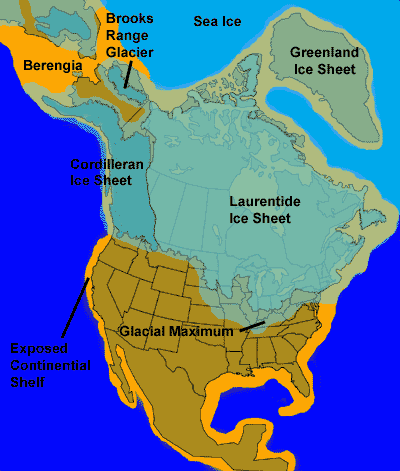
It wasnt humans moron.
The Last Time CO2 Was This High Humans Didn t Exist Climate Central
Which is the entire point you stupid son of a *****.
You are the dumbest mother fukker I believe I've ever run into on a forum board. There is no use even trying to make sense to your ******* idiocy.
mamooth
Diamond Member
WHAT PART OF YOUR DEFENSE OF MY STATEMENTS WHILE ATTEMPTING TO ATTACK THEM IS CONFUSING YOU?
In the first link, the part with "the vines grew 150% faster, the tree 20%" would be what conclusively debunks your crazy claims. The rest of the links there also pointed out how your claims were a fantasy, but you were apparently too flustered to go any further. I understand. Learning that your cult bamboozled you and that everything you knew was wrong must have been a shock.
It would if the world was a small experiment over a short period of time... however, I understood the difference between something that lives for decades, such as a tree, and something that dies off each winter like a vine. Do you? Maybe you could explain that one to the class.WHAT PART OF YOUR DEFENSE OF MY STATEMENTS WHILE ATTEMPTING TO ATTACK THEM IS CONFUSING YOU?
In the first link, the part with "the vines grew 150% faster, the tree 20%" would be what conclusively debunks your crazy claims. The rest of the links there also pointed out how your claims were a fantasy, but you were apparently too flustered to go any further. I understand. Learning that your cult bamboozled you and that everything you knew was wrong must have been a shock.
sigh...
mamooth
Diamond Member
Maybe you could explain where you got the strange idea that vines die each winter.
Most large vines don't. The only large vine I can think of that sees some cold dieback is Kudzu. In my zone, the Wild Grapes, Poison Ivy, Virginia Creeper, Japanese Honeysuckle, Moonseed and Trumpet Vine are all just like the trees, dropping leaves in the fall and resuming growth in the spring. And the English Ivy is evergreen.
And in the tropics, there is no winter.
So, the vines explode, they smother the trees, resulting in a net loss of carbon fixing.
Most large vines don't. The only large vine I can think of that sees some cold dieback is Kudzu. In my zone, the Wild Grapes, Poison Ivy, Virginia Creeper, Japanese Honeysuckle, Moonseed and Trumpet Vine are all just like the trees, dropping leaves in the fall and resuming growth in the spring. And the English Ivy is evergreen.
And in the tropics, there is no winter.
So, the vines explode, they smother the trees, resulting in a net loss of carbon fixing.
Maybe you could explain where you got the strange idea that vines die each winter.
Most large vines don't. The only large vine I can think of that sees some cold dieback is Kudzu. In my zone, the Wild Grapes, Poison Ivy, Virginia Creeper, Japanese Honeysuckle, Moonseed and Trumpet Vine are all just like the trees, dropping leaves in the fall and resuming growth in the spring. And the English Ivy is evergreen.
And in the tropics, there is no winter.
So, the vines explode, they smother the trees, resulting in a net loss of carbon fixing.
I see, so you are trying to tell me that during warmer times back when CO2 concentration was much higher than it is today that the earth was covered with nothing but vines and there were no trees.
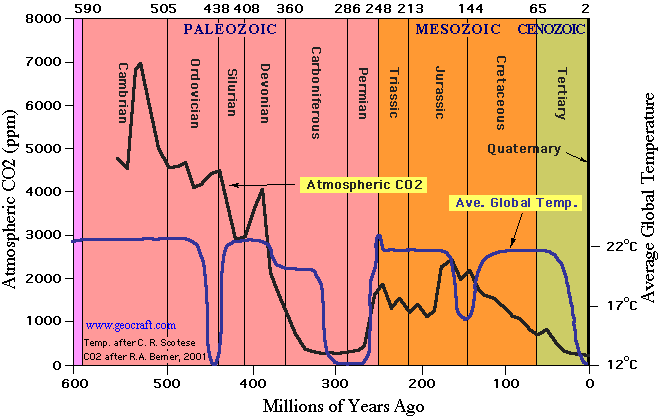
Note: mammoth says all the trees were made extinct by man over most of the last 500million years because man caused CO2 resulted in all the vines choking out all other plant life. Amazing information there mammoth.
Where's the runaway CO2 effect? How did life on earth survive for hundreds of millions of years with CO2 4-15 times higher than it is today? Everything learned to live off vines?

Billy_Bob
Diamond Member
Yeah the earth has a roof fool. Its called the atmosphere. You must not understand basic science. A greenhouse has a water convection cycle as well. Why do you think they use the "greenhouse effect" as another term for global warming?Sorry bud. Our atmosphere works just like a greenhouse. CO2 is an insulator that works just like the glass in a greenhouse.A greenhouse is an environmentally controlled structure designed to extend growing seasons. Our atmosphere is not a greenhouse.You have it backwards. It was warmer due to the abundance of CO2. Can you tell me what gas plants emit? After you do that explain to me the concept of a green house.You got it backwards... it was warmer, so much so that most of the world was much more amiable to life than this current cold snap we are living under. The result of the additional life and warmth was more CO2.
Plants consume / use CO2 through a process called photosynthesis. Some of the CO2 they consume gets converted to sugars, for example glucose C6H12O6, some exhaled, some stored.
While you could argue that plants produce CO2 that would be a half truth, as really they are just temporarily storing it.
Plants actually produce way more oxygen than CO2 However, it absolutely needs CO2 in order to survive. That proves the CO2 has to be in the environment prior to the plant gaining the large sizes it did during the periods of high heat.
A green house has a roof... The earth does not and it also has a water convection cycle that a true green house does not allow... Epic Fail..
The atmosphere is NOT A ROOF... A roof stops convection and escaping radiation, Our atmosphere does not... You really are a fool..
mamooth
Diamond Member
Note: mammoth says all the trees were made extinct by man over most of the last 500million years because man caused CO2 resulted in all the vines choking out all other plant life. Amazing information there mammoth.
Don't make up weird stories about what I supposedly said. It makes you look desperate.
Where's the runaway CO2 effect?
Why do you think there's supposed to be a runaway CO2 effect? Where do you get this stuff?
How did life on earth survive for hundreds of millions of years with CO2 4-15 times higher than it is today? Everything learned to live off vines?
A younger sun was a fainter sun. 500 million years ago, the sun was 4-5% dimmer. The extra CO2 countered the dimmer sun. Prior to that, when CO2 was low, there was snowball earth.
So, nice work there, the way you demonstrated the warming effects of CO2 by paleoclimate evidence.

Porker
Barack Obama Village Idiot b.1961 Kenya
Why so much damn hatred???? Stop bashing and use your heads for something good for once.
Hmmmm....let's see now. OK, I think I've got it. Because Asclepias is the dumbest mother fukker I believe I've ever run into on a forum board. There is no use even trying to make sense to the ******* idiot.
May I help you with any other questions?
Billy_Bob
Diamond Member
Why so much damn hatred???? Stop bashing and use your heads for something good for once.
Hmmmm....let's see now. OK, I think I've got it. Because Asclepias is the dumbest mother fukker I believe I've ever run into on a forum board. There is no use even trying to make sense to the ******* idiot.
May I help you with any other questions?
Actually Mampuke is, In my opinion... or at least a very close second...
Similar threads

- Replies
- 62
- Views
- 1K


- Replies
- 253
- Views
- 4K

- Replies
- 4
- Views
- 527


New Topics
-
 Do You Think That Trump Is Fit To Lead Our Country For The Rest Of His Term?
- Started by ChristisKing
- Replies: 5
-
 So this Texas Tech QB bets his $$$ off and a Texas judge rules he can play after conference sanction
- Started by tyroneweaver
- Replies: 0
-
-
'Oh, shoot!' Republicans Bring Live Elephant Go their Convention — And Tt Makes A Mess.
- Started by 0311
- Replies: 1
-


