Sure, silly ass. A fad to which every Scientific Society, every National Academy of Science and every major Univesity states is a fact.
http://www.usmessageboard.com/environment/147932-2011-global-temperature-thread-13.html#post3262519
Mr.Rocks would you explain to me why Polar bears case using scientific laws are wrong? It is true that co2 shares some of the wave length with water vapor and it may not be able to readmit at that wave length.
Using the equation he gave it does in fact show a log as he pointed out and does show a decrease in the compounding effect of the effects of co2 as you raise the amount of co2 within the Atmosphere. I would say that a scientific law is a respectable argument for or against something and Mr.Bear used it. DR.Hug found that co2 has the effect of only 20 percent of what climate scientist found.
Beer-Lambert Law
Quote:
A = a(lambda) * b * c
where A is the measured absorbance, a(lambda) is a wavelength-dependent absorptivity coefficient, b is the path length, and c is the analyte concentration.
where I is the light intensity after it passes through the sample and Io is the initial light intensity. The relation between A and T is:
A = -log T = - log (I / Io).
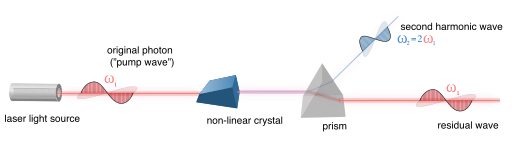
"SHG" = Secondary Harmonics Generation
and that`s where You first learn that CO2 cannot "double cost", because it does not even re-emit the energy it absorbed at the same wavelength where it absorbed it:
Second-harmonic generation - Wikipedia, the free encyclopedia
Quote:
Second harmonic generation (SHG; also called frequency doubling) is a nonlinear optical process, in which photons interacting with a nonlinear material are effectively "combined" to form new photons with twice the energy, and therefore twice the frequency and half the wavelength of the initial photons. It is a special case of sum frequency generation.
Second harmonic generation was first demonstrated by P. A. Franken, A. E. Hill, C. W. Peters, and G. Weinreich at the University of Michigan, Ann Arbor, in 1961. The demonstration was made possible by the invention of the laser, which created the required high intensity monochromatic light. They focused a ruby laser with a wavelength of 694 nm into a quartz sample. They sent the output light through a spectrometer, recording the spectrum on photographic paper, which indicated the production of light at 347 nm. Famously, when published in the journal Physical Review Letters,[1] the copy editor mistook the dim spot (at 347 nm) on the photographic paper as a speck of dirt and removed it from the pub
Beer-Lambert Law
Quote:
A = a(lambda) * b * c
where A is the measured absorbance, a(lambda) is a wavelength-dependent absorptivity coefficient, b is the path length, and c is the analyte concentration.
where I is the light intensity after it passes through the sample and Io is the initial light intensity. The relation between A and T is:
A = -log T = - log (I / Io).
lication
Can you defend against such and show us why this is wrong? He uses these rule and shows that any more increase would have very tiny effects if any.
Thanks.