
Please give us your definition of 'Woke'....Not enough to vote for him for president, but I liked him taking a stand against the woke mob. If he keeps this up there is a chance that he would earn my vote in 2028, but let's not get too ahead of ourselves. Especially since we don't know the future at this point.
Navigation
Install the app
How to install the app on iOS
Follow along with the video below to see how to install our site as a web app on your home screen.
Note: This feature may not be available in some browsers.
More options
Style variation
You are using an out of date browser. It may not display this or other websites correctly.
You should upgrade or use an alternative browser.
You should upgrade or use an alternative browser.
Ron DeSantis Just Earned A Tad Bit Of Respect Back From Me
- Thread starter ChristisKing
- Start date

justoffal
Diamond Member
- Jun 29, 2013
- 38,936
- 31,941
- 2,905
Fags, pedos, trannies, non binary whatsis people, America last morons ....so on and so forthPlease give us your definition of 'Woke'....
So define 'Critical Theory'...Well, DeSantis is My guy. Are you saying you wouldn't vote for Trump if Trump is out?
Right now, the single biggest threat this country faces is the 'Woke" or, commonly referred to as "Critical Theory."
justoffal
Diamond Member
- Jun 29, 2013
- 38,936
- 31,941
- 2,905
Critical Theory:So define 'Critical Theory'...
White people suck...in addition to that White people suck....oh and did I mention that White people suck? Yeah that too!
That about sums it up.
Jo
When the end result is that a minimal amount of people out of a few times the size in an organization that protects other people are the real heroes. One example. In those areas of employment. there are other areas of employment. and the costs are massive.Please give us your definition of 'Woke'....

Darkwind
Diamond Member
- Jun 18, 2009
- 43,459
- 32,671
- 3,615
You'll need to do some reading if you want to know what Critical Theory is.So define 'Critical Theory'...
The Critical Theory of the “Institute for Social Research,” which is better known as the Frankfurt School, focused on power analyses that began from a Marxist (or Marxian) perspective with an aim to understand why Marxism wasn’t proving successful in Western contexts. It rapidly developed a “post-Marxist” position that criticized Marx’s primary focus on economics and expanded his views on power, alienation, and exploitation into all aspects of post-Enlightenment Western culture. These theorists sometimes referred to themselves as “cultural Marxists,” and were referred to that way by others, but the term “cultural Marxism” is now more commonly used to describe (a misconception of) postmodernism (see also, neo-Marxism) or a certain anti-Semitic conspiracy theory. The big-picture agenda of the Frankfurt School was to marry Marxian economic theory to Freudian psychoanalytic theory in order to explain both the rise of fascism and the reasons that the communist revolutions were not taking place in Western democracies as had been predicted.
Max Horkheimer defined a “Critical Theory” in direct opposition to a “Traditional Theory” in a 1937 piece called Traditional and Critical Theory. Whereas a Traditional Theory is meant to be descriptive of some phenomenon, usually social, and aims to understand how it works and why it works that way, a Critical Theory should proceed from a prescriptive normative moral vision for society, describe how the item being critiqued fails that vision (usually in a systemic sense), and prescribe activism to subvert, dismantle, disrupt, overthrow, or change it—that is, generally, to break and then remake society in accordance with the particular critical theory’s prescribed vision. This use of the word “critical” is drawn from Marx’s insistence that everything be “ruthlessly” criticized and from his admonition that the point of studying society is to change it. Of note, then, a Critical Theory is only tangentially concerned with understanding or truth and has, as Hume might have it, abandoned descriptions of what is in favor of pushing for what the particular critical theory holds ought to be. The critical methodology, then, is the central object of concern, and it is the tool by which Social Justice scholarship and activism proceed.
Critical Theory
This entry in 'Translations from the Wokish' is an explanation of the term "Critical Theory."
 newdiscourses.com
Suggested reading:
Cynical Theories: How Activist Scholarship Made Everything about Race, Gender, and Identity—and Why This Harms Everybody
Race Marxism: The Truth About Critical Race Theory and Praxis
The Marxification of Education: Paulo Freire's Critical Marxism and the Theft of Education
justoffal
Diamond Member
- Jun 29, 2013
- 38,936
- 31,941
- 2,905
Oh you don't need all of that.You'll need to do some reading if you want to know what Critical Theory is.
Critical Theory
This entry in 'Translations from the Wokish' is an explanation of the term "Critical Theory."
Suggested reading:
Cynical Theories: How Activist Scholarship Made Everything about Race, Gender, and Identity—and Why This Harms Everybody
Race Marxism: The Truth About Critical Race Theory and Praxis
The Marxification of Education: Paulo Freire's Critical Marxism and the Theft of Education
Here it is in a nutshell.
1.) White people suck...2.) White people suck some more...3.) White people still suck even more.
There ya go...
Darkwind
Diamond Member
- Jun 18, 2009
- 43,459
- 32,671
- 3,615
Thanks but that is part of the problem with this forum.Oh you don't need all of that.
Here it is in a nutshell.
1.) White people suck...2.) White people suck some more...3.) White people still suck even more.
There ya go...
People just toss of flippant answers to serious issues.
Critical Theory poses a very real threat in this country. In My estimation, when they are brainwashing your children, and you do nothing to stop is, you are just handing them victory.
They already control most everything and yet people just simp around talking about anything other than the real threat.
Have we got proof of this because the prison numbers don't back up your claims...How about black people who are treated like they're above the law because they're black?
Sentencing for Black versus white
"The conditional black-white sentence disparity is approximately 9 percent at each decile in our main sample.42 If the disparityis 9 percent across the entire conditional distribution of these cases, then the conditional mean effect of race is also approximately 9.43 percent"
They were given plenty of choice... Want to work you have to do certain things...Bullshit...
Hundreds of thousands of employees were given no choice.
Want to go onto a construction site, you have to wear a hard hat... You have a choice, do you want to work in construction...
So woke is just random shit you don't like...'Woke' is a Marxst attempt to change traditional American society. It includes: Condoning sex change operations for minors without parental consent, teaching kids that they can be any 'gender' they want to be, pushing the as yet unproven 'climate change' agenda, agreeing that 'fossil fuels' are an existential threat to the globe, promoting electric vehicles as 'sustainable' when they rely on fossil fuel plants for their electricity, actually any time you hear 'sustainable' for anything you can bet it's 'woke.' There is much more but you really have to be a patriotic American to understand and that does not include you.
If it rains tomorrow, will that be woke....
You seem to want to blame Climate change concerns on Woke...
Just saying Marxism doesn't make it bad... MArxism had some good ideas too..It is far more detailed, but I don't think you'd understand.
Woke is a mutated form of Marxism, and applying Post-Modern intersectionality, it strives to overthrow established power structures inside of society in favor of a paradigm in which equality of outcomes is centered as the means of equality.
Woke, is nothing more than reheated Marxism using Marcusos Critical Theory.
HE warned about
Marx defined economic reproduction in capitalism and predicted the tendency to concentrate and centralize capital.
This leads to massive income inequality, something that is considered to make society unstable
he German philosopher was one of the first to understand that economic crises were not an error of the capitalist system, but one of its intrinsic characteristics.
Pretty sure that happens and it is built into the Capitalism..
CLASS STRUGGLE
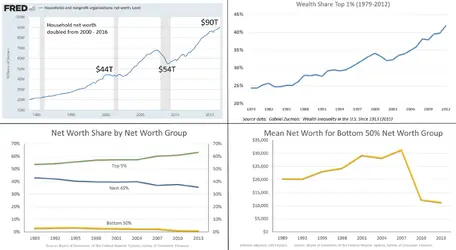
A century and a half after his death, social struggles are fought between the 1% that owns 47% of America and it is rising...
The top 1% owned a record 32.3% of the nation’s wealth as of the end of 2021, data show. The share of wealth held by the bottom 90% of Americans, likewise, has declined slightly since before the pandemic, from 30.5% to 30.2%.
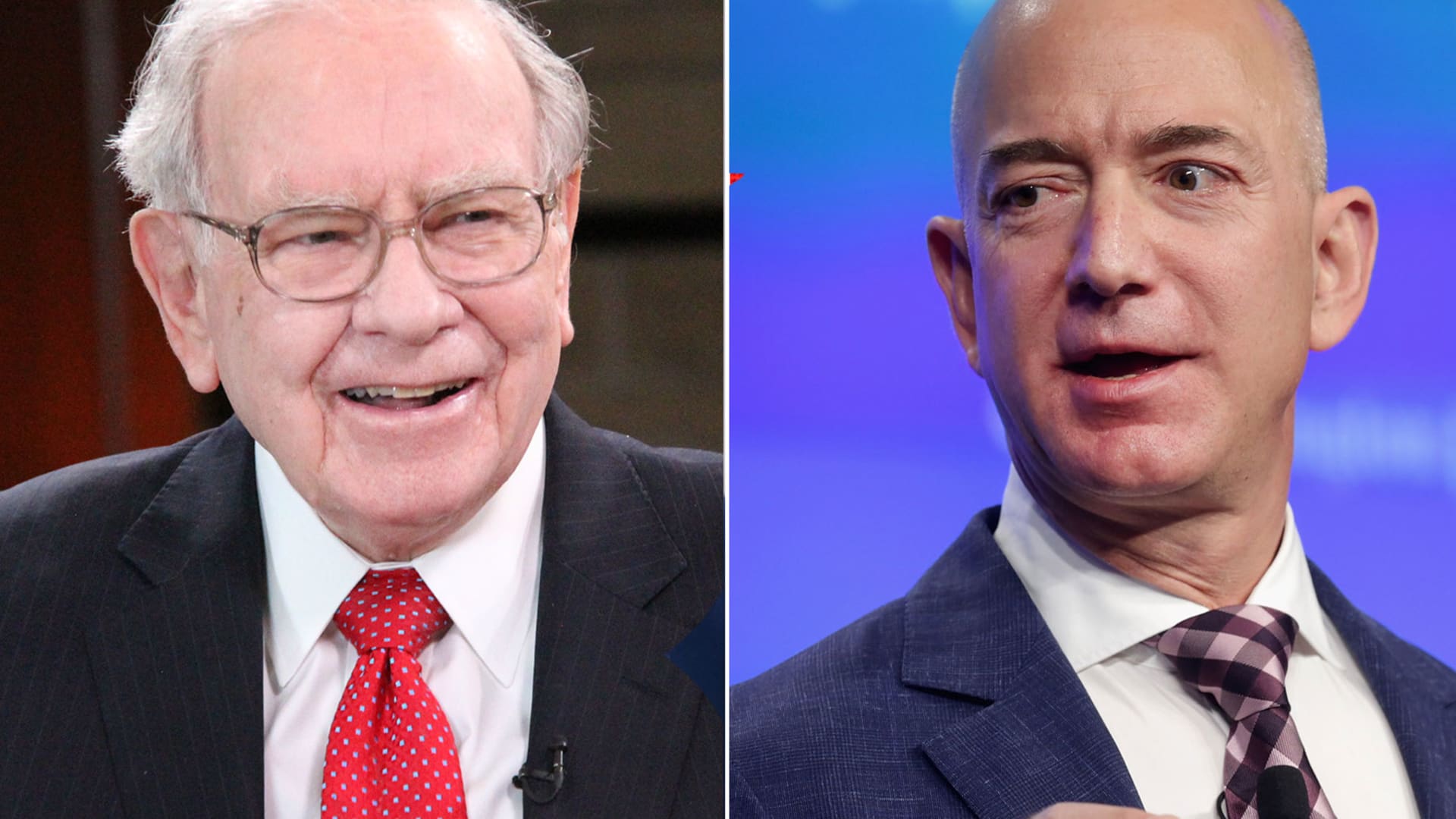
Soaring markets helped the richest 1% gain $6.5 trillion in wealth last year, according to the Fed
The wealth of the top 1% increased by $6.5 trillion last year, mainly driven by soaring stock prices and financial markets, according to the Federal Reserve.
 www.cnbc.com
I am not a fan of Karl Marx but you have to be more specific in what you don't like about him..
Attachments
I assume you are not talking about CRT... But Critical Theory and the teachings from the Frankfurt school in the 1950s and 1960s....Thanks but that is part of the problem with this forum.
People just toss of flippant answers to serious issues.
Critical Theory poses a very real threat in this country. In My estimation, when they are brainwashing your children, and you do nothing to stop is, you are just handing them victory.
They already control most everything and yet people just simp around talking about anything other than the real threat.
Could you show us where these are being taught to children today..
Darkwind
Diamond Member
- Jun 18, 2009
- 43,459
- 32,671
- 3,615
There are over 100 million dead people who are dead as a result of Marxist philosophy. The principal tenet of Marx is a march to communism. The "Utopia" of mankind in Marx posited, From each according to his ability, to each according to his needs"Just saying Marxism doesn't make it bad... MArxism had some good ideas too..
HE warned about
Marx defined economic reproduction in capitalism and predicted the tendency to concentrate and centralize capital.
This leads to massive income inequality, something that is considered to make society unstable
he German philosopher was one of the first to understand that economic crises were not an error of the capitalist system, but one of its intrinsic characteristics.
Pretty sure that happens and it is built into the Capitalism..
CLASS STRUGGLE
A century and a half after his death, social struggles are fought between the 1% that owns 47% of America and it is rising...
The top 1% owned a record 32.3% of the nation’s wealth as of the end of 2021, data show. The share of wealth held by the bottom 90% of Americans, likewise, has declined slightly since before the pandemic, from 30.5% to 30.2%.
Soaring markets helped the richest 1% gain $6.5 trillion in wealth last year, according to the Fed
The wealth of the top 1% increased by $6.5 trillion last year, mainly driven by soaring stock prices and financial markets, according to the Federal Reserve.
I am not a fan of Karl Marx but you have to be more specific in what you don't like about him..
The reality of that concept soon manifested itself in horrendous abuses and death. What Marx, and his followers failed to understand is that Capitalism does deliver the promise of an easier and more comfortable life. Until the greed of those who seek power sets in and people begin to die.
Under Marx, under the neo-Marx of the post-Modernists, people will die. Under these systems, people always die.
The main reason is that they are not doing it for the betterment of mankind, but for power.

bodecea
Diamond Member
- Banned
- #55
The Woke Mandate:Not enough to vote for him for president, but I liked him taking a stand against the woke mob. If he keeps this up there is a chance that he would earn my vote in 2028, but let's not get too ahead of ourselves. Especially since we don't know the future at this point.
Darkwind
Diamond Member
- Jun 18, 2009
- 43,459
- 32,671
- 3,615
CRT, or Critical Race Theory, is but part of Critical Theory.I assume you are not talking about CRT... But Critical Theory and the teachings from the Frankfurt school in the 1950s and 1960s....
Could you show us where these are being taught to children today..
Dr. Lindsay likens it to the Concept of the hierarchy of Evolution where there is a Genus of say, the animal kingdom. Inside this Genus of Animals, you have species. For instance, Mammals have different species, but they are all part of the animal Kingdom.
Critical Theory is the Genus of all the Critical thought. Critical Race Theory, Critical Gender Theory, Critical Sexuality Theory, and Critical Queer Theory.
They are all interchangeable in how they are enacted, attacked, and manipulated.
As for teaching our children, it is deeply researched and detailed in the book, "
The Marxification of Education: Paulo Freire's Critical Marxism and the Theft of Education"
I don't have time right now to get into a deeper conversation on this.
ETA: I'll place a link to a lecture on Paulo Freire's "Critical" Method of Education.
No specfics of Karl Marx ideas that you don't like...There are over 100 million dead people who are dead as a result of Marxist philosophy. The principal tenet of Marx is a march to communism. The "Utopia" of mankind in Marx posited, From each according to his ability, to each according to his needs"
The reality of that concept soon manifested itself in horrendous abuses and death. What Marx, and his followers failed to understand is that Capitalism does deliver the promise of an easier and more comfortable life. Until the greed of those who seek power sets in and people begin to die.
Under Marx, under the neo-Marx of the post-Modernists, people will die. Under these systems, people always die.
The main reason is that they are not doing it for the betterment of mankind, but for power.
Marx didn't like elites, so do MAGAs... So under your thoughts there, are MAGA really pushing Marxism?
Be specific please...

YoursTruly
Diamond Member
- Dec 21, 2019
- 14,393
- 10,146
- 2,140
Not enough to vote for him for president, but I liked him taking a stand against the woke mob. If he keeps this up there is a chance that he would earn my vote in 2028, but let's not get too ahead of ourselves. Especially since we don't know the future at this point.
The fact that Trump was left of center, and DeSantis is right of Trump on almost every issue, should be enough for you to support DeSantis.
Trump's the guy who said he'd be OK with a transwoman competing in the Miss America pageant.

ChristisKing
Let Freedom Ring!
- Thread starter
- #59
Trump's the guy who said he'd be OK with a transwoman competing in the Miss America pageant.
When did he say that?
YoursTruly
Diamond Member
- Dec 21, 2019
- 14,393
- 10,146
- 2,140
When did he say that?
Correction. It was Miss Universe, which he ran.
Trump let trans beauty queen compete in Miss Universe, in a potential 2024 GOP primary liability
This video show's him calling this tranny a female. He's flip flopped (again) on this recently. The only important part of this is that he's a huge flip flopper. He blows with the wind, saying what his supporters want him to say. When he was in charge of Miss Universe, that was his true self. There was no pressure to get votes back then.
Trump opposed NC bathroom bill.
Last edited:
Similar threads


- Replies
- 108
- Views
- 2K

- Replies
- 39
- Views
- 767

- Replies
- 68
- Views
- 1K
- Locked
- Replies
- 35
- Views
- 600

New Topics
-
 Democratic Rep. Seth Moulton appears to erupt when pressed on a potential Graham Platner endorsement.
- Started by DonGlock26
- Replies: 0
-

-
House Democrats’ anxiety rises after wins by Mamdani-backed candidates: ‘Are we going to let them take over the party?’
- Started by DonGlock26
- Replies: 9
-
President Trump reveals his administration is working on NATIONAL RIGHT TO CARRY
- Started by DonGlock26
- Replies: 16
-


