Last week another white home grown Republican voting terrorist killed 58 majority conservatives while wounding over 500 people.If not for Putin....Trump would be begging for his job back at The ApprenticeHow would Trump have handled it? Better than Kennedy did.
Trump is a tool of the Russians. They got him elected
He would have told us......some of them are nice people
total unadulterated horse shit. If anyone is/was owned by the Russians it was Hillary.
But if you still buy that line of BS, why would Russia want Trump over someone they could easily blackmail? They had Hillary's emails (according to you), she made the uranium deal with them, Bubba was paid huge amounts to give speeches in Russia. All kinds of blackmail material on her. So why would they prefer someone they could not control?
please actually think before responding.
so you have no answer, no surprise there.
Navigation
Install the app
How to install the app on iOS
Follow along with the video below to see how to install our site as a web app on your home screen.
Note: This feature may not be available in some browsers.
More options
Style variation
You are using an out of date browser. It may not display this or other websites correctly.
You should upgrade or use an alternative browser.
You should upgrade or use an alternative browser.
Republicans be honest: if Trump were president during the Cuban Missile Crisis, how do you think...
- Thread starter Billy000
- Start date

LordBrownTrout
Diamond Member
I doubt he was blinking but NK could be making Trump shat his pants He doesn't have his law firms now backing his assholishness...that would have turned out?
Can you see Trump achieving what Kennedy did? No you cannot. Just admit it - that would have been a terrifying time to be alive.
Kennedy was blinking like he had dirt in his eyes.
NK is the periphery. While you tinker about nothing, the real stuff is the alignment of russia, china, and iran.

SavannahMann
Platinum Member
- Nov 16, 2016
- 14,540
- 6,830
- 365
JFK pretty much fucked that whole thing up. I wouldn't bring that up if I were you.
Your's is the correct response.
In advance, I haven't read more than the first 10 replies, so others may have
already typed what I'm going to type.
Russia placed the missiles in Cuba because they knew JFK would cower.
JFK didn't commit American power at the Bay of Pigs and he didn't commit
American power at the Berlin wall. Why would he do it then?
In 1962 the Russians had very little ICBM threat against America.
I believe only 32 of them at the time. That's why they put the missiles
in Cuba in the first place. To give them a first strike capability, instead
of those 32 ICBM's plus those old reinvented B-29's they were flying,
that didn't offer much of a threat at all...especially when compared to what
we could do against them.
I doubt the Cuban Missile crisis would have even happened if DJT
had been President. If for no other reason, we would have used the
Cuban Freedom Fighters and removed Castro in 1960, instead of
betraying them on the beach and denying them our air power.
First, you obviously don’t know Trump. Let me expain.
The Bay of Pigs went ahead because the Military and CIA promised Kennedy that it could be done WITHOUT direct US involvement. If the Military had come running to Trump and said whoops, we got it wrong, we need to get involved directly after all. Trump would have said his famous two words, You’re Fired.
We know this, because Trump’s entire history has been firing people who can’t deliver on what they promise, or for doing a shabby job. So claiming that Trump would not have left the Cuban Counterrevolutionaries on the beach is ignoring what Trump would have done. First fired everyone who had misled him. Second, he probably would have gone in, and Cuba would be the Vietnam in place of Vietnam. Because one undeniable fact is that no matter how bad things were in Cuba under Castro, the Cuban people never said it would be nice if Batista was in charge again.
Second, if Trump had sent airpower in during the Cuban Missile Crisis to destroy the anti aircraft sites, and then invaded as the morons in the Pentagon were demanding we do, then the entire first wave of marines would have gone up in a Nuclear Flash, since we were ignorant of the presence of Nuclear short range missiles designed exactly for the situation where the enemy has taken a beachhead.
Third. If Trump had decided to go ahead anyway, then about a third of our Naval ships would have vanished in a nuclear fireball, since the Russian Submarines were carrying nuclear tipped torpedoes just for that.
So I guess we’re glad that the guy I voted for, wasn’t in charge then. Or at least that you were not advising him. Then again, if you were, you’d be fired now too, since you are ignorant.
Stupid me. I first should have asked the board if anybody knows Donald
on a personal level. Then you could have assisted me. With your guidance
I could have listed his favorite meal, favorite color, favorite movie of
all-time, etc, etc.
Then I could have engaged in a hypothetical debate shaping everything
in a manner that would make it appear that it is factual.
Next time I'll call.
It’s not my fault you are ignorant of historical fact. Truth is the story that connects those facts. Your story connected with nothing remotely factual.
Trump is loud, bombastic, even brash. But he expects people to deliver what they say they can or will. Failing to deliver is the one unforgivable sin in Trumps history.
Truthfully. Tell me what you think Trump would do if you said you could do a job for $10 million and then came to him and said you needed another $20 million to finish the job.
You connected nothing.
You made up a scenario based on zero actual knowledge, and shaped
it to support your invented argument.
"Boss...Boss...da plane...da plane"
What dis I make up? Everything I said about the Cuban Missile Crisis was factual. The Soviets had nuclear torpedos and short range missiles there. That fact is well known now.
Did I lie about the Military? Nope. Again that is historical fact. So what did I lie about?
and now he's pushing turkey in that directionI doubt he was blinking but NK could be making Trump shat his pants He doesn't have his law firms now backing his assholishness...that would have turned out?
Can you see Trump achieving what Kennedy did? No you cannot. Just admit it - that would have been a terrifying time to be alive.
Kennedy was blinking like he had dirt in his eyes.
NK is the periphery. While you tinker about nothing, the real stuff is the alignment of russia, china, and iran.
DJT for Life
Gold Member
- Jun 21, 2017
- 3,468
- 900
- 195
Your's is the correct response.
In advance, I haven't read more than the first 10 replies, so others may have
already typed what I'm going to type.
Russia placed the missiles in Cuba because they knew JFK would cower.
JFK didn't commit American power at the Bay of Pigs and he didn't commit
American power at the Berlin wall. Why would he do it then?
In 1962 the Russians had very little ICBM threat against America.
I believe only 32 of them at the time. That's why they put the missiles
in Cuba in the first place. To give them a first strike capability, instead
of those 32 ICBM's plus those old reinvented B-29's they were flying,
that didn't offer much of a threat at all...especially when compared to what
we could do against them.
I doubt the Cuban Missile crisis would have even happened if DJT
had been President. If for no other reason, we would have used the
Cuban Freedom Fighters and removed Castro in 1960, instead of
betraying them on the beach and denying them our air power.
First, you obviously don’t know Trump. Let me expain.
The Bay of Pigs went ahead because the Military and CIA promised Kennedy that it could be done WITHOUT direct US involvement. If the Military had come running to Trump and said whoops, we got it wrong, we need to get involved directly after all. Trump would have said his famous two words, You’re Fired.
We know this, because Trump’s entire history has been firing people who can’t deliver on what they promise, or for doing a shabby job. So claiming that Trump would not have left the Cuban Counterrevolutionaries on the beach is ignoring what Trump would have done. First fired everyone who had misled him. Second, he probably would have gone in, and Cuba would be the Vietnam in place of Vietnam. Because one undeniable fact is that no matter how bad things were in Cuba under Castro, the Cuban people never said it would be nice if Batista was in charge again.
Second, if Trump had sent airpower in during the Cuban Missile Crisis to destroy the anti aircraft sites, and then invaded as the morons in the Pentagon were demanding we do, then the entire first wave of marines would have gone up in a Nuclear Flash, since we were ignorant of the presence of Nuclear short range missiles designed exactly for the situation where the enemy has taken a beachhead.
Third. If Trump had decided to go ahead anyway, then about a third of our Naval ships would have vanished in a nuclear fireball, since the Russian Submarines were carrying nuclear tipped torpedoes just for that.
So I guess we’re glad that the guy I voted for, wasn’t in charge then. Or at least that you were not advising him. Then again, if you were, you’d be fired now too, since you are ignorant.
Stupid me. I first should have asked the board if anybody knows Donald
on a personal level. Then you could have assisted me. With your guidance
I could have listed his favorite meal, favorite color, favorite movie of
all-time, etc, etc.
Then I could have engaged in a hypothetical debate shaping everything
in a manner that would make it appear that it is factual.
Next time I'll call.
It’s not my fault you are ignorant of historical fact. Truth is the story that connects those facts. Your story connected with nothing remotely factual.
Trump is loud, bombastic, even brash. But he expects people to deliver what they say they can or will. Failing to deliver is the one unforgivable sin in Trumps history.
Truthfully. Tell me what you think Trump would do if you said you could do a job for $10 million and then came to him and said you needed another $20 million to finish the job.
You connected nothing.
You made up a scenario based on zero actual knowledge, and shaped
it to support your invented argument.
"Boss...Boss...da plane...da plane"
What dis I make up? Everything I said about the Cuban Missile Crisis was factual. The Soviets had nuclear torpedos and short range missiles there. That fact is well known now.
Did I lie about the Military? Nope. Again that is historical fact. So what did I lie about?
What Trump would have done...and why the Russians installed those
missiles in the first place. Kennedy was weak as hell.
JFK made America a better place Will Trump?
HE WAS A GOOD PRESIDENT
It's all too easy for us to sneer at Kennedy's stance as a Cold Warrior, all these decades later. But he was a man of his times, when paranoia and suspicion ruled the day. In the frightening ideological battle against the Soviets, nobody was immune to rash and half-baked ideas. In fact, the Bay of Pigs fiasco had actually been planned by President Eisenhower, not Kennedy, and simply been inherited by the Kennedy administration.
Yes, Kennedy chose to go ahead with the plan, but what president wouldn't have? Cuba was regarded as a genuine threat, a foothold for the Soviets right on America's doorstep. Kennedy HAD to do something. As Jim Rasenberger, author of The Brilliant Disaster, describes the dilemma over the Bay of Pigs plan: "[Kennedy] had a lot of doubts about it, a lot of concerns about it, but he never could figure out a way not to do it."
And as for the Cuban Missile Crisis, Kennedy absolutely deserves credit for averting total global calamity. Barraged with conflicting opinions from military advisors - some of whom were pressing for the US to trigger war against the Soviets - Kennedy DID keep a cool head, and he DID make the right deal with the Soviets to steer the world away from a nuclear holocaust. It's sheer good luck we had him in the driving seat rather than someone who might have listened to bad advice and gone with a military response.
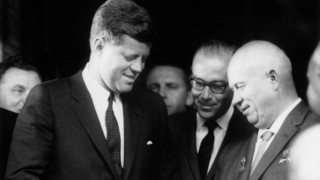
Picture shows: During the Vienna summit in Austria, John Fitzgerald Kennedy, United States president, meets with USSR Premier and Council head Nikita KHRUSHCHEV during the height of the Cold War, June 3, 1961. Taken from The Sixties: The World On The Brink.
What about Kennedy's importance on the domestic front? He founded the Peace Corps, an organisation of volunteers which works to improve the lives of people across the world, and is still going strong to this day.
He also set America on the path to the Moon landing, proclaiming in 1961 that "I believe that this nation should commit itself to achieving the goal, before this decade is out, of landing a man on the moon and returning him safely to the Earth." This seemed like science fiction at the time, but Kennedy's vision was so strong, so convincing, that the goal was indeed achieved.
And, most importantly of all, Kennedy directly paved the way for civil rights in the United States. His speech in 1963, in which he tackled the plight of black Americans head on, was a landmark moment. "We are confronted primarily with a moral issue. It is as old as the Scriptures and is as clear as the American Constitution," Kennedy said to the nation. "One hundred years have passed since President Lincoln freed the slaves, yet their heirs, their grandsons, are not fully free. They are not yet freed from the bonds of injustice. They are not yet freed from social and economic oppression. And this nation, for all its hopes and all its boasts, will not be fully free until all its citizens are free."
The speech was praised by none other than Martin Luther King as "the most sweeping and forthright ever presented by an American president". Following Kennedy's assassination, his successor Lyndon Johnson pushed forward with the sweeping Civil Rights Act, saying that "No memorial oration or eulogy could more eloquently honor President Kennedy's memory".
Kennedy may have been a flawed president, but - constrained by his turbulent times - he made a difference, and he made his nation better.
HE WAS A GOOD PRESIDENT
It's all too easy for us to sneer at Kennedy's stance as a Cold Warrior, all these decades later. But he was a man of his times, when paranoia and suspicion ruled the day. In the frightening ideological battle against the Soviets, nobody was immune to rash and half-baked ideas. In fact, the Bay of Pigs fiasco had actually been planned by President Eisenhower, not Kennedy, and simply been inherited by the Kennedy administration.
Yes, Kennedy chose to go ahead with the plan, but what president wouldn't have? Cuba was regarded as a genuine threat, a foothold for the Soviets right on America's doorstep. Kennedy HAD to do something. As Jim Rasenberger, author of The Brilliant Disaster, describes the dilemma over the Bay of Pigs plan: "[Kennedy] had a lot of doubts about it, a lot of concerns about it, but he never could figure out a way not to do it."
And as for the Cuban Missile Crisis, Kennedy absolutely deserves credit for averting total global calamity. Barraged with conflicting opinions from military advisors - some of whom were pressing for the US to trigger war against the Soviets - Kennedy DID keep a cool head, and he DID make the right deal with the Soviets to steer the world away from a nuclear holocaust. It's sheer good luck we had him in the driving seat rather than someone who might have listened to bad advice and gone with a military response.
Picture shows: During the Vienna summit in Austria, John Fitzgerald Kennedy, United States president, meets with USSR Premier and Council head Nikita KHRUSHCHEV during the height of the Cold War, June 3, 1961. Taken from The Sixties: The World On The Brink.
What about Kennedy's importance on the domestic front? He founded the Peace Corps, an organisation of volunteers which works to improve the lives of people across the world, and is still going strong to this day.
He also set America on the path to the Moon landing, proclaiming in 1961 that "I believe that this nation should commit itself to achieving the goal, before this decade is out, of landing a man on the moon and returning him safely to the Earth." This seemed like science fiction at the time, but Kennedy's vision was so strong, so convincing, that the goal was indeed achieved.
And, most importantly of all, Kennedy directly paved the way for civil rights in the United States. His speech in 1963, in which he tackled the plight of black Americans head on, was a landmark moment. "We are confronted primarily with a moral issue. It is as old as the Scriptures and is as clear as the American Constitution," Kennedy said to the nation. "One hundred years have passed since President Lincoln freed the slaves, yet their heirs, their grandsons, are not fully free. They are not yet freed from the bonds of injustice. They are not yet freed from social and economic oppression. And this nation, for all its hopes and all its boasts, will not be fully free until all its citizens are free."
The speech was praised by none other than Martin Luther King as "the most sweeping and forthright ever presented by an American president". Following Kennedy's assassination, his successor Lyndon Johnson pushed forward with the sweeping Civil Rights Act, saying that "No memorial oration or eulogy could more eloquently honor President Kennedy's memory".
Kennedy may have been a flawed president, but - constrained by his turbulent times - he made a difference, and he made his nation better.

Markle
Diamond Member
Obama did not add $20 trillion! Why are you conservatives pole suckers such liars???
You're proud of petulant former President Barack Hussein Obama adding ONLY $10 TRILLION to our DEBT in only EIGHT YEARS.
Would you like to add the unfunded liabilities that were added over the past EIGHT YEARS? I didn't think so.
Markle
Diamond Member
Last week another white home grown Republican voting terrorist killed 58 majority conservatives while wounding over 500 people.
Still lying.
Nothing new.
LordBrownTrout
Diamond Member
and now he's pushing turkey in that directionI doubt he was blinking but NK could be making Trump shat his pants He doesn't have his law firms now backing his assholishness...that would have turned out?
Can you see Trump achieving what Kennedy did? No you cannot. Just admit it - that would have been a terrifying time to be alive.
Kennedy was blinking like he had dirt in his eyes.
NK is the periphery. While you tinker about nothing, the real stuff is the alignment of russia, china, and iran.
Turkey was already headed that direction 10 years ago.
ain't it great to have a guy who pushes them over the edge like your leader does NK Iran and now Turkey??? along with tax reform doesn't the idiot have anything better to do than get on the case of people kneeling??and now he's pushing turkey in that directionI doubt he was blinking but NK could be making Trump shat his pants He doesn't have his law firms now backing his assholishness...that would have turned out?
Can you see Trump achieving what Kennedy did? No you cannot. Just admit it - that would have been a terrifying time to be alive.
Kennedy was blinking like he had dirt in his eyes.
NK is the periphery. While you tinker about nothing, the real stuff is the alignment of russia, china, and iran.
Turkey was already headed that direction 10 years ago.

Redfish
Diamond Member
You wanted him to solve all the worlds problems??? Just stopping Russia was enough imho to make his name known throughout history with great honorHe de escalated the situationHow many of Americas lives were lost ??? JFK did a great job If dump was president then YOU might not be around now talking out of your buttJFK pretty much fucked that whole thing up. I wouldn't bring that up if I were you.
Something Trump seems incapable of
you mean he allowed the brutal Castro regime to continue to abuse the people of Cuba? He stopped the Russian missiles but left Cuba to Castro.
yes, he stopped the Russian missiles from being installed in cuba, that was good. He badly screwed up the bay of pigs invasion and that gave Castro more power.
I think Kennedy was on balance a good president. He would be a republican today.
Redfish
Diamond Member
ain't it great to have a guy who pushes them over the edge like your leader does NK Iran and now Turkey??? along with tax reform doesn't the idiot have anything better to do than get on the case of people kneeling??and now he's pushing turkey in that directionI doubt he was blinking but NK could be making Trump shat his pants He doesn't have his law firms now backing his assholishnessKennedy was blinking like he had dirt in his eyes.
NK is the periphery. While you tinker about nothing, the real stuff is the alignment of russia, china, and iran.
Turkey was already headed that direction 10 years ago.
He is doing what all of his predecessors should have been doing. Reagan and Truman were the only ones in the recent past with the guts to do what needed to be done. Trump is faced with undoing the incompetence of the Bushes, Clinton, and Obama, its no small task.
Redfish
Diamond Member
poor little gnat, his boi friend kicked him out of bed on a sunday morning
Mr. Tuna......just because I basically called your cult hero a ******* idiot, should not have prompted you to make your usual gay-bashing retorts.
Instead, go light a cross somewhere......
I have no problem with you being gay, do you?
Redfish
Diamond Member
Obama did not add $20 trillion! Why are you conservatives pole suckers such liars???So did Bush....Reagan tripled itYou really have to look at the bigger picture, what JFK and latter what Reagan achieved was two huge achomplisments in modern day America...you can't deny it ..
Kennedy landed us on the moon.
Reagan landed us in debt.
and Obama doubled that debt, what's your point?
Does anyone really care?
obozo added 20 trillion, how much did Reagan and Bush add? The dollars added to the debt is what matters, not the %.
and Yes, many people care. Interest on our national debt will soon be the largest item in our national budget
when he took office the national debt was 10.6 T, when he left it was 19.7 T. So I stand corrected. Obama only added 9.1 T. 1.5 T short of doubling it. Happy now, dipshit? The bottom line is that Obama added more to the national debt than any previous president. Almost more than all of them combined.
Now, spin away in your libtardian fantasy land.
I think he cared too much about social issues to ever be a republicanYou wanted him to solve all the worlds problems??? Just stopping Russia was enough imho to make his name known throughout history with great honorHe de escalated the situationHow many of Americas lives were lost ??? JFK did a great job If dump was president then YOU might not be around now talking out of your buttJFK pretty much fucked that whole thing up. I wouldn't bring that up if I were you.
Something Trump seems incapable of
you mean he allowed the brutal Castro regime to continue to abuse the people of Cuba? He stopped the Russian missiles but left Cuba to Castro.
yes, he stopped the Russian missiles from being installed in cuba, that was good. He badly screwed up the bay of pigs invasion and that gave Castro more power.
I think Kennedy was on balance a good president. He would be a republican today.
Redfish
Diamond Member
Last week another white home grown Republican voting terrorist killed 58 majority conservatives while wounding over 500 people.If not for Putin....Trump would be begging for his job back at The ApprenticeHow would Trump have handled it? Better than Kennedy did.
Trump is a tool of the Russians. They got him elected
He would have told us......some of them are nice people
total unadulterated horse shit. If anyone is/was owned by the Russians it was Hillary.
But if you still buy that line of BS, why would Russia want Trump over someone they could easily blackmail? They had Hillary's emails (according to you), she made the uranium deal with them, Bubba was paid huge amounts to give speeches in Russia. All kinds of blackmail material on her. So why would they prefer someone they could not control?
please actually think before responding.
so you have no answer, no surprise there.
except that he was a registered democrat and antifa supporter. Try the truth once in a while, you will feel better
Redfish
Diamond Member
I think he cared too much about social issues to ever be a republicanYou wanted him to solve all the worlds problems??? Just stopping Russia was enough imho to make his name known throughout history with great honorHe de escalated the situationHow many of Americas lives were lost ??? JFK did a great job If dump was president then YOU might not be around now talking out of your butt
Something Trump seems incapable of
you mean he allowed the brutal Castro regime to continue to abuse the people of Cuba? He stopped the Russian missiles but left Cuba to Castro.
yes, he stopped the Russian missiles from being installed in cuba, that was good. He badly screwed up the bay of pigs invasion and that gave Castro more power.
I think Kennedy was on balance a good president. He would be a republican today.
You "think" wrong. Are you a product of common core education? I was alive when Kennedy was president, he was not a liberal by today's standards. No liberal today would say "ask not what your country can do for you, ask what you can do for your country" That statement is as anti liberal as anything said by Trump.
I think he cared too much about social issues to ever be a republicanYou wanted him to solve all the worlds problems??? Just stopping Russia was enough imho to make his name known throughout history with great honorHe de escalated the situation
Something Trump seems incapable of
you mean he allowed the brutal Castro regime to continue to abuse the people of Cuba? He stopped the Russian missiles but left Cuba to Castro.
yes, he stopped the Russian missiles from being installed in cuba, that was good. He badly screwed up the bay of pigs invasion and that gave Castro more power.
I think Kennedy was on balance a good president. He would be a republican today.
You "think" wrong. Are you a product of common core education? I was alive when Kennedy was president, he was not a liberal by today's standards. No liberal today would say "ask not what your country can do for you, ask what you can do for your country" That statement is as anti liberal as anything said by Trump.
For Red and Pap
CNN Michael Smerconish says Corker’s building a 25th Amendment case for removing Trump from office

CNN Michael Smerconish says Corker’s building a 25th Amendment case for removing Trump from office
CNN’s Monday morning “New Day” began with a stunned host Alisyn Camerota calling Sen. Bob Corker’s (R-PA) conversation with the New York Times…
RAWSTORY.COM
I was not only alive then red but was at fort Bliss when we were called to Florida Thank god JFK kept us from a war trump wouldn't have...Of course Trump is smarter than the Generals lolI think he cared too much about social issues to ever be a republicanYou wanted him to solve all the worlds problems??? Just stopping Russia was enough imho to make his name known throughout history with great honorHe de escalated the situation
Something Trump seems incapable of
you mean he allowed the brutal Castro regime to continue to abuse the people of Cuba? He stopped the Russian missiles but left Cuba to Castro.
yes, he stopped the Russian missiles from being installed in cuba, that was good. He badly screwed up the bay of pigs invasion and that gave Castro more power.
I think Kennedy was on balance a good president. He would be a republican today.
You "think" wrong. Are you a product of common core education? I was alive when Kennedy was president, he was not a liberal by today's standards. No liberal today would say "ask not what your country can do for you, ask what you can do for your country" That statement is as anti liberal as anything said by Trump.
Similar threads

- Replies
- 12
- Views
- 200

- Locked
- Replies
- 37
- Views
- 446


- Poll
- Replies
- 20
- Views
- 376


- Replies
- 49
- Views
- 483

New Topics
-
 Please give your opinion/rating of this Country Music Singer (Youtube and some Talent Show I gather)
- Started by Seymour Flops
- Replies: 0
-
 Using online activities for assessing individuals
- Started by Divine Wind
- Replies: 0
-

-
-
 The Nature of War has had two major developments in the past 70 years
- Started by Hafar1014
- Replies: 0

