Then why do you fail to do so?
Just for starters and cause this is just about my favorite nagging point: there's no such thing as proof in the natural sciences. Secondly, I have no problem accepting proper applications of the scientific method. That's why I tend very strongly to accept the views of mainstream science. You're the one that is rejecting all the actual evidence out of hand.
I have done no such thing. Models make use of lots of averages and integrals and running means and average standard deviations and floating norms and RMSs because the have to; the world is a very big place.
The world's climate scientists tell us that CO2 is the primary driver because that is what their calculation tell them. And, as I have told you before, you're just going to have to pardon me for preferring their word to yours.
Your babbling.
Yes. I've read it
That's an 11% range of values. Yet modern measurements show less than 3% in the 11-year cycle and less than half that in the last century's change. I'd say this was an indication of some crap data pre-satellite. Funny how much that sounds like something you'd say about some dataset we 'warmers' had presented.
Tett (
Gambassa - Ammon Tuimaualuga - web document - (Tett et al. 1999) was suggesting TSI changes affected global temperatures in the early part of the century. His paper fully accepts and supports AGW.
Cubasch and Voss were talking about the 11-year cycle when they mentioned a temperature change of a few tenths C. The two of them have spent the last several years working on SOLVO: "The aim of this project is to investigate the solar influence on climate with a GCM recently developed at the National Center for Atmospheric Research (NCAR) in Boulder, USA. The model is the first that has been designed specifically to investigate the interaction between radiation, chemistry and dynamics from the Earth's surface to the thermosphere (140 km). The close collaboration with NCAR's experienced model team ensures the realization of the project which adds new aspects to previous work with GCMs looking for the mechanism of Sun-climate interactions."
Neither of these folks have said anything that would alter the current understanding of AGW. All three of them accept AGW as settled science.
So... where's your proof?
I've seen these plots in numerous locations. They are not being repressed.
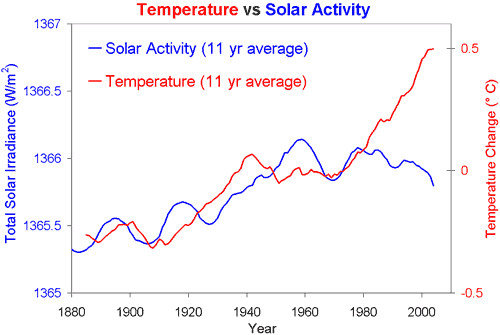
Surprising that you would bring that up. At that point point in time, CO2 levels dropped and, within two years, temperatures dropped. TSI, on the other hand, chose that point in time to accelerate an upward climb. So, what correlation are you seeing?
Changes in TSI do have an effect on global temperatures but they're small ones. The actual changes in TSI over the pertinent time period simply have not been large enough to have caused the observed warming.
That's right. Cause if you look at the TSI sources to which the IPCC refers, you will see the change over the last century has been much smaller than some earlier estimates - the estimates you and FCT like to use.
I am uncertain what you're trying to say here. If you're suggesting that BTK did not find a sharp recent rise in OHC, I would have to say you're full of __it. If you're trying to say something else, you're going to have to make yourself a little more comprehensible.


 ).
).