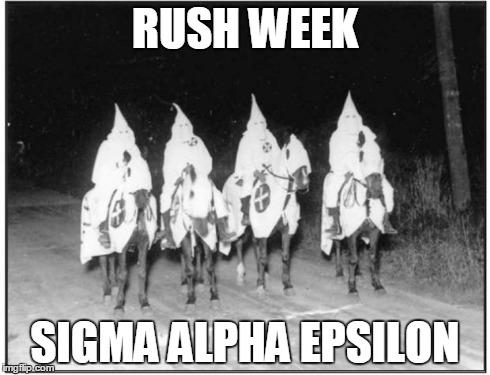
If there wasn't a code or rule being violated, then the college just censored free speech and on top of it slandered these students reputation by publicizing this situation in the way that they did, and potentially did financial harm to them.
It's a "public" university. Free speech could have been violated a right granted to every citizen no matter what they say under article 1 of the constitution.
Hi
Judicial review and thanks for standing up for the side that isn't being heard for all the hoopla over the R and N word.
Yes and no.
The University has policies about not creating a hostile environment.
One of the students who videotaped the chant felt this was hostile, and exposed it.
There was nothing wrong with protesting the chants, and the University following up with protocol within their policies.
The SAE also has the right to disband a group they find as failing to meet their standards and policies.
These groups have the right to act in this way.
Where I MIGHT agree with you, is if people conspire to retaliate, if they abuse free speech to slander or harass the students further, that might be excessive.
Frankly I believe it would be more productive, constructive and corrective for the student body to work WITH the students to address the matter.
I started a thread, asking should there be other corrections or restitution. And one of the poll options was to let the students work out a plan for resolving the conflict.
The peer counseling, mediation models, honor system/consensus penalties,
and teen court programs I've looked at are very effective
in empowering students to resolve noncriminal issues like violations of school policy.
I would have supported the students in addressing this, since both the chants were
led by students, participated in, and videotaped. I would trust the students to work out a solution
and use this as a good exercise in petitioning to redress grievances.
Thanks Judicial
There have been a couple of cases of free speech and school policy violations
at my own alma mater that I believe could be better resolved by a joint review by students and faculty
so the community takes full ownership and responsibility for both the rules, infractions and consequences
for deterrence, correction and prevention. I believe the restorative justice approach works better in such cases.
Yours truly,
Emily