Of polar caps and climate change

EMH

Diamond Member
Joined
Apr 5, 2021
Messages
30,210
Reaction score
17,817
Points
2,788
Just in our solar system, there are several other planets/moons/dwarf planets/round objects in space that have frozen polar caps. Why does whatever form of "ice" always freeze at the poles? The poles are coldest because they are at the worst angle to the Sun and get the least amount of heat energy from Sun. The equator is perpendicular to the Sun and hence gets the strongest energy. I don't think that is too controversial, but with CO2 FRAUD you never know.

Mars is a fascinating laboratory of planetary climate change because of its highly elliptical orbit. Mars has massive climate change during each year. It goes from cold to extremely cold, and its surface air pressure (SAP) fluctuates considerably, going way up as the planet warms and way down as the planet cools.


See the source image


Now, not all of that is warming/cooling, the Martian polar ice caps, mostly CO2, vary considerably during the year, and greatly affect SAP. CO2 sublimes, doesn't go into a liquid phase, simply goes from solid to gas.

The polar CO2 ice caps from Mars
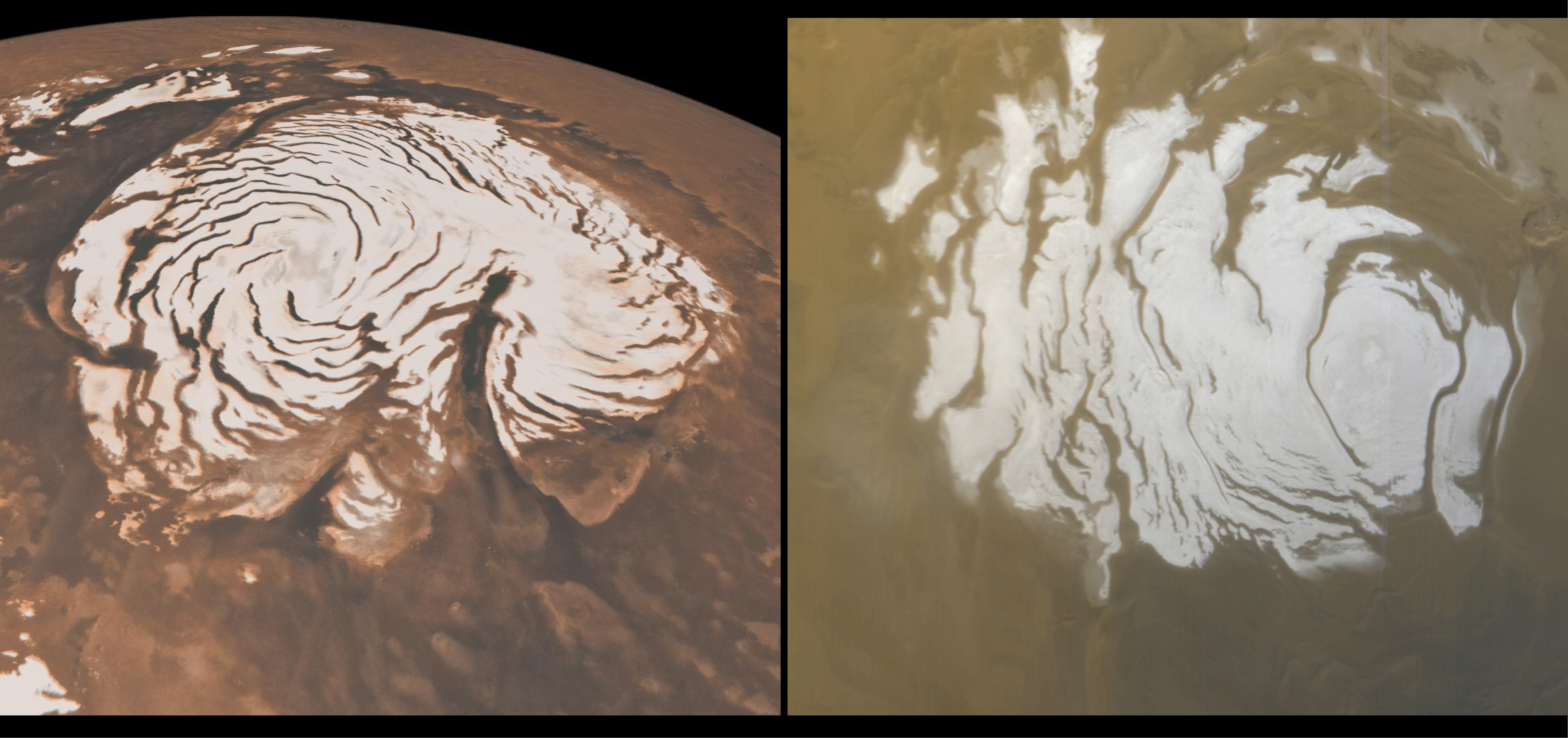


Planet Mars Ice Caps


The "irregularities" are from the shape of the land, hills blocking Sun etc. But they are polar caps and the frozen CO2 is generally within a certain range of the pole given the time of year, a Mars year.


On Earth we have polar caps made of H2O that do go into a liquid phase, water. It is that issue that causes Earth to have its irregular polar ice caps... the ice only grows on land, not water, or sea ice, which is only 1% or so, and includes icebergs originating from land. Antarctica is 90%, Greenland is 7%, Ellesmere is 0.3%, that's 97.3% of Earth ice. The rest is mountains and sea ice.


Difference between arctic and antarctic | Arctic Vs Antarctic ...


So while Mars' polar caps fluctuate off distance from Sun, Earth, with its more circular orbit, has a different trigger for climate change, the position of land. An Earth polar circle with no land within 600 miles of the pole has no ice, essentially "winking out" one of the planet's ice caps. That does warm Earth, as the ice cools both the air that goes above it and the water where it dumps icebergs, and that wouldn't be there anymore.

Essentially, the tectonic movement of the plates and the position of land controls the size and scope of our two polar caps. And it really does the same thing as it does on Mars.


No land near the poles = no ice = warmer, wetter, much higher SAP = Jurassic


OK, so then the question is, but the ice melts into water, it doesn't go into the atmosphere. OK, the H2O doesn't, but... the ice is from ice age glacier, where each year's ice layer is layered on top of the prior one.


GoogAI...

A 10:1 ratio is a common rule of thumb where 10 inches of snow equals 1 inch of water.


and all of that air is trapped in the ice, and those annual layers compress as more weight is added on top each year. There is more gas trapped in Antarctic ice than there is in the atmosphere now. Melt that ice and all that gas goes back into the atmosphere, so Earth's ice situation really isn't any different from Mars in that regard... melt the ice, more gas goes into atmosphere.


If you allow yourself to entertain the idea that a higher atmospheric pressure, say between 3 and 5 bar, could have existed in the time of the dinosaurs, it would resolve two of the anomalies that face us today, which are:* how a dinosaur’s heart could pump blood 7 or more meters upwards, without introducing the ideas of multiple hearts (as many as 8), giant hearts, and hearts located right under their chins, and * how a giant flying quetzalcoatlus had the energy to stay airborne, something that biology and aerodynamics says is not possible in today’s atmosphere.


So yeah, planetary climate change, assuming stable orbit, Sun energy, is driven by changes to the polar caps, whatever they are made out of, Pluto has N polar caps.


Warm the planet = cap melts/sublimes = warmer and higher SAP

For Earth, the warming comes from the changes to the amount of ice on the planet, which is about tectonic plate movement and 600 miles to the pole, but the same thing happens
 
Just in our solar system, there are several other planets/moons/dwarf planets/round objects in space that have frozen polar caps. Why does whatever form of "ice" always freeze at the poles? The poles are coldest because they are at the worst angle to the Sun and get the least amount of heat energy from Sun. The equator is perpendicular to the Sun and hence gets the strongest energy. I don't think that is too controversial, but with CO2 FRAUD you never know.

Mars is a fascinating laboratory of planetary climate change because of its highly elliptical orbit. Mars has massive climate change during each year. It goes from cold to extremely cold, and its surface air pressure (SAP) fluctuates considerably, going way up as the planet warms and way down as the planet cools.


See the source image


Now, not all of that is warming/cooling, the Martian polar ice caps, mostly CO2, vary considerably during the year, and greatly affect SAP. CO2 sublimes, doesn't go into a liquid phase, simply goes from solid to gas.

The polar CO2 ice caps from Mars


Planet Mars Ice Caps


The "irregularities" are from the shape of the land, hills blocking Sun etc. But they are polar caps and the frozen CO2 is generally within a certain range of the pole given the time of year, a Mars year.


On Earth we have polar caps made of H2O that do go into a liquid phase, water. It is that issue that causes Earth to have its irregular polar ice caps... the ice only grows on land, not water, or sea ice, which is only 1% or so, and includes icebergs originating from land. Antarctica is 90%, Greenland is 7%, Ellesmere is 0.3%, that's 97.3% of Earth ice. The rest is mountains and sea ice.


Difference between arctic and antarctic | Arctic Vs Antarctic ...


So while Mars' polar caps fluctuate off distance from Sun, Earth, with its more circular orbit, has a different trigger for climate change, the position of land. An Earth polar circle with no land within 600 miles of the pole has no ice, essentially "winking out" one of the planet's ice caps. That does warm Earth, as the ice cools both the air that goes above it and the water where it dumps icebergs, and that wouldn't be there anymore.

Essentially, the tectonic movement of the plates and the position of land controls the size and scope of our two polar caps. And it really does the same thing as it does on Mars.


No land near the poles = no ice = warmer, wetter, much higher SAP = Jurassic


OK, so then the question is, but the ice melts into water, it doesn't go into the atmosphere. OK, the H2O doesn't, but... the ice is from ice age glacier, where each year's ice layer is layered on top of the prior one.


GoogAI...

A 10:1 ratio is a common rule of thumb where 10 inches of snow equals 1 inch of water.


and all of that air is trapped in the ice, and those annual layers compress as more weight is added on top each year. There is more gas trapped in Antarctic ice than there is in the atmosphere now. Melt that ice and all that gas goes back into the atmosphere, so Earth's ice situation really isn't any different from Mars in that regard... melt the ice, more gas goes into atmosphere.


If you allow yourself to entertain the idea that a higher atmospheric pressure, say between 3 and 5 bar, could have existed in the time of the dinosaurs, it would resolve two of the anomalies that face us today, which are:* how a dinosaur’s heart could pump blood 7 or more meters upwards, without introducing the ideas of multiple hearts (as many as 8), giant hearts, and hearts located right under their chins, and * how a giant flying quetzalcoatlus had the energy to stay airborne, something that biology and aerodynamics says is not possible in today’s atmosphere.


So yeah, planetary climate change, assuming stable orbit, Sun energy, is driven by changes to the polar caps, whatever they are made out of, Pluto has N polar caps.


Warm the planet = cap melts/sublimes = warmer and higher SAP

For Earth, the warming comes from the changes to the amount of ice on the planet, which is about tectonic plate movement and 600 miles to the pole, but the same thing happens


Human activities, primarily the emission of greenhouse gases since the Industrial Revolution, are causing rapid melting and thinning of polar ice caps. Rising global temperatures are causing Arctic sea ice to decline by 13% per decade and accelerating the melting of the Greenland and Antarctic ice sheets, contributing to sea-level rise and habitat loss.
 
Al Roker explained how MMCC or Global Warming caused the crazy cold the North East experienced this last month. I was happy in Fort Lauderdale that whole time btw.

Al Roker has explained that while the planet is warming overall, climate change can cause intense cold spells in the Northeast by disrupting the polar vortex, allowing arctic air to escape southward.
Roker has noted that "global warming" can be misleading, and prefers "climate change" because it encompasses this increase in extreme weather variability, including, paradoxically, more severe cold snaps.
 
Human activities, primarily the emission of greenhouse gases since the Industrial Revolution, are causing rapid melting and thinning of polar ice caps


Completely false. You can't even show us a single photo of "ocean rise." The actual data from the satellites and balloons showed no warming in atmosphere until your side FUDGED the data in 2005...


and surface air pressure on Earth is not rising, proving Earth is neither warming nor experiencing an ongoing net ice melt.

CO2 does NOTHING.


Rising global temperatures are causing Arctic sea ice to decline by 13% per decade


No, what is causing the slow decline in Arctic SEA ice is the growth of Arctic Ocean, which used to be smaller and closer circled around north pole.

The big time one year melts in Arctic Sea Ice 2005 and 2007 fool only absolute morons now... Gakkel Ridge has undersea volcanos.
 
accelerating the melting of the Greenland and Antarctic ice sheets


An ice age glacier like Greenland and AA grows a new layer of ice every year, and the ice cores prove it. CO2 FRAUD defines that as "melting."

97% of Earth ice today has grown every year for at least the past million...
 
Completely false. You can't even show us a single photo of "ocean rise." The actual data from the satellites and balloons showed no warming in atmosphere until your side FUDGED the data in 2005...


and surface air pressure on Earth is not rising, proving Earth is neither warming nor experiencing an ongoing net ice melt.

CO2 does NOTHING.


No, what is causing the slow decline in Arctic SEA ice is the growth of Arctic Ocean, which used to be smaller and closer circled around north pole.

The big time one year melts in Arctic Sea Ice 2005 and 2007 fool only absolute morons now... Gakkel Ridge has undersea volcanos.
You climate change deniers are a hoot.
 
You climate change deniers are a hoot.


Climate change is a science. You cannot refute one word I've posted.

Global Warming, the theory that CO2 has anything to do with Earth climate change, is 100% bullshit and proven so easily.

YOU DENY CLIMATE CHANGE by insisting CO2 FRAUD is not FRAUD when it is and always was.
 
Just in our solar system, there are several other planets/moons/dwarf planets/round objects in space that have frozen polar caps. Why does whatever form of "ice" always freeze at the poles? The poles are coldest because they are at the worst angle to the Sun and get the least amount of heat energy from Sun. The equator is perpendicular to the Sun and hence gets the strongest energy. I don't think that is too controversial, but with CO2 FRAUD you never know.

Mars is a fascinating laboratory of planetary climate change because of its highly elliptical orbit. Mars has massive climate change during each year. It goes from cold to extremely cold, and its surface air pressure (SAP) fluctuates considerably, going way up as the planet warms and way down as the planet cools.


See the source image


Now, not all of that is warming/cooling, the Martian polar ice caps, mostly CO2, vary considerably during the year, and greatly affect SAP. CO2 sublimes, doesn't go into a liquid phase, simply goes from solid to gas.

The polar CO2 ice caps from Mars


Planet Mars Ice Caps


The "irregularities" are from the shape of the land, hills blocking Sun etc. But they are polar caps and the frozen CO2 is generally within a certain range of the pole given the time of year, a Mars year.


On Earth we have polar caps made of H2O that do go into a liquid phase, water. It is that issue that causes Earth to have its irregular polar ice caps... the ice only grows on land, not water, or sea ice, which is only 1% or so, and includes icebergs originating from land. Antarctica is 90%, Greenland is 7%, Ellesmere is 0.3%, that's 97.3% of Earth ice. The rest is mountains and sea ice.


Difference between arctic and antarctic | Arctic Vs Antarctic ...


So while Mars' polar caps fluctuate off distance from Sun, Earth, with its more circular orbit, has a different trigger for climate change, the position of land. An Earth polar circle with no land within 600 miles of the pole has no ice, essentially "winking out" one of the planet's ice caps. That does warm Earth, as the ice cools both the air that goes above it and the water where it dumps icebergs, and that wouldn't be there anymore.

Essentially, the tectonic movement of the plates and the position of land controls the size and scope of our two polar caps. And it really does the same thing as it does on Mars.


No land near the poles = no ice = warmer, wetter, much higher SAP = Jurassic


OK, so then the question is, but the ice melts into water, it doesn't go into the atmosphere. OK, the H2O doesn't, but... the ice is from ice age glacier, where each year's ice layer is layered on top of the prior one.


GoogAI...

A 10:1 ratio is a common rule of thumb where 10 inches of snow equals 1 inch of water.


and all of that air is trapped in the ice, and those annual layers compress as more weight is added on top each year. There is more gas trapped in Antarctic ice than there is in the atmosphere now. Melt that ice and all that gas goes back into the atmosphere, so Earth's ice situation really isn't any different from Mars in that regard... melt the ice, more gas goes into atmosphere.


If you allow yourself to entertain the idea that a higher atmospheric pressure, say between 3 and 5 bar, could have existed in the time of the dinosaurs, it would resolve two of the anomalies that face us today, which are:* how a dinosaur’s heart could pump blood 7 or more meters upwards, without introducing the ideas of multiple hearts (as many as 8), giant hearts, and hearts located right under their chins, and * how a giant flying quetzalcoatlus had the energy to stay airborne, something that biology and aerodynamics says is not possible in today’s atmosphere.


So yeah, planetary climate change, assuming stable orbit, Sun energy, is driven by changes to the polar caps, whatever they are made out of, Pluto has N polar caps.


Warm the planet = cap melts/sublimes = warmer and higher SAP

For Earth, the warming comes from the changes to the amount of ice on the planet, which is about tectonic plate movement and 600 miles to the pole, but the same thing happens
Mars and Earth are both subject to orbital geometry, axial tilt, and solar input, but the physics of planetary warming is very different between them. On Mars, the polar CO2 caps sublimate seasonally and the atmosphere is thin, so surface air pressure swings dramatically. On Earth, polar ice is mostly H2O, the atmosphere is dense, and melting glaciers release water, not trapped CO2.

Ice melt does not instantly “pump gas” into the atmosphere in anywhere near the quantities required to explain current warming. The air trapped in ice is minuscule compared with atmospheric CO2 and its radiative forcing. Tectonics and land distribution affect where ice forms, but they do not drive the global energy imbalance we see today.

Modern warming is driven by measured increases in greenhouse gases, primarily CO2, which trap outgoing infrared radiation and increase global temperatures. This is fully consistent with thermodynamics, satellite observations, and ocean heat content, independent of where land or ice exists.
 
Mars and Earth are both subject to orbital geometry, axial tilt, and solar input, but the physics of planetary warming is very different between them.


Total BS. There is no difference. Both warm when closer to Sun.


On Mars, the polar CO2 caps sublimate seasonally and the atmosphere is thin, so surface air pressure swings dramatically.


And what causes the sublimation?

WARMING

WARMING and MELTING go together. As MARS WARMS its CO2 polar caps sublime/melt.


On Earth, polar ice is mostly H2O, the atmosphere is dense, and melting glaciers release water, not trapped CO2


The melting of ice age glacier ice releases water AND AIR.

GoogAI
A general rule of thumb is that 10 to 12 inches of snow melts down to approximately 1 inch of water. Therefore, one foot (12 inches) of snow is roughly equivalent to 1 inch of liquid water


And that is what is trapped in the ice. Take a foot of snow and compress it to a tiny fraction of an inch, what the ice cores document, and that air, all 10 inches of it at surface pressure, is still there. There is more air trapped in Antarctic Ice than is in the atmosphere now. Melt it and Surface Air Pressure on Earth goes up 3-5 fold, the only explanation for how the ancient dinosaurs flew.


Ice melt does not instantly “pump gas” into the atmosphere in anywhere near the quantities required to explain current warming.


All wrong. Yes melting ice age glacier releases the air trapped in it instantly back into atmosphere. There is no warming on Earth because neither Greenland nor Antarctica are losing ice, which explains why

1. you cannot show us a single photo of "ocean rise"
2. Earth is not warming despite Urban Heat Island Effect according to ALL ACTUAL DATA, not FUDGE


The OP explains that fully.


Tectonics and land distribution affect where ice forms


An ice age requires land to grow on, it cannot form on ocean. So tectonics dictates how much land is within 600 miles of a pole and hence in "ice age" like AA and Greenland are now.

Air that passes over Antarctic Circle is 50F colder than air that passes over Arctic.
AA dumps 9 times the ice the Arctic does into oceans, 46 times the H20 the Mississippi dumps into the Gulf, and that ice averages -100F or so inside


Antarctic cools Earth more than Arctic, both the air and the water. The "settings" of each pole are dictated by the position of land. Two polar oceans = Earth has no ice except mountain tops. Now, it has 9 million cubic miles of it. Put another Antarctic sized continent on North Pole and it would be colder, lower oceans, lower SAP, little to no cane activity etc...
 
Total BS. There is no difference. Both warm when closer to Sun.


And what causes the sublimation?

WARMING

WARMING and MELTING go together. As MARS WARMS its CO2 polar caps sublime/melt.


The melting of ice age glacier ice releases water AND AIR.

GoogAI
A general rule of thumb is that 10 to 12 inches of snow melts down to approximately 1 inch of water. Therefore, one foot (12 inches) of snow is roughly equivalent to 1 inch of liquid water


And that is what is trapped in the ice. Take a foot of snow and compress it to a tiny fraction of an inch, what the ice cores document, and that air, all 10 inches of it at surface pressure, is still there. There is more air trapped in Antarctic Ice than is in the atmosphere now. Melt it and Surface Air Pressure on Earth goes up 3-5 fold, the only explanation for how the ancient dinosaurs flew.


All wrong. Yes melting ice age glacier releases the air trapped in it instantly back into atmosphere. There is no warming on Earth because neither Greenland nor Antarctica are losing ice, which explains why

1. you cannot show us a single photo of "ocean rise"
2. Earth is not warming despite Urban Heat Island Effect according to ALL ACTUAL DATA, not FUDGE


The OP explains that fully.


An ice age requires land to grow on, it cannot form on ocean. So tectonics dictates how much land is within 600 miles of a pole and hence in "ice age" like AA and Greenland are now.

Air that passes over Antarctic Circle is 50F colder than air that passes over Arctic.
AA dumps 9 times the ice the Arctic does into oceans, 46 times the H20 the Mississippi dumps into the Gulf, and that ice averages -100F or so inside


Antarctic cools Earth more than Arctic, both the air and the water. The "settings" of each pole are dictated by the position of land. Two polar oceans = Earth has no ice except mountain tops. Now, it has 9 million cubic miles of it. Put another Antarctic sized continent on North Pole and it would be colder, lower oceans, lower SAP, little to no cane activity etc...
Tectonics and land distribution do dictate where ice can accumulate, and Antarctica’s massive ice sheet has a huge influence on local climate and ocean circulation. That said, the total mass of air trapped in glaciers is tiny compared to the atmosphere; melting it doesn’t cause a 3-5× increase in surface air pressure.

The actual contribution of trapped gas is negligible relative to the greenhouse driven energy imbalance warming the planet today. Antarctic ice does affect ocean salinity and circulation, which modulates regional climate, but it is a feedback, not the primary driver of modern global warming.
 
Human activities, primarily the emission of greenhouse gases since the Industrial Revolution, are causing rapid melting and thinning of polar ice caps. Rising global temperatures are causing Arctic sea ice to decline by 13% per decade and accelerating the melting of the Greenland and Antarctic ice sheets, contributing to sea-level rise and habitat loss.
Antarctica has more ice. Sea levels are not rising. Humans cant change the climate. CO2 is good we need more.
 
Antarctica has more ice. Sea levels are not rising. Humans cant change the climate. CO2 is good we need more.
Lol

"I don't understand anything happening here, and I'm not interested in learning.

LALALALALALA!"
 
Tectonics and land distribution do dictate where ice can accumulate, and Antarctica’s massive ice sheet has a huge influence on local climate and ocean circulation.


Translation - the position of land dictates how much ice Earth has at any given time, not CO2, not atmosphere, not Sun given current orbit and Sun status.

Antarctica's ice, 8 million cubic miles of it, 90% of Earth ice, cools Earth by massively cooling a large piece of Earth. It cools the atmosphere and the oceans. Ocean currents spread heat around, they do not alter Earth's heat content at all.


That said, the total mass of air trapped in glaciers is tiny compared to the atmosphere; melting it doesn’t cause a 3-5× increase in surface air pressure

Yes it does and it has in the past....


"If you allow yourself to entertain the idea that a higher atmospheric pressure, say between 3 and 5 bar, could have existed in the time of the dinosaurs, it would resolve two of the anomalies that face us today, which are:•

how a dinosaur’s heart could pump blood 7 or more meters upwards, without introducing the ideas of multiple hearts (as many as 8), giant hearts, and hearts located right under their chins, and•

how a giant flying quetzalcoatlus had the energy to stay airborne, something that biology and aerodynamics says is not possible in today’s atmosphere."
 
Lol

"I don't understand anything happening here, and I'm not interested in learning.

LALALALALALA!"
NASA climate scientists report that Antarctica has gained ice in the form of snow accumulation. This study was recently published in the Journal of Glaciology and reporters have sought comments from their peers at the Polar Science Center.
 
Humans cant change the climate.


If the US, Russia, and China launched all nuke missiles at Antarctica right now, Earth's climate would be dramatically changed.
 
NASA climate scientists report that Antarctica has gained ice in the form of snow accumulation. This study was recently published in the Journal of Glaciology and reporters have sought comments from their peers at the Polar Science Center.


The ice cores prove it does that every year and has for tens of millions of years, and it won't stop doing that until it moves off South Pole and gets 600 miles from it.

At no point during CO2 FRAUD has Antarctica not manufactured its annual ice layer.

It actually doesn't really snow on AA in the middle, the ice gain is really "frost" not snow, but it is inches thick every year at the top.
 
15th post
If the US, Russia, and China launched all nuke missiles at Antarctica right now, Earth's climate would be dramatically changed.
So what the point is normal human activity will not change the climate. Volcanoes can have short term effect
 
Translation - the position of land dictates how much ice Earth has at any given time, not CO2, not atmosphere, not Sun given current orbit and Sun status.

Antarctica's ice, 8 million cubic miles of it, 90% of Earth ice, cools Earth by massively cooling a large piece of Earth. It cools the atmosphere and the oceans. Ocean currents spread heat around, they do not alter Earth's heat content at all.


Yes it does and it has in the past....


"If you allow yourself to entertain the idea that a higher atmospheric pressure, say between 3 and 5 bar, could have existed in the time of the dinosaurs, it would resolve two of the anomalies that face us today, which are:•

how a dinosaur’s heart could pump blood 7 or more meters upwards, without introducing the ideas of multiple hearts (as many as 8), giant hearts, and hearts located right under their chins, and•

how a giant flying quetzalcoatlus had the energy to stay airborne, something that biology and aerodynamics says is not possible in today’s atmosphere."
That PDF is not evidence that melting glaciers could multiply Earth’s surface air pressure 3-5×. The total volume of air trapped in ice sheets is tiny relative to the atmosphere, on the order of 0.01% or less. Even releasing it all wouldn’t meaningfully change global surface pressure.

The Quetzalcoatlus and dinosaur circulation problems are addressed by different paleophysiological hypotheses, like higher oxygen concentration, different muscle and heart structures, or flight mechanics, not a suddenly massive atmosphere. Glacial air isn’t a pressure pump.
 
NASA climate scientists report that Antarctica has gained ice in the form of snow accumulation. This study was recently published in the Journal of Glaciology and reporters have sought comments from their peers at the Polar Science Center.
Antarctica gaining mass in some regions due to increased snowfall is true, but it doesn’t offset the net ice loss from thinning glaciers and ice shelves along the Antarctic coast. Overall, satellite gravimetry and altimetry show Antarctica is losing ice mass and contributing to sea level rise. Snow accumulation inland adds mass locally, but the dynamics of outlet glaciers and ice streams dominate the net balance. It's a partial, region specific effect, not the full picture.
 
That PDF is not evidence that melting glaciers could multiply Earth’s surface air pressure 3-5×. The total volume of air trapped in ice sheets is tiny relative to the atmosphere, on the order of 0.01% or less. Even releasing it all wouldn’t meaningfully change global surface pressure.

The Quetzalcoatlus and dinosaur circulation problems are addressed by different paleophysiological hypotheses, like higher oxygen concentration, different muscle and heart structures, or flight mechanics, not a suddenly massive atmosphere. Glacial air isn’t a pressure pump.
There is more ice not less, we arent getting warmer, CO2 is good for the planet, Humans dont change the climate, renewable energy will wreck the economy, climate change is a lie,
 
Back
Top Bottom