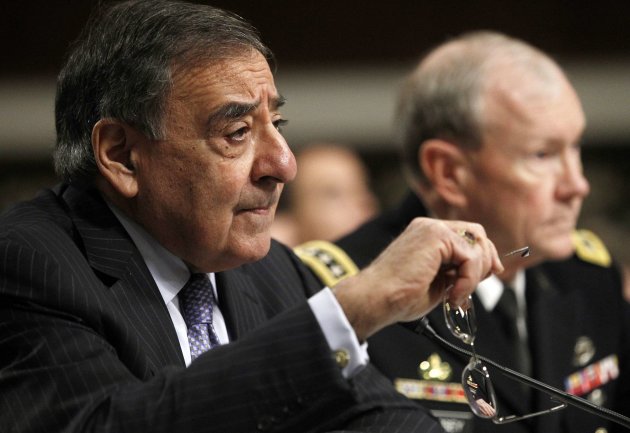
Testifying for likely the last time on Capitol Hill before stepping down, Panetta said the Obama administration was trying to assess the threat from protests in Tunisia, Egypt, the Libyan capital of Tripoli and other countries while trying to move quickly to respond to two separate assaults six hours apart in Benghazi. The positioning of military teams far from the U.S. installation made it difficult to respond swiftly, he said. The assault claimed the lives of Ambassador Chris Stevens and three other Americans.
"The United States military is not and should not be a global 911 service capable of arriving on the scene within minutes to every possible contingency around the world," Panetta told the Senate Armed Services Committee. Army Gen. Martin Dempsey echoed the argument that the military did what its location allowed, which angered Sen. John McCain, R-Ariz., who accused the Joint Chiefs of Staff chairman of peddling falsehoods. "For you to testify that our posture did not allow a rapid response, did not take into account threats to our consulate ... is simply false," McCain told Dempsey. McCain contended that the military's capability allowed armed forces to intervene in short order.
U.S. Secretary of Defense Leon Panetta (L) and U.S. Army General Martin Dempsey, the Chairman of the Joint Chiefs of Staff, testify on the Defense Department's response on the attack on U.S.
Dempsey said he stood by his testimony, "your dispute of it notwithstanding." The general said the military was concerned with multiple threats worldwide and, based on time and positioning of forces, "we wouldn't have gotten there in time." Between midnight and 2 a.m. on the night of the attack, Panetta issued orders, telling two Marine anti-terrorism teams based in Rota, Spain, to prepare to deploy to Libya, and he ordered a team of special operations forces in Central Europe and another team of special operations forces in the U.S. to prepare to deploy to a staging base in Europe.
The first of those U.S. military units did not actually arrive in the region until well after the attack was over and Americans had been flown out of the country. Just before 8 p.m., the special operations team landed at Sigonella Naval Air Station in Sicily. An hour later, the Marine team landed in Tripoli. Defense officials have repeatedly said that even if the military had been able to get units there a bit faster, there was no way they could have gotten there in time to make any difference in the deaths of the four Americans. "This was, pure and simple, a problem of distance and time," Panetta said.
More
Panetta defends military response in Libya attack - Yahoo! News